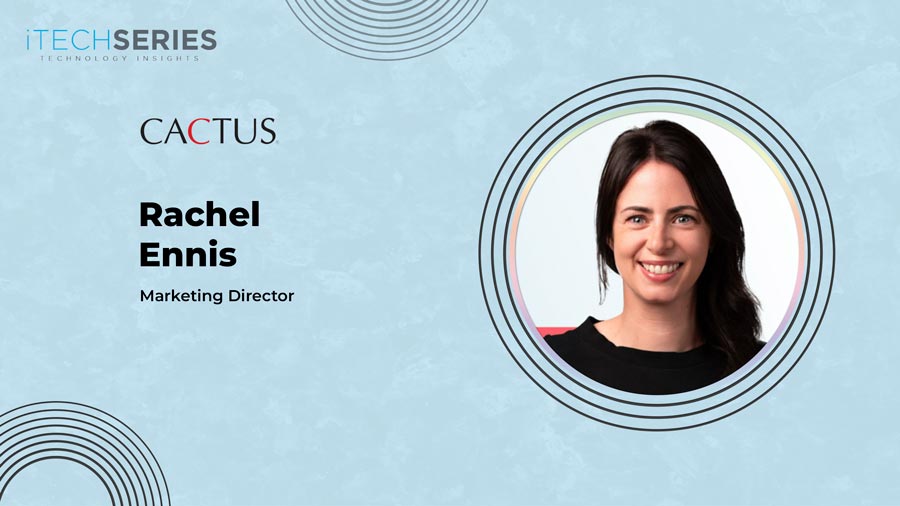
In this iTechSeries Unplugged interview, Rachel Ennis, Marketing Director at CACTUS, shares her perspective on strategic B2B marketing, building credibility, and keeping go-to-market simple and focused. She explores global-local marketing, meaningful customer signals, cross-functional alignment, and the shift from campaign execution to commercially focused leadership, offering practical insights for marketers navigating growth and change.
Welcome to the interview series, Rachel. Could you tell us about yourself and your marketing journey?
I started on the agency side at Omnicom Media Group, and this was the best possible training ground to mold an all-round marketer. Multiple times a day, you’re required to justify every thought, recommendation, and decision you make to clients who are focused on the results you deliver, not the process you follow to get there. So much of what I learned in my ad-land days has stayed with me; I even ensure my team is following a template I used to plan my traditional media plans for Boots back in 2012! I started as a PPC Executive and left as a Senior Media Planner, having experienced all areas that media has to offer.
Now I’m Marketing Director at CACTUS, where I lead strategy, brand, thought leadership, events, and content for our B2B business. What’s shaped me most recently is leading a team through a growth period in our business and pushing us out of a comfort zone to get more creative and embrace new business areas. I’m currently leading a rebrand of our B2B business where building shared understanding and alignment around the vision is essential.
How does your approach to customer needs, messaging, and campaigns differ across B2B and B2C audiences?
B2C sells a feeling in a moment; B2B sells confidence and credibility, and these have to be re-earned at every single touchpoint.
People love to say B2B just means longer cycles and more stakeholders, and yes, that’s true, but I think that skips over a key difference.
In B2C, you’re selling a feeling in a moment; you get someone’s attention for a few seconds, and you either connect with them or you don’t. In B2B, you’re selling confidence over months, sometimes across five or six people who all have veto power and (in some cases) none of whom asked to be sold to in the first place. The job is more about consistency and thought leadership, rather than random campaign bursts. It’s integral in B2B that your company/product/solution/service is showing up as credible and useful each time a potential buyer encounters you in the funnel. Whether that’s a whitepaper, an organic LinkedIn post, or a brief conversation at an event.
The first half of my career was in a B2C capacity, and I can safely say that the best B2B marketers borrow from B2C’s craft storytelling, brand feel, and how the creative makes you feel, and then strategically apply that to the much more patient (longer sales cycle) trust-building game of B2B marketing.
Across international markets, what has been most effective in balancing global consistency with local relevance?
Global consistency vs. local relevance, ensuring you maintain the desired feeling across global audiences.
Most of my time in ad land was in Dublin, where global brands, usually headquartered in the UK, would often try to ‘Irish-ise’ what they’d created for the UK market. Without fail, these ads always landed flat on their face with Irish audiences, as they were so obviously not created with an Irish audience in mind, so the relevancy score was always low.
Being on the client side of marketing now, I can see why it happens; usually it’s for ease and cost purposes. But treating global consistency as a locked-down style guide and local relevance as just translating the copy is a terrible and obvious mistake to make. Tapping into local colloquialisms and trusting your local colleagues and agencies is imperative to remaining consistent as well as successfully reaching your audience.
What must stay consistent is the core story of why you matter because that’s your brand equity, and diluting it market to market is how you end up with no identity anywhere or a bunch of terribly confused potential customers.
What should flex is the proof: the case studies demonstrating your top results and the specific pain points you can solve. Working across markets from the US, Europe, the Middle East, and Asia, I’ve found the fastest way to get this right is having someone in-market who can tell you which stat will land successfully and which one is a clear copy-and-paste from another market.
Which data points or customer signals do you find most valuable when planning and optimizing marketing campaigns?
Though I am, of course, interested in who engaged and do see value in them, I also want to know where an engaged buyer stalls. Clicks and open rates signal curiosity, but there’s little indication as to what stopped them from continuing the potential journey through the funnel.
The signals that I home in on are things like content consumption patterns, which pieces get shared internally, and which panel conversations or conference presentations can break through so well that it still gets brought up months later (this happened for us, so I’m always delighted to bring it up!). Because I run several events each year, I think about the conversations that turn into a next step, not just a polite handshake. In a business like ours, where credibility and relationships really matter, I care more about depth than volume—one senior stakeholder spending 15 minutes with a piece of content or having a 15-minute conversation with us at an event can tell me more than a thousand impressions.
“In B2B, your credibility is everything, and for me, keeping things simple and letting your offering, portfolio, demos, testimonials, and people do the talking speaks volumes.”
Could you walk us through your go-to-market approach, from identifying the opportunity to getting the product on the shelves?
I feel like this is a question of two parts: the funnel and simplicity.
I’m sure most marketers will think of the marketing funnel, but there’s something about the word “funnel” that gives me the ick, and I hate referring to it in strategies and campaigns. I understand its value, but it can kill creativity and spontaneity and lock marketers in a sad little box! I encourage using a “filter” rather than a “funnel,” identifying what won’t work given your parameters before you ever get to what will.
That filtering starts with being ruthless about which opportunity is worth chasing, because with a small team, saying yes to too many “good ideas” can do more damage to a team’s and therefore the business’s performance than saying no ever would. Everybody has an opinion on marketing, and plenty think it’s an “easy” job. Get that first step wrong, and it could spell disaster for your ROI and pipeline. Learning that “No” is an answer and a full sentence is a must. So, get filtering!
Once something has passed that filter, it’s easy to become overwhelmed by the need to be exceptionally creative to stand out. Competition is fierce, and AI is making it more intense. If I were still working in ad land, I’d be locked into this way of thinking. But in B2B, your credibility is everything, and for me, keeping things simple and letting your offering, portfolio, demos, testimonials, and people do the talking speaks volumes. We’re exposed to so much that we don’t need multiple times a day, so I want our marketing to be a breath of fresh air: informative and credible. That’s why my B2B plans always include CACTUS-run events, conference booths, content, thought leadership, lead gen campaigns, and ABM. If I see too many “gimmicky” things, I wonder, “What are you trying to hide?”
Once we’ve committed, we work with Sales, Design, and Product to get the messaging right and cure pain points, not just name them. We work backwards from the end decision-maker who’ll sign off: who has to say yes, what must each believe, and what’s the sequence of proof? Before creating assets, we build the story and message, map it across channels, and create sales support materials that help move a buyer from “ok, you have my interest” to “it’s now on the decision maker’s desk, ready to be signed.”
How do you drive effective cross-functional collaboration when bringing a product or campaign to market?
Cross-functional collaboration mostly fails because marketing asks for buy-in too late, after the plan is built or when executing a campaign because someone said so.
Most cross-functional friction I’ve seen is a timing problem. Marketing builds the plan, then goes around asking sales, product, and leadership to align on it, and alignment after the fact just means persuasion, which takes twice as long and often results in redoing the whole strategy and plan. Sales and other functions need to be involved while the narrative is still being shaped. Asking for alignment means receiving critiques and having holes poked in your plan, which leads to a whole lot of wasted time and rushing things in the final hurdles to meet go-live timelines, with mistakes being made.
Practically, that means things like building shared visibility for the team so everyone, not just marketing, can see what’s moving and what’s stuck, rather than status updates living in one of thirty Teams chats. It sounds small, but visibility is most of what “alignment” actually means in practice.
What advice would you give marketers looking to move from campaign execution to strategic, commercially focused leadership?
Any leader worth following is always learning! They’re willing to adapt as they grow.
In campaign execution, your success is measured by output and stats, and it’s a hard habit to shift. I still remind myself that senior leadership doesn’t care about the number of campaigns we executed but what story we told to deliver a healthy pipeline revenue number. As I set my sights on the top of the career ladder, I noticed in interviews that I was asked to give examples of how I influenced a decision. As you progress, much of what you do will be influencing stakeholders to buy into your thinking and gain their trust.
The shift I’d tell any marketer to make is to start tracking the decisions you’ve shaped, not the deliverables you’ve produced. That’s the thinking commercial leadership appreciates.
Practically: ask for a seat in rooms where budget and priority decisions get made, get familiar with the numbers important to the business, volunteer a point of view even when it’s not your lane, and, most importantly, get comfortable asking questions and making “why” your best friend.
Just because it’s always been done a certain way doesn’t mean you have to continue that way. Leadership requires change and putting your stamp on things, so embrace the creative side of your brain and get stamping!
My last piece of advice is for the girls and women reading this. Part of stepping into commercial leadership is deciding what kind of leader you become, and I strongly believe that includes lifting other women as you go. If you’re early in your career, find a female colleague you can learn from, someone who’ll remind you it’s okay to ask questions and advise you with care. If you can mentor a woman earlier in her journey, do it. Advocate for her, share what you know, and encourage her to step outside her comfort zone. Because that, as much as any P&L or campaign result, is what strategic leadership actually looks like: the decisions you shape in other people, not just the ones you make for the business.
About Rachel Ennis
Rachel Ennis is a strategic and hands-on marketing leader with 15 years of experience across B2B and B2C marketing. As Marketing Director at CACTUS, she leads strategy, brand, thought leadership, events, and content for its B2B business. Her expertise spans data-driven product marketing, international growth, cross-functional collaboration, and team leadership. Having begun her career at Omnicom Media Group, Rachel combines commercial thinking, creativity, and insight-led storytelling to drive meaningful marketing impact.