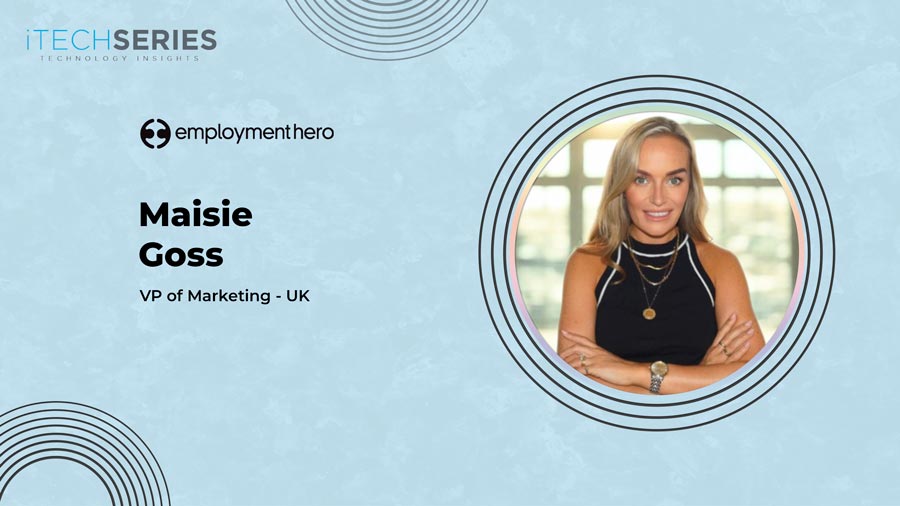
Maisie Goss, VP of Marketing-UK at Employment Hero, shares her perspective on modern B2B marketing, full-funnel accountability, and revenue-driven growth. Drawing from her experience leading UK marketing at Employment Hero, she discusses attribution challenges, simplifying ABM, aligning cross-functional teams, and balancing creativity with data to drive meaningful business outcomes.
Could you tell us about yourself and your journey as a marketer?
I lead marketing for Employment Hero’s UK business—which means full-funnel ownership across brand, demand gen, content, paid, and partnerships, with pipeline firmly in my remit.
My career has been pretty varied. I studied at Manchester and Leeds, and early on, I worked across a few different sectors before landing in B2B SaaS. That breadth has been useful—it pushed me to think commercially pretty early, rather than sitting comfortably in one channel.
What I find genuinely interesting about marketing right now is the tension between rigour and creativity. The instinct to measure everything can actually kill what makes a brand distinctive. Getting that balance right—especially as a UK function inside a global business—is where most of the interesting work happens.
How do you define “full-funnel marketing” when attribution and buyer journeys are more complex than ever?
Honestly, the term “full-funnel” has become a bit of a catch-all, so I try to be specific about what it actually means in practice.
For me, it means being accountable to outcomes at every stage, not just the stage that’s easiest to measure. Top-of-funnel brand work absolutely influences the pipeline. The problem is that most attribution models are built to reward the last click, so anything that happens earlier, a billboard, a podcast, or a thought leadership piece, just disappears from the story.
What I rely on more than any single attribution model is pattern recognition. Which channels are bringing in prospects who actually convert? Where does deal velocity improve? When we run a regional campaign or a compliance seminar, does the pipeline in that geography move? Those are the questions I find more useful than arguing about whether a touchpoint gets 20% or 40% attribution credit.
The buyer journey being non-linear isn’t new; it’s just more visible now. The job is to show up consistently across multiple surfaces so that when someone is ready, they already know who you are.
ABM is often over-engineered. How do you keep it simple enough to actually drive revenue instead of just activity?
The best ABM I’ve done has been intentionally lightweight. Pick a short list of accounts that genuinely matter, agree on the definition of an engaged account with sales, and do something that gets their attention. It doesn’t need a 12-step orchestration sequence. It needs a clear reason for them to care.
Where ABM goes wrong is when marketing builds a beautifully complex programme and then presents it to sales as a fait accompli. The pipeline doesn’t follow. The relationship doesn’t follow either.
The other thing I’d push back on is treating ABM as a separate motion from everything else. In a mid-market business like ours, your target accounts are also seeing your brand content, your compliance webinars, and your PR. ABM at its best accelerates and personalises what’s already working—it doesn’t try to replace it.
What are the foundational elements of successful global go-to-market strategy execution across multiple regions?
The tension in any global-local model is between consistency and relevance. Global wants coherence. Local markets need resonance. Both are right, and the job is to hold that tension without collapsing into one extreme.
The things that actually make it work, in my experience, are a genuinely strong understanding of the local buyer—not just the ICP on paper, but also what’s happening in their regulatory environment, their industry, and their specific pressures. In the UK right now, that means understanding how the Employment Rights Act is landing for SME employers. That’s not a global brief; it’s a local one.
The other foundational element is trust between the regional team and the global one. If you’re constantly waiting for approval on things that need to move quickly, you lose market opportunity. That trust is built by showing your work—being clear on why you’re diverging from the global playbook and what outcome you’re optimising for.
“The buyer journey being non-linear isn’t new; it’s just more visible now. The job is to show up consistently so that when someone is ready, they already know who you are.”
What’s been the biggest impact you’ve seen from stronger alignment across marketing, sales, product, RevOps, and customer success teams?
Speed to pipeline. When those functions are genuinely aligned—not just in the same Slack channel, but working to the same definitions and the same goals—the whole machine runs faster.
The thing I’ve noticed most is what happens at the handoff points. The MQL-to-SAO conversion rate is as much a relationship metric as it is a data metric. When sales trusts that marketing is sending them the right people, they follow up faster and with better context. When marketing understands what’s actually happening in deal conversations, it informs content and campaign decisions in a way that no amount of internal briefing documents can replicate.
The hardest part isn’t getting everyone in a room. It’s agreeing on definitions—what counts as a qualified lead and what a “good” pipeline looks like—and then holding to those consistently rather than relitigating them every quarter.
Beyond the usual KPIs, which performance indicators do you rely on to uncover deeper insights into marketing impact?
MQL volume is a vanity metric if it’s not connected to what happens next. So I spend more time on MQL-to-SAO conversion, deal velocity by source, and the ratio of organic and direct traffic to paid—the latter being a reasonable proxy for brand health that doesn’t require a brand tracker budget.
One I find underused is channel-level cohort analysis—not just which channels drive the most leads but which drive leads that actually close and at what contract value. That changes the investment conversation significantly.
I also pay attention to what’s not in the data. If a segment is consistently underperforming relative to expectations, that’s usually a signal of the message, product fit, or sales motion—not just a campaign problem. Those conversations tend to be more useful than optimising click-through rates.
What advice would you give to emerging marketers on developing a strong balance of technical, creative, and strategic skills?
Get comfortable with discomfort on the side you’re weakest in. If you’re naturally creative, spend time in the data. If you’re analytically strong, go and make something—write a brief, run a campaign end-to-end, or do something where the creative output is yours.
The strategic layer builds from both. You can’t develop a genuinely good point of view on where to invest without understanding what the data is telling you and having the creative judgment to know what good looks like in the market.
The other thing I’d say is find a place where you’re allowed to own the outcome, not just execute a task. The learning compounds much faster when you’re accountable for the result. Junior roles in big marketing teams can be frustrating for exactly this reason—you end up specialized too early. If you can find a smaller business, a start-up, or a function where you have to cover a lot of ground, take it.
About Maisie Goss
Maisie Goss is a marketing leader and GTM strategist with extensive experience driving demand generation, pipeline growth, and revenue performance for high-growth technology companies. She also advises PE and VC-backed businesses through Maverick & Co., helping teams scale marketing and go-to-market efforts. Previously, she led global demand generation at Payhawk, delivering significant growth in pipeline, leads, and closed deals. Maisie specializes in full-funnel marketing, ABM, and revenue-focused strategy.