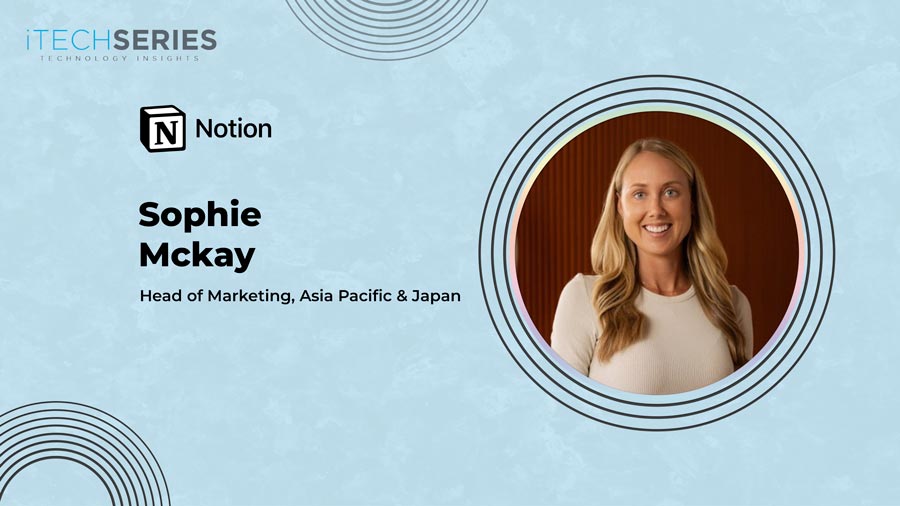
In our latest interview, Sophie Mckay, Head of Marketing, Asia Pacific & Japan at Notion, shares her insights on building globally consistent brands with local market relevance, scaling demand generation across diverse regions, aligning revenue teams for stronger business outcomes, leveraging AI to accelerate marketing, and harnessing community-driven strategies to drive sustainable growth and lasting customer impact.
Welcome to the interview series, Sophie. Could you tell us about yourself and your journey as a marketer?
I lead marketing for Notion across APAC, covering both B2C and B2B marketing across brand, community, startups, and demand generation. My team is distributed across Japan, South Korea, Australia, New Zealand, and Singapore. I’ve spent more than 18 years in tech marketing, largely in B2B, and I’m especially passionate about bringing new technology brands into the region and building both the brand presence and the team from the ground up. Before joining Notion, I was at Qualtrics for nine years, where I helped launch the brand across six APAC regions and built the APAC marketing team from zero to seventeen.
My marketing journey was very non-traditional. After high school, I didn’t go straight to university. I knew I wanted to be in the corporate world, but I wasn’t sure what function. I started as a receptionist at a small local business, and over three years I moved through a range of roles, including marketing, sales, customer support, factory operations, and executive assistance. That experience gave me a strong foundation in how a business runs end-to-end. I then joined a tech company (UXC Connect at the time, now DXC Technologies) initially as an executive assistant and, over time, found my way into the marketing team. That’s when I realised marketing was the path I wanted to pursue, so I completed my marketing degree online while working full-time, finishing it in about a year and a half. Early in my marketing career, I was part of a very small marketing team that quickly became even leaner after redundancies, which meant I had to cover everything across B2B marketing: social, events, PR, web, digital, and marketing automation. That broad, hands-on start shaped the way I work today; I never really specialised in just one area, and every role since has built on that end-to-end marketing foundation.
You’ve launched brands across multiple regions. How do you balance global brand consistency with local market expectations?
When I’m launching across multiple regions, I start by anchoring everything to the global brand foundations. Clear hierarchy, positioning, and the official asset system, so the brand is unmistakably consistent everywhere. From there, I work closely with the global team to translate those foundations into practical, channel-specific toolkits (for example, digital, events, and community) so local teams and agencies can self-serve and execute quickly without reinventing the wheel. Within those guardrails, I intentionally leave room for local adaptation so markets like Korea and Australia feel culturally authentic and relevant, while still looking and sounding like Notion. And when we run global brand campaigns, I take an educational approach, bringing the global team along on local context, norms, and customer expectations so we can make the right creative and messaging adjustments (often significant in places like Japan) without compromising the core brand.
What principles have helped you build demand generation programs that consistently scale across different markets?
In APAC, I take a slightly different view on “scaling” demand generation. The principle that’s helped me most is accepting that one size rarely fits all. The APAC region is incredibly diverse, with different languages, buying behaviours, channels, and even sales follow-up motions. So instead of forcing a single demand generation program to roll out unchanged, I focus on creating clear goals, guardrails, and optional playbooks, which I then give country teams the flexibility to build programs that match their market maturity, customer needs, priority industries, and sales team dynamics. In practice, that local autonomy leads to stronger execution and materially better outcomes, while still benefiting from shared learnings and reusable elements where they make sense.
How do you ensure different revenue functions work together to drive growth and business outcomes?
It starts with shared goals and a shared source of truth. Marketing, sales, SDRs, customer success, and solutions engineering all need to work from the same numbers. The same target account lists, the same pipeline goals, and the same definition of what a qualified account looks like. When everyone can see the same performance data and agrees on what success means, most alignment problems disappear before they start. We then back that up with clear operating agreements, including follow-up SLAs on marketing-generated accounts so nothing falls through the cracks, plus briefing kits for sales on every campaign so reps know exactly what customers experienced and how to follow up.
The second part is structural. I organise around the customer, not the function. In APAC, each country operates as one revenue team, with marketing, sales, SDRs, customer success, and solution engineers planning together from strategy through lead follow-up. That shows up in the details: SDRs staffing event booths, outbound days planned ahead of third-party events, and customer success taking marketing-built workshop playbooks directly into accounts. Regular rhythms (weekly updates, shared pipeline reviews, joint planning) keep everyone honest and connected. In my experience, when revenue functions plan together from day one rather than handing work over a fence, execution is faster, follow-up is stronger, and results compound.
“Bring the global team along on local context, norms, and customer expectations so you can make the right creative and messaging adjustments without compromising the core brand.”
As AI becomes a bigger part of marketing, how do you see it changing the way teams engage customers and drive growth?
AI is changing marketing from a function that uses AI for individual productivity into one that can operate with AI as part of the team and as part of the system. I think about it through Notion’s AI Transformation Model: Level 1 is AI as a thought partner, where teams use it to brainstorm, draft, research, and improve decisions; Level 2 is AI as an assistant, where context-aware tools help people move faster with meeting notes, enterprise search, writing, and one-off task support; Level 3 is AI as teammates, where agents start running recurring workflows end-to-end; and Level 4 is AI as the system, where agents coordinate critical work across teams, tools, and processes.
For marketing, that shift is significant. Most teams are still somewhere between Level 1 and Level 2. They are using AI to draft content, summarise meetings, search for information, or speed up individual tasks. The real unlock is moving into Level 3, where agents can take on repeatable workflows like campaign operations, sales briefing, launch coordination, competitive monitoring, customer insight synthesis, and performance reporting. That doesn’t replace marketers; it gives them more leverage. It frees the team to spend more time on strategy, creative judgment, customer understanding, and the kind of cross-functional work that AI can support but not fully own.
The critical ingredient is context. The model is clear that companies cannot really move beyond Level 1 if AI is disconnected from the knowledge, decisions, workflows, and permissions that shape how work actually gets done. Teams that keep their strategy, messaging, campaign plans, customer insights, and performance data connected will get more value from AI than teams using standalone tools in isolation.
On the customer side, AI is also changing expectations. Buyers don’t just want to hear claims about AI anymore; they want to experience what it can do. Some of our highest-performing programs in APAC are hands-on workshops where customers, prospects, and community members build AI workflows together in the room. That kind of education-led marketing creates value before a sales conversation happens, and it helps customers see their own path from Level 1 experimentation to Level 4 operational transformation.
Counterintuitively, AI has made in-person engagement more important, not less. When technology is moving this fast, people want real demos, peer proof, and the chance to ask questions live. And as AI workflows create measurable outcomes (e.g., hours saved, cycle times reduced, work automated, capacity reclaimed), marketing can anchor growth conversations in concrete business impact rather than abstract promises.
What has been the most memorable experience of your marketing career so far?
The most memorable experience of my marketing career so far was our Notion Australia launch moment. It proved what’s possible when you orchestrate a true, end-to-end “market splash” and let community energy lead.
What made it memorable wasn’t a single event; it was the coordination across every major lever. PR and storytelling, out-of-home to create real-world presence, creator and influencer partnerships to make the brand feel culturally current, community programming to bring existing champions into the spotlight, and executive engagement to signal long-term commitment.
The part that genuinely surprised me was just how strong the Notion community already was in Australia. Seeing customers and community members take ownership of the story, sharing their setups, inviting peers, and celebrating the office news as if it were their own win was a reminder that a brand isn’t built by campaigns alone. It’s built when people feel like they belong to something and want to carry it forward.
That launch reinforced a belief I’ve developed over the years: your community and customers will tell your story better than any ad you run. If you earn trust and give people a platform, the impact is stronger, travels further, and lasts longer than any single media moment.
About Sophie McKay
Sophie is a B2B marketing leader with more than 18 years of experience building brands and high-performing marketing teams across Asia Pacific and Japan. She specializes in launching and scaling technology companies, driving demand generation, brand strategy, and community-led growth. Throughout her career, she has successfully expanded global brands into new markets while leading integrated marketing initiatives that deliver sustainable business growth.