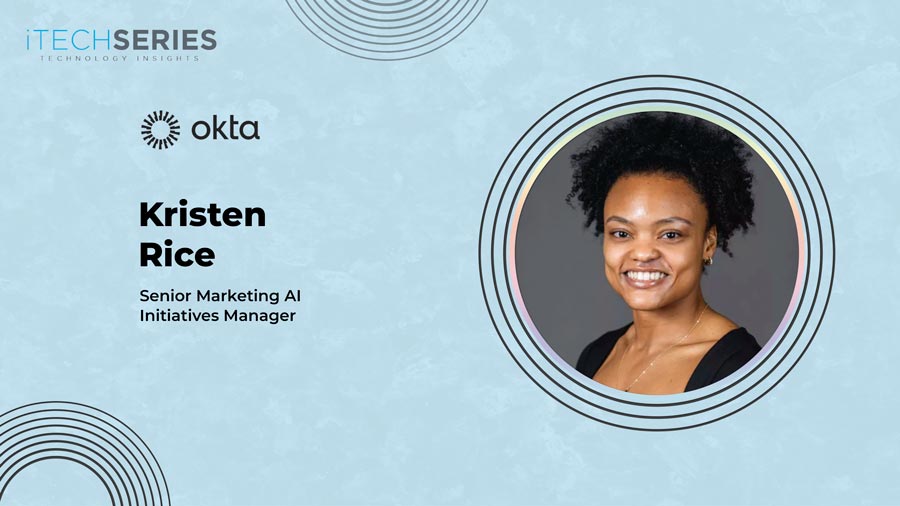
Kristen Rice, Senior Marketing AI Initiatives Manager at Okta, explores how data, AI, experimentation, and cross-functional alignment can transform modern growth marketing. From building connected GTM strategies and demand generation engines to turning complex data into actionable insights, Kristen shares practical perspectives on creating scalable systems, accelerating learning, and balancing short-term performance with sustainable, long-term growth.
Welcome to the interview series, Kristen. Could you tell us about yourself and your marketing journey?
Thanks for having me! I’m really excited to be here.
My path has been anything but a straight line, and I’ve come to see that as one of my biggest strengths. I’ve spent the last 13+ years across finance, analytics, and digital marketing. Today, I sit at the intersection of AI, marketing operations, creativity, and growth.
I actually started my career in insurance. It wasn’t until about five years in that I made the jump into tech, at a Chicago startup called Sprout Social. That’s really where I found my footing and grew into a growth marketer. Over the last 8+ years, I’ve worked across a lot of disciplines within marketing, including growth, data analytics, demand generation, and experimentation. Most recently, I’ve been focused on what happens when you put AI into the growth engine itself.
When I look back, the common thread is curiosity. I started very close to the data. I was always the person who wanted to know why a number moved, not just that it did. That question kept pulling me into new places. It took me into experimentation, then creativity, then working side by side with engineering, and eventually into building with AI.
I’ve pivoted a few times, but I’ve tried to be intentional about it. Each move built on the skills I already had instead of starting over. Because of that, I can usually see a problem from a few different angles at once: the analyst, the marketer, the operator, and the builder. That mix shapes how I think about growth today. I don’t really see marketing as a set of separate channels. I see it as a system where data, creativity, technology, and people all have to work together.
How do you approach building a GTM strategy that connects marketing, sales, and customer success around shared growth goals?
I start by getting everyone aligned on where we want to create the most impact. That comes from my experimentation mindset. I want us all pointed at a clear measure of success so we know whether we’re actually moving the needle.
Marketing, sales, and customer success often optimize for different numbers and different parts of the funnel. Each of those makes sense on its own, but together they can pull in different directions. A prospect or customer doesn’t experience you that way. To them, it’s one journey. So one of the first things I like to build is a shared metric tree. It ties each team’s work to the outcomes the business cares about, whether that’s leads, pipeline, retention, or something else.
From there, it comes down to a few shared foundations. The first is shared definitions: what counts as a qualified lead, an activated customer, or an at-risk account. If teams can’t agree on those, they end up arguing about the data instead of acting on it. The second is shared signals, so product usage, intent, and engagement data flow to everyone. A churn-risk signal is just as useful to marketing for a win-back program as it is to CS. The third is shared rituals, like a regular cadence where the teams look at the funnel together and decide what to do next.
I also try to be realistic. You rarely get full alignment on day one, and I’m upfront about that. We work with what we have. I like to group the work into buckets, drive impact in increments, and build feedback loops so each win sets up the next one. Over time, those small wins connect the dots across teams. Real alignment is something you make progress on, not something you announce once.
My leadership style reflects that. It’s less “here’s the plan” and more “how does this align with what you’re already doing, and what’s the next conversation we can have to move one of these shared goals forward?” I’ve mostly led cross-functional, dotted-line teams, and alignment lasts much longer when people can see their own goals in the shared strategy.
What are the key elements of an effective growth marketing strategy, and how do you balance short-term performance with sustainable, long-term growth?
This is one of my favorite questions, because it speaks to both the analyst and the creative in me. Not everything can go up at once. The goal is a growth strategy that keeps compounding learning over time. That doesn’t mean you never go after short-term gains. It means you’re intentional about them.
For me, it starts with a clear model of the full funnel, from acquisition through activation, conversion, retention, and expansion. That’s how you find the real leverage. A lot of teams don’t look across the whole funnel, sometimes because of data or attribution challenges. But the more clearly a team can map its funnel and separate where it has a direct impact from where its impact is indirect, the better its decisions will be. Maybe that’s just the analyst in me making a plug for investing in a strong data foundation. It pays off every time.
Next is a disciplined experimentation program. Test where you can and where you can’t launch and learn quickly. I like simple prioritization frameworks like ICE (impact, confidence, ease) so the team works on the highest-value bets, not the loudest requests. I’ve also started building in “kill switches.” These are clear signals that tell you when a tactic has run its course and is starting to add friction instead of value.
Underneath all of that, you need reliable data and fast feedback loops, because you can only learn as fast as you can trust your results. You also need to invest in assets that compound, like your website, content, lifecycle programs, and owned audiences. Those keep paying off long after a campaign ends.
When it comes to balancing short- and long-term growth, I think of it as a portfolio. Part of the roadmap goes to quick wins that build momentum and trust, like conversion fixes, offer tests, and channel tuning. Another part goes to longer-term work, like retention, lifecycle, and the infrastructure that makes the whole engine faster.
The trap is optimizing only for this quarter’s number. You can push acquisition hard and still lose ground if those customers churn. That’s why I look at metrics across the whole funnel, not just the top of it. Some of the best growth comes from the customers you already have.
“I don’t really see marketing as a set of separate channels. I see it as a system where data, creativity, technology, and people all have to work together.”
How do you build a demand generation engine that drives meaningful engagement and generates a qualified pipeline?
I build demand generation backwards from the pipeline. Before choosing channels or campaigns, I want to understand who the best-fit accounts are, what signals show they’re in market, and what actually moves them from interest to a real sales conversation.
The first principle is to target with intent, not just volume. Account-based approaches and intent data, from tools like 6sense, let you focus your spend and your sales team’s attention on accounts that are actually showing buying signals. That’s a very different motion from casting the widest possible net.
The second is making every touchpoint earn its place. Paid, content, web, and email should feel like one connected journey, not a set of separate campaigns. The website matters a lot here, because it’s often where intent turns into action. That’s why I see CRO as a demand gen lever, too. Every touchpoint is connected, so each one should make sense and add value. That’s where experimentation comes in. It’s how you find out what’s actually working, instead of assuming.
Third, measure quality, not just quantity. I’d much rather have fewer leads that convert to pipeline than a big volume that sales ignores. Tracking how leads move through each stage and what they contribute to the pipeline keeps everyone honest and keeps marketing and sales on the same side of the table.
And finally, operationalize the engine. Repeatable campaign systems, clean handoffs, and automation free the team to spend its time on strategy and creativity instead of manual execution. This is where AI has made a real difference for me. Building programs in Marketo or setting up campaigns in Salesforce used to be a lot of manual work, and much of it can now be automated. The point isn’t just to move faster. It’s to give the team more time to be intentional about building the right campaigns.
How do you turn complex marketing data into clear, actionable insights that inform better decisions?
I’m an analyst at heart, so I can easily spend an entire day digging into data. Part of my discipline, however, is knowing when to step back from the details. My biggest advice is to start with the decision, not the data. Before building any analysis, I ask, “What decision is this meant to inform, and what would we do differently depending on the answer?” That question helps eliminate dashboards and reports that may look useful but don’t drive action.
From there, a few habits make a big difference. I always lead with the “so what.” The headline should communicate the insight and recommendation, with the supporting data coming afterwards. Busy stakeholders should be able to understand what matters and what action to take from the first sentence. I also connect metrics to the outcomes people care about. A lift in conversion rate becomes much more meaningful when you can demonstrate its impact on the pipeline or revenue.
I believe in being transparent about confidence. I try to distinguish between what the data clearly supports, what is directional, and what still needs to be tested. That transparency builds trust in the numbers, and trust is what gets insights acted on.
Another priority is shortening the time to insight. An insight delivered three weeks too late can lose much of its value. Automating how insights reach teams can make a major difference. A former teammate built a Slack bot that surfaced performance data and generated insights automatically. I loved the concept because it centralized the story and helped everyone work from the same picture before decisions were made.
My background in analytics and experimentation has shaped this approach. The goal has never been to create more data; it has always been to enable faster, better decisions.
That’s also where AI comes in. I see three big opportunities in marketing. First, AI can remove operational drag by automating repetitive work such as campaign setup, asset formatting, QA, and reporting. Second, it can accelerate experimentation by helping teams generate ideas, prioritize tests, analyze results, and identify what matters. More experiments create more learning, and that learning compounds. Third, AI can make insights more accessible by turning complex data into plain-language answers.
The key is designing Human + AI workflows rather than trying to replace people. AI brings speed and scale, while humans provide judgment, context, and creativity. Start with one workflow, measure the outcome, build trust, and scale from there. You don’t need to boil the ocean to make AI meaningfully improve marketing performance.
What advice would you give marketing leaders looking to build a scalable, data-driven growth engine?
I love this question, because I think a lot of leaders feel pressure to have everything figured out at once, especially right now with AI moving so fast. The truth is, the strongest growth engines I’ve seen weren’t built in one big launch. They were built layer by layer, with a lot of learning along the way. With that in mind, here’s what I’d share.
First, get your foundations right. Shared definitions, clean data, and a clear funnel model aren’t glamorous, but everything else depends on them. If the foundation is shaky, every decision on top of it is shaky too. Second, build a culture of experimentation, not just a testing calendar. Celebrate learning, including the losses. A test that disproves a strong assumption is often more valuable than a small win, because it changes how you think. Third, prioritize ruthlessly. Use a simple framework so the team stays focused on the highest-leverage work, not whatever request is loudest that week. Fourth, treat speed as a strategy. The teams that win usually aren’t the ones with the most ideas. They’re the ones that learn the fastest. Invest in whatever shortens the cycle from idea to insight to action.
Fifth, start with AI now, but start with a real problem. Pick one painful, repetitive workflow, understand your baseline, improve it, and show the impact. Small, proven wins build momentum much faster than big, vague AI initiatives. And finally, lead through alignment. Growth is a team sport across marketing, sales, product, engineering, and beyond. The more people see their own goals in the strategy, the faster the whole engine moves. In my experience, that’s what really makes it scale.
About Kristen Rice
Kristen Rice is a growth and AI marketing leader focused on helping teams build systems that multiply output through strategy, experimentation, and intentional AI workflows. With 13+ years spanning financial analysis, data, growth product management, CRO, and marketing operations, she brings a cross-functional perspective to modern growth. At Okta, Kristen is building the AI function from the ground up, designing agentic systems, workflows, and internal tooling that enhance marketing performance.