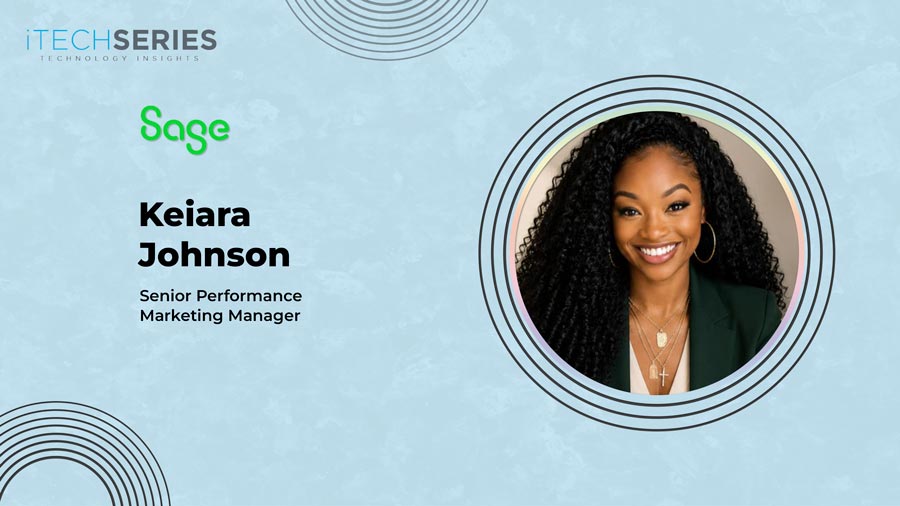
Keiara Johnson, Senior Performance Marketing Manager at Sage, growth marketing and AI consultant, and founder of Growth Guru Marketing, explores how customer insight, data, and AI can transform marketing into measurable growth. She shares perspectives on revenue-focused strategies, customer engagement, performance measurement, and using AI to help marketers make smarter decisions and build sustainable business impact.
Welcome to the interview series, Keiara. Could you tell us about yourself and your marketing journey?
Thank you for having me! I’m Keiara Johnson, Senior Performance Marketing Manager at Sage. My career has spanned B2C, B2B demand generation, and customer marketing, giving me a broad perspective on how businesses earn attention, build relationships, and create lasting growth.
In my current role, I focus on customer marketing, using customer insight and performance data to guide engagement and support adoption, retention, and expansion. I’m particularly interested in how AI can strengthen marketing decisions and improve how teams work.
What has stayed consistent throughout my journey is my curiosity about people: what they’re trying to achieve, what’s getting in their way, and how marketing can help them move forward. That understanding is the foundation of how I approach growth.
With experience across B2C, B2B demand generation, and customer marketing, what shaped your transition into revenue-focused marketing?
Each stage of my career added another layer to how I understood growth. B2C taught me the importance of emotion, relevance, and earning attention. B2B demand generation taught me to connect that attention to buying intent and opportunity creation. Customer marketing expanded my perspective to what happens after the sale: whether customers adopt the solution, realize value, stay, and grow.
That progression made me more interested in the entire customer relationship. A campaign can perform well on paper while the business still struggles to convert demand or retain customers. I wanted to understand that disconnect and help solve it.
Revenue-focused marketing starts with asking better questions: Which customers have a meaningful need? What action would help them? How will we know that action created value? Those questions have shaped how I approach strategy, investment, and collaboration with sales.
As performance marketing evolves beyond campaign execution, what capabilities help teams drive strategic growth?
The strongest teams combine commercial understanding, customer insight, and the ability to turn data into decisions.
Commercial understanding means knowing how the business earns revenue, where growth opportunities exist, and what prevents customers from moving forward. Customer insight means understanding the people behind the segments—their priorities, pressures, and reasons for making a decision. Analytical capability means explaining what the results suggest we should do next.
Teams also need strong stakeholder management. Growth depends on marketing, sales, customer success, product, and operations working toward shared outcomes. That requires clear ownership and agreement on what happens after a customer responds.
Finally, teams need disciplined experimentation. They should be able to form a clear hypothesis, test it, and decide whether to scale, adjust, or stop. Strategic growth comes from improving those decisions consistently.
Can you share a challenging campaign you led and the key decisions that contributed to its success?
One example involved engaging existing B2B customers around a solution that required a considered buying decision. The challenge was that interest in the topic did not automatically translate into readiness for a sales conversation. Customers had multiple stakeholders, competing priorities, and a need to understand the business value.
A key decision was to build the message around customer challenges and desired outcomes. We coordinated educational content and outreach to give customers several opportunities to understand the relevance of the solution.
The campaign reinforced the importance of looking beyond the initial response. Engagement is an encouraging signal, but the next step must help customers evaluate the opportunity and move forward at a pace appropriate to their needs.
My biggest takeaway was that campaign success depends on continuity between the message, the experience, and the follow-up. Each interaction should help the customer make a more informed decision.
“Every interaction should build on what we know about the customer and help them move toward an outcome they care about.”
What approaches have you found most effective for engaging different customer segments and driving retention, adoption, and growth?
I start with what the customer needs to accomplish and where they are in their relationship with the business. Company size and industry provide useful context, but they don’t tell the whole story. Product adoption, engagement, business priorities, and readiness for change matter too.
For adoption, customers need practical education and a clear path to using the capabilities they already have. For retention, they need continued evidence of value and timely support when something is getting in the way. For expansion, they need a credible connection between an additional solution and a business problem worth solving.
The experience should also match the complexity of the decision. Some customers benefit from scalable digital education; others need a more personalized conversation involving sales or subject-matter experts.
My approach is to make the next step feel useful and achievable. Relevance earns engagement, and consistently delivering value builds the relationship that supports growth.
Which metrics and frameworks help connect marketing investment to measurable business impact?
I look at measurement as a connected journey: engagement, qualified demand, opportunity creation, revenue, and customer value over time.
Engagement metrics help diagnose whether the message and experience are working. Opportunity and revenue metrics help establish commercial contribution. Adoption, renewal, retention, and expansion show whether growth is sustainable.
The connections between those stages matter. I want to understand conversion rates, follow-up speed, opportunity quality, win rates, and where momentum is lost. A high lead volume is less valuable if the leads never progress.
A useful framework is to define the business objective first, identify the customer behavior that would support it, and then select the measures that show progress. That keeps reporting focused on decisions and outcomes.
I also distinguish between marketing-sourced and marketing-influenced revenue. Clear definitions and agreed measurement windows help teams assess contribution honestly and make better investment decisions.
As AI reshapes marketing, what capabilities will matter most for marketers going forward?
Judgment will become even more valuable. As AI makes producing content and completing tasks easier, marketers need to be clear about which problems deserve attention, what a good outcome looks like, and how to evaluate the work.
That requires strong problem framing, data literacy, customer understanding, and the ability to design workflows. Marketers should understand where AI can support a process, where human review belongs, and who is accountable for the result.
In helping marketers build their first AI agents, I’ve seen how valuable it is to start with a specific business need. The quality of the instructions matters, but so do the information the agent receives, the boundaries it operates within, and the way its outputs are tested.
The marketers who stand out will connect technology with sound business decisions. AI can increase our capacity, but we still need the expertise to decide what deserves to be built and whether it actually helps the customer.
About Keiara Johnson
Keiara Johnson is a growth marketing and AI leader focused on building growth systems that connect customer intelligence, commercial strategy, technology, and people. She leads customer growth strategy across Sage Intacct’s $300M revenue portfolio, with expertise spanning lifecycle strategy, retention, expansion, measurement, sales alignment, and AI-enabled commercial intelligence. Keiara also speaks and teaches on AI, growth marketing, customer behavior, career development, and human judgment in intelligent systems.