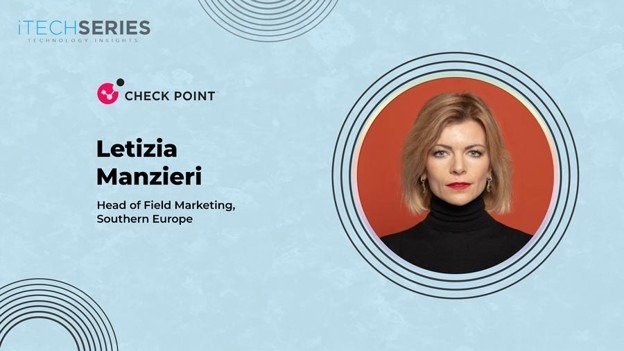
Letizia Manzieri, Head of Field Marketing, Southern Europe, at Check Point Software, shares her journey from channel marketing to leading field marketing across Southern Europe. She explores building flexible regional strategies, fostering cross-functional collaboration, measuring commercial impact beyond leads, and embracing AI to elevate marketing effectiveness. She also reflects on curiosity, continuous learning, and sustainable growth as essential drivers of marketing success.
Welcome to the interview series, Letizia. Could you tell us about yourself and your marketing journey?
My journey has been one of continuous, sustainable growth. It started in channel marketing, where I learned firsthand how central partners are to the go-to-market motion of any IT company; they are not a distribution layer but a true extension of the business. From there, I moved into leading field marketing for Italy and more recently into leading the Southern Europe region as a whole. Each step has been a natural widening of scope and responsibility, built on the same foundation: consistency. Rather than reinventing myself with every move, I’ve tried to carry forward what worked, adapt it to a bigger stage, and keep building on it.
Consistency has been my compass throughout.
How do you build a regional field marketing strategy that balances Southern Europe’s diverse market needs with broader business objectives?
The keyword is flexibility. Southern Europe is truly a mosaic of distinct markets, requiring a customized approach rather than a universal playbook. What works in Italy doesn’t necessarily work in Iberia or Israel. So I’ve learned to think “global but stay local.”
I lean heavily on strong local teams who truly understand their markets and know how to translate our regional strategy into something that actually resonates there. My job is to give them direction and set the guardrails, the non-negotiables we can’t compromise on—but without squeezing out the flexibility they need to make it work on the ground.
In driving regional initiatives, which approaches help marketing, sales, communications, and partner teams work toward shared goals?
I call it my “open garden” approach. The idea is simple: instead of building walls between functions, you create an environment where ideas can circulate freely while still keeping a clear structure underneath.
In practice, this means strong collaboration, continuous alignment with stakeholders, and genuine cross-pollination of ideas across marketing, sales, communications, and partner teams. Each of these functions sees the business through a different lens: sales are closest to the customer’s urgency, partners bring market reach and local credibility, communications shapes how the story lands externally, and marketing connects all of it into a coherent narrative and pipeline engine.
The best initiatives are never born in a silo; they emerge precisely at the intersection of these perspectives, when people are willing to challenge and enrich each other’s thinking rather than simply execute in parallel.
What keeps an “open garden” from turning into chaos is discipline around the destination. The shared goals have to stay fixed and non-negotiable; everyone needs to be rowing toward the same outcome, whether that’s pipeline generation, a specific launch, or a regional campaign. At the same time, respect for each team’s roles and responsibilities (R&R) is essential and never becomes lost along the way: openness to contribution doesn’t mean blurring accountability. Everyone must know their responsibilities and metrics while being open to input from other functions. It’s that balance—fixed goals and clear ownership, paired with fluid collaboration and cross-functional contamination of ideas—that allows regional initiatives to move fast without losing coherence and to feel truly “owned” by every team involved rather than imposed top-down.
“I lean heavily on strong local teams who truly understand their markets and know how to translate our regional strategy into something that actually resonates there.”
Could you tell us about your most challenging yet memorable experience as a marketer?
There have been several, but what stands out most is the pressure and expectations that come with the role, which ultimately also reflect trust. It’s trust I never want to let down. What has always carried me through is collaboration: a real team spirit, the sense that we’re all playing the same match, no matter our role in the hierarchy. When a team truly moves as one, even the toughest moments become not just manageable but genuinely memorable in the best way. Those experiences have taught me that resilience grows when people support each other, stay focused on a shared purpose, and keep moving forward together.
Beyond lead generation, which metrics do you use to evaluate the commercial impact of field marketing programs?
The metrics that matter most to me go well beyond top-of-funnel leads: marketing-sourced pipeline, C-level engagement, win rate, and marketing’s overall contribution to total pipeline. Together, these give a much clearer picture of commercial impact; they show not just that marketing is generating activity, but that it’s engaging the right audience and genuinely moving revenue forward. I also look at sales alignment and progression after key engagements to understand whether field programs are creating meaningful opportunities and supporting sustainable revenue growth.
How do you see AI reshaping field marketing, campaign execution, and customer engagement in the coming years?
There’s no doubt AI is already making a difference; it’s helping us move faster on the recurring, time-consuming tasks that used to eat up our days. For me, it’s really about time management. But the real challenge, the one I keep thinking about, is what we do with that extra time. I believe the teams that will truly win are the ones that reinvest it into high-value work, especially building new skills instead of just using it to do the same old things faster. That means becoming more strategic, creative, and customer-focused, using AI not simply as a productivity tool, but as a catalyst for better ideas, experiences, and decisions.
What advice would you share with field marketers looking to make a greater impact on pipeline and revenue?
Stay curious, always. Make it a habit to immerse yourself in innovation hubs, keep your mind open to new ideas, and never stop learning. For me, impact has always come from contamination, letting yourself be challenged by different perspectives and trends, and being willing to let them reshape how you work.
In conclusion, if there’s one word that ties everything together, it’s “growth.” It’s there in the sustainable path my own career has taken, in the flexibility I bring to every Southern Europe market, in the collaboration and cross-pollination of ideas that make our teams stronger together, in the toughest experiences that shaped who I am as a marketer, in the pipeline and C-level engagement I use to measure real impact, in the new skills I get to build when AI frees up my time, and in staying curious enough to keep learning from everyone around me. If I had to leave you with one thought, it would be this: widen the scope, but never lose the core. That’s the balance I try to live by every single day.
About Letizia Manzieri:
With over 15 years of marketing experience across national and multinational organizations, Letizia Manzieri specializes in brand awareness, event management, social media communications, and pipeline generation. At Check Point Software Technologies, she leads the Southern Europe regional marketing team, developing country-specific strategies aligned with business goals. Her expertise spans cross-functional collaboration, customer acquisition, and maximizing local impact through global programs, with a strong focus on measurable outcomes and sustainable marketing growth.