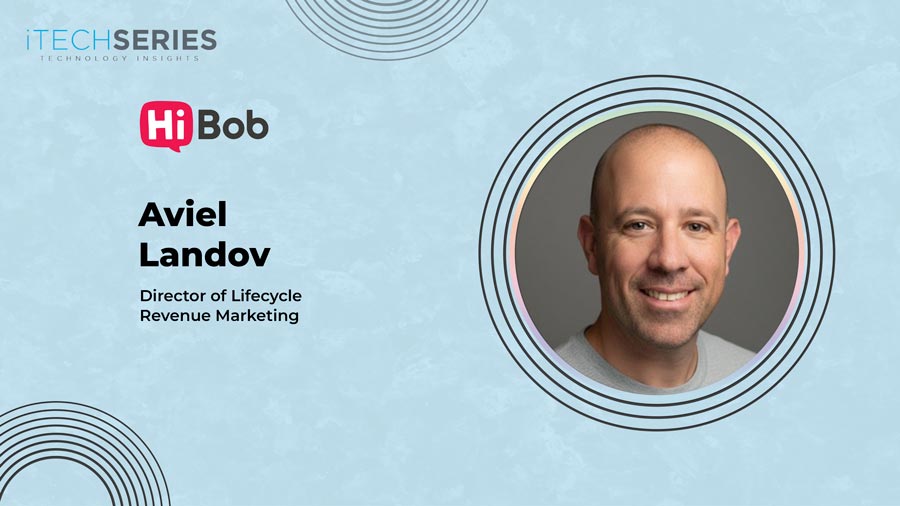
Aviel Landov, Director of Lifecycle Revenue Marketing at HiBob, shares how lifecycle marketing drives measurable revenue through data, AI, and customer-centric strategies. From identifying the right customer signals to aligning cross-functional teams, he discusses building smarter marketing systems, measuring meaningful business outcomes, and preparing marketers for an AI-powered, revenue-focused future.
Welcome to the interview series, Aviel. Could you tell us about yourself and your journey as a marketer?
I started my career almost by accident, joining a small start-up that was building a networking solution for events and tradeshow attendees. That role opened a door I didn’t know existed: the life sciences industry. I ended up leading marketing across APAC for that company for several years, which was a formative experience in understanding how to build a pipeline in complex, relationship-driven markets.
Over time, I became genuinely fascinated by the intersection of data, marketing, and product, specifically what happens after someone becomes a lead or a customer. That curiosity led me to specialize in CRM, retention, and lifecycle marketing. I’ve been doing it for over a decade now, across companies like Checkpoint, monday.com, and HiBob. Each one taught me something different about how to build systems that actually move revenue, not just metrics.
What key customer signals or behaviors help you identify the right time for retention, cross-selling, or upselling opportunities?
Intent and timing are everything. The signals I pay most attention to fall into three buckets:
The first is behavioral signals, things like product usage patterns shifting (either a spike or a drop), feature adoption milestones, or engagement with specific content that signals they’re thinking about a new use case. A customer who suddenly starts exploring your enterprise feature docs is telling you something.
The second is commercial signals, contract milestones, upcoming renewals, headcount growth at the account, and new hires in decision-making roles. These are often underused in lifecycle marketing.
The third is intent data, third-party signals like review site activity or competitor research. We use 6sense at HiBob, and while it’s not perfect, it adds a layer of context that purely internal data can’t give you.
The real skill is in combining these signals to surface the right moment, not just when there’s an opportunity in theory, but when the customer is actually receptive. Timing a retention touch six months before renewal is very different from doing it six weeks before.
How are you currently using AI in lifecycle marketing, and where do you see the biggest untapped opportunities?
We’re using AI across a few layers right now. On the qualification side, we’ve built a self-serve AI product tour for inbound leads that don’t fit our core ICP; it filters and qualifies them before routing them, reducing noise for sales without killing the lead. On the content side, my team uses AI to personalize nurture sequences by segment, which has compressed the time it takes to build meaningful programs.
Internally, I led an AI workflow audit across our marketing org, and we identified five cross-functional skills where AI could meaningfully accelerate output, everything from scoring model inputs to inbound sequence drafting to intent data interpretation.
Where I see the biggest untapped opportunity is in real-time personalization within the funnel itself, not just better emails but dynamic journey logic that adjusts based on behavioral signals without a human having to reconfigure it every time. We’re building toward that, but most orgs, including us, are still operating with a lot of manual orchestration that AI could automate. The infrastructure has to be there first, clean data, and solid routing logic; AI just accelerates the wrong things.
How do you ensure strong alignment between product, sales, data, and customer success teams?
Honestly, alignment is a process, not a state. You don’t achieve it and then move on; you maintain it through shared language, shared data, and shared rituals.
A few things that have worked for me: First, anchor everything to outcomes that each team actually cares about. Sales cares about SQA quality, not MQL volume. Product cares about retention signals, not email open rates. When we restructured our lifecycle KPIs around pipeline influence and funnel velocity, conversations with sales and revenue ops immediately became more productive.
Second, build feedback loops that are structured, not ad hoc. We have a formal MQL acceptance workflow with a rejection taxonomy. When sales pass on a lead, they have to select from a defined list of reasons. That data flows back to marketing and becomes an input for scoring and targeting decisions. It sounds basic, but most orgs don’t do it systematically.
Third, I try to be present in cross-functional conversations early, before decisions are made, not after. Being in the room when the product is defining a new feature or when CS is seeing a churn pattern means the lifecycle can respond proactively instead of reactively.
“What I learned is that marketing fundamentals, understanding your buyer, meeting them where they are, and building trust before asking for anything don’t change regardless of market or technology.”
Could you tell us about your most memorable experience as a marketer?
The one that stands out most is from my APAC years. We were a small team trying to build a pipeline in markets where relationships and face-to-face trust matter enormously: Southeast Asia, Japan, and Australia. There was no playbook. We had to figure out which events were worth being at, which local partners could actually open doors, and how to build credibility in industries where our company name meant nothing yet.
What I learned from that period is that marketing fundamentals, understanding your buyer, meeting them where they are, and building trust before asking for anything, don’t change regardless of market or technology. The tools change, the channels change, but the core doesn’t.
That experience is also part of why I’m drawn to life cycle work. The same principles apply: understanding where a customer is in their journey, knowing what they actually need at that moment, and showing up with relevance instead of noise.
How do you track the success of a lifecycle marketing strategy beyond the usual metrics?
The “usual metrics,” open rates, click rates, and MQL volume are outputs, not outcomes. I try to track closer to the outcome.
For me, the primary measure is funnel velocity: how quickly are we moving the right accounts from awareness to opportunity, and what’s our conversion rate at each stage? That’s not a marketing metric in isolation; it’s a revenue metric, and that’s intentional. Lifecycle marketing should be accountable to the pipeline, not just activity.
Beyond that, I track a few things that aren’t standard: marketing-influenced pipeline quality (not just quantity, are the deals we sourced or touched actually closing?); reactivation rate on churned or dormant accounts; and time-to-opportunity for different inbound segments. These are directional signals that tell you whether your programs are actually working or just generating motion.
I also use attribution not as a “who gets credit” exercise but as a diagnostic tool. When you can see which touchpoints preceded a closed deal, intent signals, content interactions, and email sequences, you can make better decisions about where to invest.
What would be your advice to marketers looking to move up the ladder in the next 5-10 years?
Get closer to revenue. Not as a slogan, but structurally. Understand how your work connects to pipeline, conversion rates, and deal velocity. If you can’t trace a line from what you do to a commercial outcome, you’re in a vulnerable position both in terms of impact and career progression.
Second: learn to work with data without waiting for a data team to do it for you. You don’t need to be an engineer, but you should be able to form a hypothesis, define what data would test it, and interpret the result. Marketers who can do that move faster and build more credibility with leadership.
Third: specialize, but stay curious. The generalist who knows a little of everything is getting squeezed. The specialist who understands their domain deeply and can also speak the language of adjacent teams is in high demand. For me, those have been the lifecycle and the revenue funnel. For others, it might be product marketing, ABM, or growth. Pick something and go deep.
And finally: work with AI, not around it. The marketers who thrive in the next decade will be the ones who treat AI as a force multiplier on their thinking, not a replacement for it, and not something to avoid.
About Aviel Landov
Aviel Landov is a lifecycle marketing leader with over a decade of experience in CRM, retention, and revenue marketing. Having held leadership roles at Check Point, monday.com, and HiBob, he specializes in building data-driven, AI-powered marketing programs that drive customer growth and lifetime value. Passionate about aligning strategy, product, and data, Aviel focuses on creating scalable systems that turn customer insights into measurable business impact.