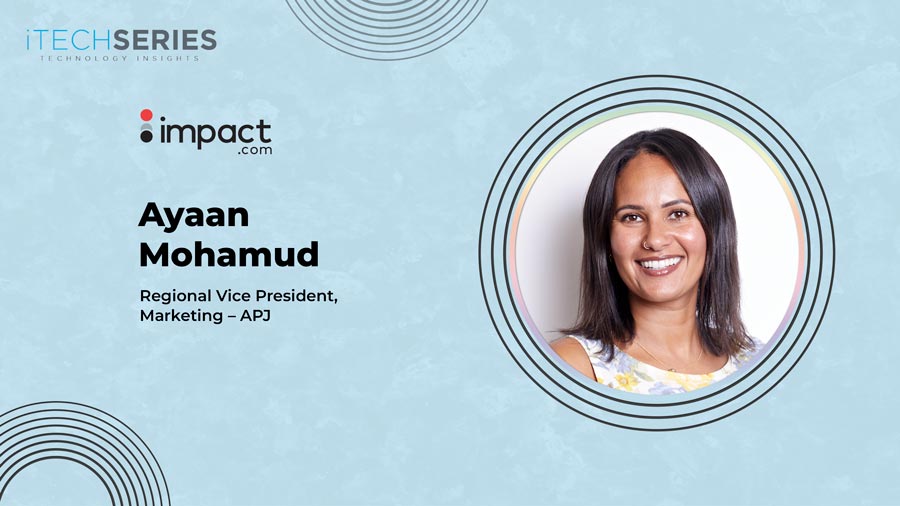
In this interview edition, Ayaan Mohamud, Regional Vice President, Marketing – APJ at impact.com, shares her journey from storytelling and consumer behaviour to building high-impact regional marketing functions. She discusses scaling global strategies across APAC, aligning GTM teams, driving B2B growth through ABM, and balancing AI innovation with human connection, trust, and authentic customer experiences.
Welcome to the interview series, Ayaan. Could you tell us about yourself and your journey as a marketer?
I didn’t set out to be a marketer, and I’m not sure any kid grows up wanting to be one. I studied Media, Culture, and Society, and it was through a few modules on psychology and consumer behaviour that I realised I could combine my love of writing and storytelling with a more commercial mindset. That led me to a Master’s in Marketing, and I’ve worked in the field ever since.
My background probably explains a lot about how I work. I was born in Germany, grew up between Zimbabwe, the UK, and Australia, and my parents are from different countries themselves. Constantly adapting to new places made me resilient, curious about people, and comfortable with change—all things that turned out to be useful in a marketing career built almost entirely on regional, ground-up roles in both EMEA and APAC.
I started in a small UK marketing agency doing a bit of everything from email campaigns and writing blogs to running workshops on social media and SEO, which threw me into a lot of responsibility very young. From there, I moved into media and tech marketing, first at Comscore, then at DataXu (now Roku) in the early days of programmatic, before relocating to Australia 11 years ago.
My last two roles at Sizmek (now Amazon) and currently at impact.com have both had me build a regional APAC marketing function as the first marketer on the ground. That journey was recognised in 2023 when I received B&T’s Women Leading Tech Award, which was especially meaningful because so much of my career has been about building teams, strategies, and brands from scratch.
One thing I’d flag: almost none of my later roles came from cold outreach. They came through my network, colleagues or clients I’d worked with, trusting me enough to bring me along to the next thing or introduce me to the right opportunities. That’s shaped how much I value mentorship, including being part of Macquarie University’s Lucy Mentoring program and the IAB (Interactive Advertising Bureau) Australia, both of which are close to my heart.
Having led marketing across diverse APAC markets, how do you balance global brand consistency with local market relevance?
I’ve spent most of my career translating a US company’s vision for a region that isn’t one market; it’s dozens of them, each with its own stage of maturity, culture, and buying behaviour. Consistency, to me, isn’t about saying the same thing everywhere. It’s about staying true to a company’s purpose and values, then finding the right way to express that locally.
That only works if you’ve built trust in both directions. I’ve had to earn credibility with global leadership so they trust my read on what a market needs, and I try to lead with curiosity rather than assumption by asking questions before I act. That extends to how I build teams: I hire people I trust in-market, give them the strategic direction and guardrails, then let them execute their way. If something doesn’t work, we figure out why together and try again. I care about the details, but I don’t let a need for perfection slow down progress.
Singapore is a good example of this in practice. When we started there, nobody knew who impact.com was. Over time, through consistent event activity, a local data partnership with Cube, now in its third year, and a steady cadence of customer stories, research, and PR, we built real credibility in the market, including wins at the SBR Tech Excellence Awards and Malaysia Tech Excellence Awards in 2024 and the Marketing Tech Awards in 2025. Our influencer marketing research in partnership with Cube has also become a reference point for the regional trade press, regularly cited by top-tier regional outlets.
Throughout your leadership roles, what practices have helped you build strong cross-functional alignment across sales and product teams?
Marketing doesn’t sit in a silo, and it doesn’t succeed on its own. We can build an enviable brand and generate a lot of demand, but if it isn’t converting into revenue for the business, it doesn’t mean much. So the starting point for me is understanding that we’re all ultimately working toward one shared outcome, not separate departmental goals running in parallel.
That takes real communication and collaboration, not the accidental kind, but deliberate, regular effort. I try to connect with the human before the title: understand what someone is actually trying to achieve and look for where our goals overlap. As a leader, a big part of my job is translating in both directions, staying close enough to the global strategy that I can apply the right filter locally, and surfacing what’s happening on the ground so it feeds back into global thinking.
I also believe in fighting for the things that will genuinely move the needle, whether that’s budget, headcount, or the space to execute, and removing whatever is blocking the team from getting there. That kind of energy is contagious; it sets the tone for how the whole team shows up.
Some of the best moments in my career have come from a product expert, a sales leader, and someone from my team sitting in a room and asking, “What if we did this differently?” Those conversations only happen when there’s real trust in the room.
What demand generation strategies have proven most effective in engaging modern B2B buyers and driving pipeline growth?
The biggest shift in my thinking has been remembering that even in B2B, we’re marketing to humans, not corporations. The organisation might be the buyer on paper, but the person on the other end cares about how something makes their job easier or makes them look good to their boss, not a feature list. Everything we do has to be outcome-focused, not features-focused.
That’s pushed us toward a real ABM (Account-Based Marketing) strategy, knowing exactly which accounts we’re going after, backed by proof points: customer testimonials, case studies, and in-person moments where prospects meet people already succeeding with the technology. Community matters more here than people give it credit for.
We’ve also learned that people are overwhelmed with generic invitations to another vendor dinner or lunch. So we’ve shifted our event strategy toward experiences that feel like they can’t be bought elsewhere. In Australia, we closed down the July Luggage flagship store after hours for a VIP shopping evening with a CMO fireside chat, built around the insight that our audience travels constantly. We’ve also taken customers to see inspirational speakers like Michelle Obama and Oprah Winfrey to enjoy a shared, memorable experience together, not just another touchpoint.
Our biggest annual event, iPX (impact.com Partnerships Experience), is built on the same idea. It’s not an event; it’s an experience people want to be part of. Underneath all of this is a simple balance: long-term brand building versus short-term demand generation. Seven years ago, nobody knew who impact.com was in this region; the awareness and community we’ve built since are now a meaningful driver of pipeline and revenue growth.
“The best marketing rarely comes from big budgets or clever campaigns alone. It comes from understanding what people actually need in the moment and showing up for them authentically.”
How has the role of data and AI evolved in your marketing strategy, and where do you see the greatest opportunities for marketers over the next few years?
We’ve moved from the Search Era into the Answer Era. Buyers aren’t scrolling through pages of links anymore; now they’re asking AI directly for answers. That shifts the question for marketers from “how do we rank?” to “how do we become part of the answer?” Which means our content needs to be credible and consistent enough that AI systems recognise it as trustworthy in the first place.
That’s also changing how marketers think about partnerships. Creators, affiliates, and publishers aren’t just a revenue channel; they’re trust signals feeding the AI ecosystem. When a trusted third-party voice recommends a brand, that’s credibility data an AI model is learning from.
Internally, we’re using tools like Enterprise Claude and Enterprise Gemini, and honestly, everyone is still figuring out the right workflows. What I don’t think AI replaces, though, is judgment. Someone early in their career, without years of experience, doesn’t always have the critical thinking to know which part of an AI-generated answer to trust and which to question; that layer still has to be human.
Besides efficiency gains, I think the biggest opportunity is AI as a decision-support layer by surfacing anomalies and missed opportunities so marketers can spend less time digging through data and more time on strategy. But there’s a real risk of teams getting seduced by the technology and forgetting the human piece. And ironically, as more content becomes AI-generated, people are craving the opposite: real humor, real connection, real experiences, and authentic reviews, which is why the creator economy keeps growing.
Tell us about your most memorable experience as a marketer and how it helped shape your journey.
COVID, without question. Overnight, our entire in-person events calendar disappeared, and we had to throw out the playbook and rebuild from scratch. What came out of that was a four-part webinar series we called “Create Impact,” deliberately not about the impact.com product at all, but about what people were actually struggling with while adjusting to working from home. We covered topics such as building resilience, virtual storytelling, and how to stay focused.
We tried to meet people where they were rather than sell to them. For example, we hosted an online terrarium-making class where we shipped plant kits to people’s homes and then stayed on the call chatting with customers and partners for over an hour. We curated a landing page of WFH offers from our own customers and partners, including discount codes for home office setups, meditation apps, and even headphones. Out of that also came APM Connect, a LinkedIn community for affiliate and partnership marketers that grew to around 400 members and still exists today.
Not every initiative ran smoothly. During one virtual event, our webinar provider had a global outage mid-broadcast. We owned it, sent everyone a recording afterward along with an Uber Eats voucher so they could “watch with lunch on us,” and were transparent about what went wrong. That response, not the failure itself, is what kept the trust intact.
What that period taught me is that the best marketing rarely comes from big budgets or clever campaigns alone. It comes from understanding what people actually need in the moment and showing up for them authentically. That lesson has shaped everything I’ve done since.
What advice would you give to marketers aspiring to take on regional or global marketing leadership roles?
Be a generalist first. When you’re the first person building a function from nothing, you can’t afford to be “just” an events specialist or “just” a demand generation leader; you need to understand PR, sales enablement, product marketing, and all of it. I tried specialising in social media early in my career and realised I’m someone who thrives on variety; that generalist instinct has made me a better leader because I understand how all the pieces connect. Specialists absolutely matter once you’re building a team, but the person launching something from scratch needs breadth.
Be honest with yourself about what “regional” or “global” actually means: there’s no 9-to-5. Time zones don’t disappear because you wish they would, and you have to build your own schedule and protect it fiercely. Some days you’re ordering office snacks; the next you’re presenting to the C-Suite at 3 am, and you need to be comfortable doing both. It’s not always easy, especially early on when you don’t yet have the budget, resources, or support behind you. But it’s genuinely rewarding to look back a few years later and see how far things have come.
Two other things I’d say: invest in the right people and stay close to your market and your customers; everything changes, and you need to change with it. And find a mentor along the way. I’ve been part of the Lucy Mentoring program at Macquarie University for four years and the IAB program as well, and both have shaped my career. Sponsorship—someone actively backing you, not just advising you—matters as much as mentorship. And once you’ve been doing this long enough, go be that person for someone else.
About Ayaan Mohamud
Ayaan Mohamud is a GTM and marketing leader focused on helping organisations navigate complexity and accelerate growth in the modern partnership economy. With deep expertise spanning brand building, demand generation, sales enablement, and GTM transformation, she has built high-performing teams and scaled pipeline growth across APAC and EMEA. Ayaan’s work seamlessly blends marketing strategy, emerging technology, and human-centric design to help brands turn trust and diverse partner ecosystems into their primary growth engines.