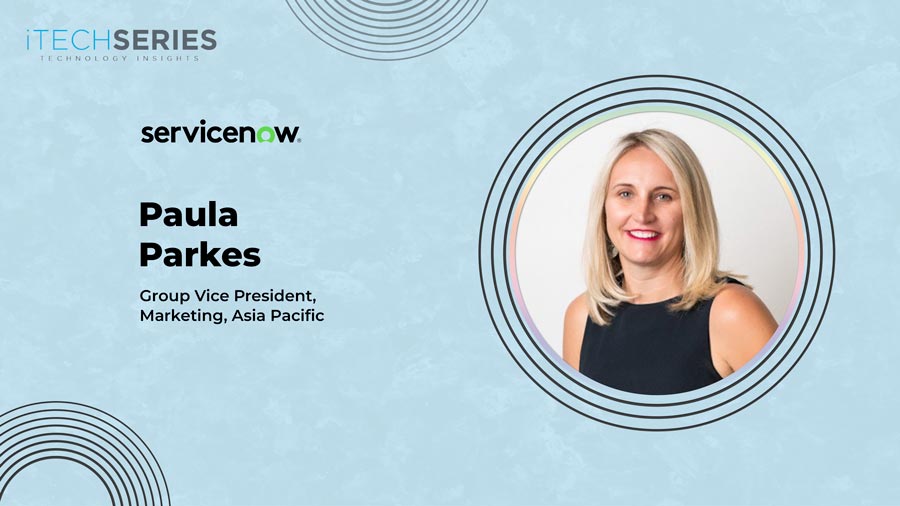
Paula Parkes, Group Vice President of Marketing, APAC at ServiceNow, shares how modern marketing has evolved into a revenue-driving function powered by AI, cross-functional alignment, and customer-centric innovation. In this interview, she discusses empowering teams to embrace AI, balancing brand with pipeline, measuring meaningful outcomes, and leading with curiosity, courage, and commercial impact.
Welcome to the interview series, Paula. Could you tell us about yourself and your journey as a marketer?
I’m the Group Vice President of Marketing for Asia Pacific at ServiceNow, and I lead a distributed regional team from my corner of the world here in New Zealand. My through line has always been curiosity; I’ve been a curious learner my whole life. It actually started early: I was selling Avon catalogues at the age of 15 and somehow landed in the top 15% for New Zealand, so the commercial instinct was there before I had a name for it.
At university, my love of marketing, information systems, international business, and psychology collided, and that combination has shaped everything since. The thread ran from content into analytics, data, and now AI, and it’s stayed anchored in technology the whole way through, from working for the CMO of the London Institute to marketing healthcare risk management technology and eventually to the platform companies I’ve been fortunate to accelerate growth for.
What I love hasn’t changed in two decades: people and purpose. I enjoy bridging gaps between teams and cultures, and I am a self-proclaimed data enthusiast who eagerly seeks out the insights that matter. Being in the Asia Pacific is an extraordinary privilege for exactly that reason; it’s one of the most relationship-based, culturally rich markets in the world to operate in.
How has the role of marketing evolved with greater synergy and alignment between the different revenue functions?
Marketing has moved from being seen as a cost centre to earning its place as a genuine revenue partner, and that shift is the single most important evolution of my career. Our focus at ServiceNow is what I call conversion quality: inching every cent of investment closer to revenue. That reframing changes everything about how marketing sits alongside sales, success, and finance.
The alignment is no longer a nice-to-have; it’s the operating model. The most powerful example I can point to is a customer experience campaign that ran across 11 countries and reached over 783 million people. That didn’t come from marketing in a silo; it came from a cross-functional team who laboured long and hard together, and it generated millions in pipeline as a result. When support, success, and sales operate on a shared account model with one data model, the customer experience gets sharper, and the commercial outcome follows.
The north star for me is a business where the CFO can go to the CMO to forecast revenue opportunities. That’s when you know marketing and the revenue functions are truly aligned, and it’s immensely powerful when you get there.
AI has reshaped enterprise marketing. Which areas offer the greatest opportunity to improve productivity and business impact?
The greatest opportunity, and honestly what keeps me awake at night, is the pace of reskilling and empowering teams to innovate right at the edge. That means embracing urgency over fear to meet the pace of change in the macro environment.
The area with the most tangible upside right now is content and elite execution at scale. Let me give you a real example. Our APAC team ran a dedicated AI Learning Day; we paused business as usual and invested a full day in experimentation as a collective. The outcome wasn’t just awareness; it was one product live in production and six new use cases submitted to our AI Center of Excellence.
The standout was one of the team members who built a content-generation engine on Claude in two weeks. Before, we were looking at two-to-three-week agency turnarounds at $30K, a package, manually searching through 47-plus reference slides to serve 8,000+ accounts. After, we had enterprise-quality content in minutes, powered by 74 messaging libraries and 1,700+ customer references across 11 countries and 3 languages, with 504 quality rules baked in. She shot to the top of our global AI usage charts and took home a Global AI Accelerator award from our CMO.
The lesson: the biggest impact comes not from a vague “use AI more” mandate but from empowering people to solve specific business problems with the right tools and permission to build. Beyond content, I’d point to personalization grounded in real-need data and to taking the soul-crushing busywork off people’s plates so they can focus on the moments that matter.
How do you align brand-building initiatives with measurable pipeline and revenue outcomes?
For me, it comes back to a simple belief: all roads lead to market share through mind share. Brand and pipeline aren’t in tension; brand is what makes the pipeline convert. But you have to hold both accountable.
Historically, marketing lived by “more is more.” The data has moved me firmly to bigger, fewer, better. Every time I’ve stress-tested it, refining the focus produces bigger impact and better results. Marketing shouldn’t be about busy work; it should be about the right work and the moments that matter.
Practically, that means pulling back on the noise while doubling down on meeting your customers where they are. At ServiceNow, our brand ambition is real; we’re doing beautiful, bold brand work, including our partnership with Idris Elba on how we put AI to work for people. But even the boldest brand play should ladder back to mind share, market share, and ultimately revenue. You can get the inside scoop on that from our legendary Jim Lesser: Why ServiceNow looked past Apple to Idris for its brand strategy-Mumbrella
“Marketing has moved from being seen as a cost centre to earning its place as a genuine revenue partner.”
Could you tell us about your most challenging yet memorable experience as a marketer?
Beyond me as a marketer, the one that changed the way I work and live: during the pandemic, I moved countries, and I moved companies, and I did it all with a five-month-old and a two-year-old. Fortune favors the bold, and I’d long envisaged living my best life doing a truly global role beside the beach. So I leaped.
It absolutely came with its downsides. Post-midnight calls with a London-based boss while a screaming baby was waking me up after I’d finally gotten to sleep—that was real. But what it proved is that you can do a genuinely global role from this corner of the world and that you can meet talent where talent is. It also pushed me to work smarter: I leaned into understanding circadian rhythm and optimizing for time zones so I could work out when I best engage and how I best operate as an individual.
Plenty of people went into stasis during that period. I did the opposite; I changed almost everything I could. The one thing I never changed was my commitment to the craft. And I wouldn’t undo a moment of it, because I truly believe we are the sum of all our choices.
As a marketing leader, how do you evaluate the success of a marketing program beyond the standard metrics?
I’m intensely data-driven, so for me this is less about softer signals and more about interrogating whether a program is actually working end-to-end. My buzzword bugbear is KPIs; just because we can measure something doesn’t mean we should. John Doer’s Measure What Matters has stayed with me: the discipline is measuring the right things.
The lens I apply is the full demand continuum: education, acquisition, progression, and adoption. Too many programs get judged on a single stage, a reach number, or an MQL count when the real question is whether demand is moving all the way through. Are we educating the market and building mind share? Are we acquiring the right accounts, not just volume? Are we progressing opportunities and compressing the path to pipeline velocity? And critically, are customers adopting what they bought? Because all roads lead to customer value realization and revenue. A program that generates a pipeline but stalls at adoption hasn’t succeeded; it’s just deferred the failure.
The other measure I refuse to let go of is durability. Anyone can spike once. Our customer experience campaign has run for four years and been nominated for industry awards three years running, raising the bar every single year even as attention spans shrink. Sustained relevance across the full demand cycle is worth far more than a one-off result, because it compounds, and compounding is where the real revenue impact lives.
If you could give one piece of advice to marketing leaders responsible for driving business growth today, what would it be?
Be brave, and permit your people to build, not just permission to learn. My father always told me, “Paula, you need to push your own barrow, because no one else is going to do it for you.” That’s stood me in good stead.
The practical version for leaders is this: stay visibly curious yourself, create the conditions for your team to experiment with a real commercial hook attached, and celebrate the builds, not just the ideas. Change fatigue is real, but people can tolerate enormous amounts of change if they understand why and where it’s going. The teams that struggle are the ones where change happens to them; the teams that thrive are the ones where change happens with them.
And protect your energy, because you can only give it to your team if you have it yourself. For me, everything ultimately comes back to mindset; it can be trained, tweaked, and rewired. That belief is my secret weapon, and it’s the one I’d hand to any leader trying to drive growth today.
About Paula Parkes
Paula Parkes is a seasoned marketing executive with extensive experience driving business growth and leading transformation across global technology organizations. She specializes in developing high-impact marketing strategies, optimizing investments, and delivering measurable commercial outcomes in competitive markets. Recognized for influencing executive-level decisions, she has successfully led cross-functional, multicultural teams across regions while fostering innovation, operational excellence, and sustainable growth through customer-focused and data-driven marketing.