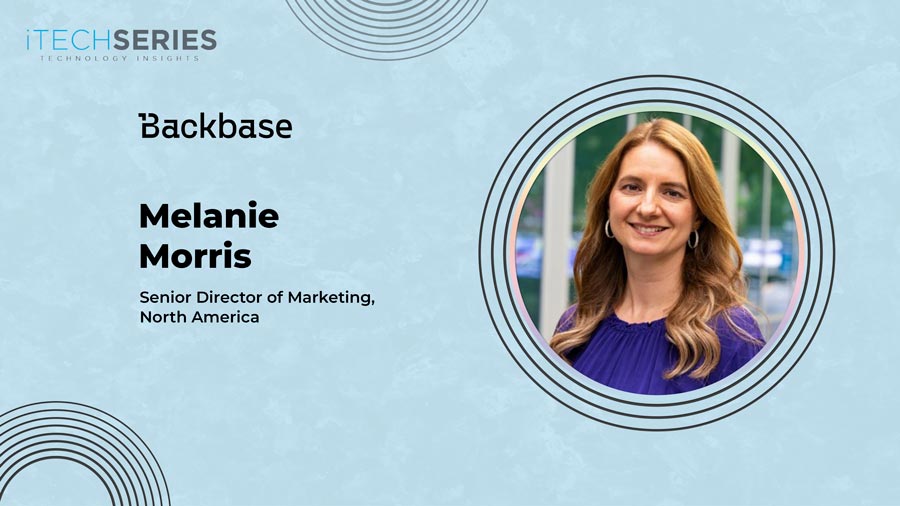
Melanie Morris, Senior Director of Marketing, North America at Backbase, shares insights on scaling growth in complex B2B environments, emphasizing cross-functional alignment, sales and marketing collaboration, and talent development. She also discusses global campaign execution, improving lead quality, and AI’s growing role in modern GTM systems, offering practical guidance for today’s marketing and GTM leaders.
It’s great to have you for this, Melanie. Could you tell us about yourself and your journey as a marketer?
My career has spanned telecom, FinTech, and SaaS, but the common thread has always been building scalable demand engines in complex environments.
I started on the agency side before spending ten years consulting for Microsoft across multiple product groups, including Windows, Office, Dynamics, and Bing. That experience is where I fell in love with B2B marketing: the complexity of enterprise buying cycles, the challenge of positioning the same product differently for distinct audiences, and the power of strategic storytelling at a global scale.
I then moved to T-Mobile, where I gained deep experience in B2C marketing and sophisticated audience segmentation. Reaching the right customers within a base of more than 75 million subscribers required precision and personalization that have shaped how I think about demand generation today. Eventually, I joined the early T-Mobile for Business division, which at the time operated very much like a startup within a large enterprise. This was a pivotal role for my career. I helped build the SMB demand marketing engine, and once that was driving predictable lead flow, I launched and scaled an SDR organization within Marketing to support pipeline conversion. That gave Marketing visibility and influence across the full funnel, which gave us a remarkable advantage for rapidly optimizing performance.
Since then, I’ve continued building and transforming GTM systems across B2B organizations, always focused on connecting strategy, execution, and measurable business outcomes.
You’ve built marketing organizations in complex B2B environments. What are the biggest challenges companies face when trying to scale growth?
Scaling growth in B2B organizations is rarely a tooling problem. It’s usually an alignment problem. The companies that scale effectively create shared accountability across Marketing, Sales, Product, and Customer teams. Without that alignment, organizations tend to operate in silos, which creates friction for both internal teams and buyers.
Building that foundation requires strong communication, transparency, and curiosity. Every time I am faced with an obstacle or my team gets blocked, I ask lots of questions. This helps build understanding and trust. Teams need shared visibility and a willingness to challenge assumptions together. From my perspective, that cross-functional alignment is both the hardest and most rewarding part of scaling a GTM organization.
The other critical piece is talent development. High-performing teams do not happen overnight. You have to invest in people individually, understand their strengths, and create an environment where they will take risks and grow.
Marketing and sales misalignment is a common issue. What practical steps help create stronger alignment between both teams?
A good starting point is speaking the language of Sales.
Sales teams care about pipeline, revenue impact, account prioritization, and increasingly, the buyer signals that help them focus their efforts. The strongest marketing organizations build credibility with Sales by helping to answer two questions: where should we focus, and why?
When Marketing can surface meaningful engagement signals, connect activity to pipeline progression, and provide insight into buyer behavior, the relationship shifts from lead provider to strategic partner.
It’s also important to create consistent feedback loops. Some of the most valuable insights come directly from conversations with Sales teams and customers. That alignment helps Marketing refine messaging, improve targeting, and build campaigns that resonate more effectively in the market.
You’ve scaled integrated campaigns across North America and EMEA. How do you balance global consistency with local market relevance?
The most successful global campaigns are rooted in a strong brand narrative and strategic content foundation. That work often starts with Product Marketing having a deep understanding of the product fit, market dynamics, and differentiators. From there, global teams can create core messaging and campaign assets that regional teams tailor for local market conditions.
It’s also important to involve regional marketers early in the process. Lean regional teams should not have to carry the entire campaign execution burden themselves. Global should provide the strategic foundation and core assets, while regions localize the final layer to ensure relevance within their markets. That balance creates consistency without fragmenting the brand or ignoring market nuances.
“When marketing connects engagement signals, pipeline impact, and buyer insights, it evolves from a lead source into a strategic partner.”
From your experience, what factors have the biggest influence on improving lead quality and pipeline performance?
Lead quality improves when marketing stays close to customer reality. Marketing teams can create compelling campaigns and creative messaging, but if those messages are not resonating with buyers, performance eventually stalls. That’s why strong feedback loops with Sales and customers are essential.
I always encourage marketers to join customer calls, review meeting transcripts, and listen closely to objections and priorities. Those insights help shape better segmentation, stronger messaging, and more effective campaigns.
The other important factor is measurement discipline. Over time, organizations should develop clear performance baselines around conversion rates, engagement, and pipeline progression. When campaigns underperform against those benchmarks, teams can pivot messaging, targeting, or channel strategy quickly and continuously improve the system.
AI-enabled ABM workflows are becoming more important. How do you see AI improving account prioritization and executive engagement?
We recently built an AI-powered GTM signal engine with Claude, Vercel, GitHub, and other tools, which was designed to help Sales prioritize accounts and personalize engagement at scale.
The system aggregated third-party intent data, first-party engagement signals, account activity, and buyer insights into a unified scoring model that fed directly into our CRM. That allowed Sales teams to identify both high- and low-engagement accounts and tailor outreach based on real buyer behavior and signals.
We also developed agents to generate personalized messaging and content by account and buyer persona, helping teams scale executive engagement in a much more targeted way.
What’s most exciting is that these capabilities are becoming increasingly accessible. Organizations no longer need massive custom infrastructures or expensive third-party platforms to begin building intelligent, AI-driven GTM systems.
Based on your experience leading global marketing teams, what advice would you give to marketers looking to grow into senior leadership roles?
Pay attention to the problems you naturally gravitate toward solving, then become exceptional at them. For me, that has been building GTM systems and helping organizations connect strategy, execution, and outcomes. Over time, that focus became part of my leadership identity and personal brand.
I also believe relationships and influence matter tremendously. Senior leadership is not just about expertise; it’s about collaboration, trust, and the ability to align teams around a vision.
Take on high-visibility or stretch opportunities, even when the immediate benefit is not obvious. In a previous role, I volunteered to manage logistics for a leadership offsite, which gave me direct exposure to the CMO. That relationship eventually turned into a mentorship and opened new doors for my career. Sometimes the experiences that accelerate growth are not the most glamorous in the moment.
The best senior marketing leaders do more than drive pipeline. They create alignment, build future leaders, and shape how organizations grow. If you prioritize this transformational work, you will be amazed at the opportunities that will arise.
About Melanie Morris
Melanie is a marketing executive with 15+ years of experience building scalable B2B marketing organizations that connect strategy to measurable pipeline impact. She has led global GTM and demand generation initiatives across telecom, FinTech, and SaaS, driving significant growth through the alignment of marketing and sales. With experience at Microsoft, T-Mobile, and in enterprise consulting, she specializes in building data-driven, high-performing demand engines in complex environments.