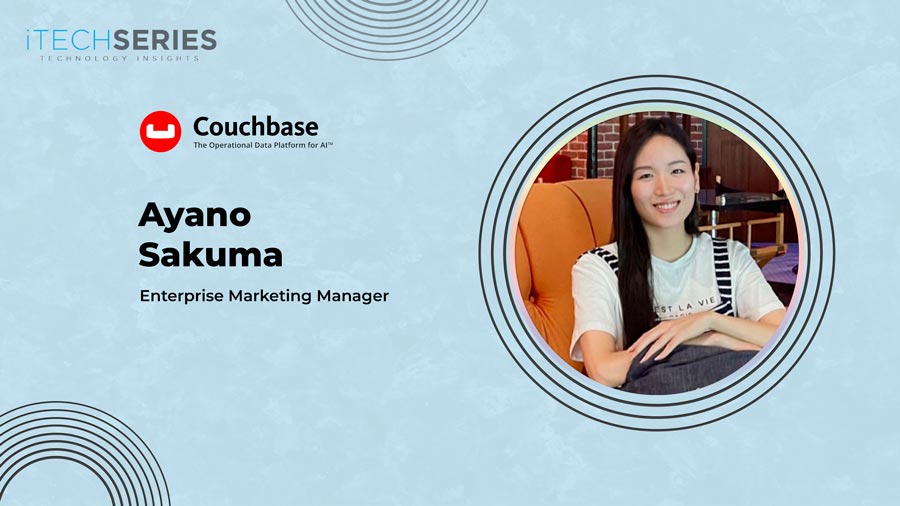
As enterprise marketing evolves, success increasingly depends on connecting AI, ABM, brand, and revenue into one cohesive growth strategy. In our latest interview, Ayano Sakuma, Enterprise Marketing leader at Couchbase, shares her perspective on building market trust, aligning revenue teams, using AI with purpose, and driving measurable enterprise growth through localized marketing.
Welcome to the interview series, Ayano Sakuma. Could you tell us about yourself and your journey as a marketer?
Thank you for having me. In my first job out of university, while running a B2C campaign in a wine importer’s e-commerce department, I exceeded our campaign sales target by 300%. I analyzed buyer personas, studied historical campaign performance, and reviewed notes from past team members to understand why previous attempts had fallen short. My background in microbiology naturally drives me to rely on behavioral insights and data—building hypotheses around facts and testing them through deliberate execution.
After that, my career shifted into the B2B tech world. Currently, I oversee Enterprise Marketing for Japan at Couchbase, driving local GTM strategy across field and partner marketing, brand presence, and pipeline generation. Outside of work, I still enjoy a good glass of wine.
Throughout my journey, my core specialization has been helping Western enterprise tech companies successfully enter, land, and expand in Japan. I’ve also crossed over into the revenue management side, serving as a team lead managing KPIs for ad sales. That experience grounded me in the mechanics of revenue generation. My focus is always on translating complex technical value propositions, such as modern database architectures, into local market leadership by ensuring local decision-makers understand what that value truly means for their business.
How are AI and automation changing enterprise marketing, and where do they create the most value?
AI acts as an assistant, collecting data, researching, analyzing, summarizing, taking notes, drafting, and correcting grammar. It has helped us shift our focus from broad reach to hyper-contextual, personalized engagement. The real value lies not just in faster content generation but in precision. By synthesizing intent data, AI helps us pinpoint buyer pain points while tailoring messaging. That being said, AI is still an assistant that supports your tasks—it won’t own them. Hallucinations and off-target messaging still occur, which is why human marketers must be the ones to take ownership, review, and finalize the work.
In your experience, where has the role of marketing evolved the most due to greater alignment between the different revenue functions?
Marketing has evolved from a demand generation engine into a co-driver of net new ARR and account expansion. This isn’t just my perspective. It is an approach my team and I execute every day at Couchbase Japan.
Because I’ve led teams with direct revenue responsibilities, I view alignment through a commercial lens. Marketing cannot end at leads or MQLs, passing them off to SDRs or sales like a live grenade, nor can we simply tag a campaign and move on. Today, marketing, sales, customer success, and partner ecosystems operate as a single revenue team. In markets like Japan, where trust and partner channels are paramount, marketing works directly with field sales to accelerate stalled deals and open executive doors. We co-own pipeline generation, conversion, and retention, ensuring every dollar spent maps directly to business growth.
How should marketers balance long-term brand building with the need to generate measurable pipeline and go-to-market impact?
I don’t view brand and performance as competing priorities—brand multiplies performance. I do not use “building awareness” as an excuse for failing to deliver high-quality, conversion-ready leads. Before any launch, the entire team—including sales and the country manager—understands the campaign type, expectations, rationale, and target outcomes.
When a Western tech company enters Japan or the APAC region, the brand is often completely unknown. If you only focus on short-term lead generation, your acquisition costs will skyrocket because trust has not yet been established. My approach is integrated:
- Short-term: High-intent ABM, targeted field events, and pipeline generation tied directly to sales targets.
- Long-term: Local customer success stories and thought leadership that build market trust.
A strong local brand reduces sales cycles and increases win rates, directly feeding performance metrics.
“Marketing has evolved from a demand generation engine into a co-driver of net new ARR and account expansion.”
Could you tell us about your most memorable experience as a marketer?
While helping a Western software company expand into Japan, we hosted an executive roundtable where an executive from one of our existing clients convinced a prospect on the spot, resulting in an immediate deal. That moment reinforced the true value of cross-functional teamwork. Had our customer not been genuinely satisfied—a testament to our customer success and technical support teams—they would never have advocated for us to a peer. Sales and marketing also worked tirelessly to bring the right decision-makers into the room. A win feels so much more rewarding when it is a collaborative victory rather than an internal battle over who gets the credit.
How do you measure the success of your enterprise and field marketing programs beyond the standard metrics?
Ultimately, it all comes down to closing deals. However, since I oversee both enterprise and partner marketing, success goes beyond direct metrics. While direct marketing is relatively straightforward, the partner ecosystem is complex—local partners operate differently, with unique strengths, motivations, and business models. Unless we clearly define “what’s in it for them,” partners will not prioritize a vendor that is not yet a household name in Japan. Given that Japan is a heavily partner- and SIer driven market, my primary success metric is the growth delta in partner enablement and active engagement.
What would be your advice to marketers who are starting their journey?
Be curious, and keep learning about both your target accounts and your own product technology. Listen to customer and prospect earnings presentations whenever possible. You do not need to listen to every call in full. Use modern AI tools to pinpoint the C-suite’s top three strategic priorities and current investment mandates. When you understand what keeps the C-suite up at night, you can translate those insights directly into marketing initiatives that drive net new opportunities and account expansion.
About Ayano Sakuma
Ayano Sakuma is an experienced B2B technology marketer specializing in enterprise marketing, field marketing, partner programs, and go-to-market strategy. With a data-driven approach shaped by her background in microbiology, she combines behavioral insights with deliberate experimentation to drive growth. Her experience spans marketing, sales, revenue management, and team leadership across Japan and APAC, with a focus on helping global technology companies build market presence, trust, pipeline, and sustainable revenue.