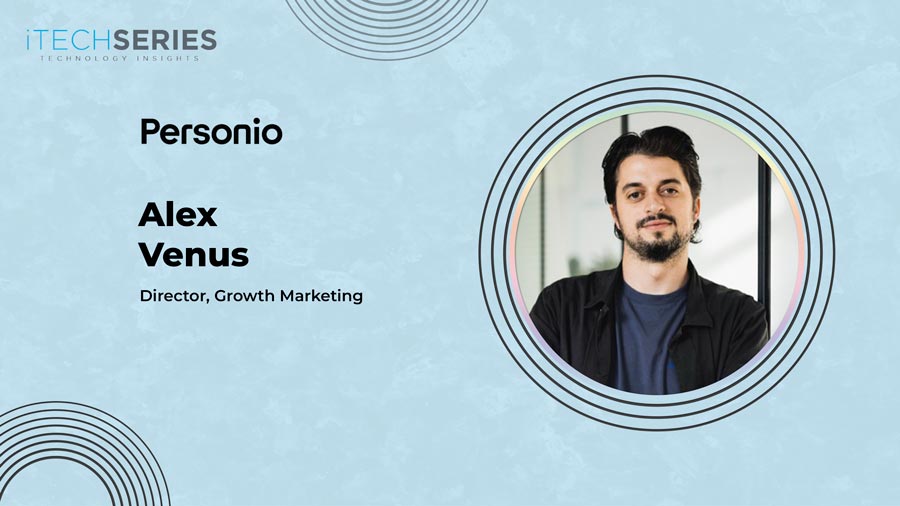
With nearly 15 years of B2B SaaS experience, Alex Venus, Director of Growth Marketing at Personio, brings a fresh perspective on sustainable growth. In this iTechSeries Unplugged interview, he explores the balance between brand building and demand capture, AI-powered personalisation, revenue-focused metrics, and cross-functional GTM alignment to drive lasting business impact.
Welcome to the interview series, Alex. Could you tell us about yourself and your marketing journey?
I’ve spent almost 15 years in B2B SaaS, the last five leading demand generation at Personio, one of Europe’s leading HR and payroll SaaS platforms for mid-sized businesses. Much of it was in HR tech, at Workplace by Facebook, Peakon (now Workday), and Korn Ferry. I came into marketing from sales and product, and for a long time I took pride in being a technical practitioner rather than a generalist. About ten years ago, I was also skeptical of brand building and thought leadership. Ironically, those are now what I’m most passionate about and what keeps me up at night. My greatest asset today is my intuition and judgement, not my depth in any one tool or channel. I’ve applied it from enterprise B2B to B2C ecommerce, and that success wasn’t a fluke. Good marketing is built on fundamental principles, not growth hacks or saturating single channels.
That’s also what shapes my goal at Personio: take us from one of Europe’s leading HR and payroll providers to the category leader, get to €1bn ARR, and build the best marketing team in Europe along the way. I want this to be the main act of my team’s careers, not the rehearsal. In a category this competitive, it comes down to focus and speed. Five years in, I still feel like I’m just getting started.
What makes a successful growth strategy, and how do you balance short-term results with long-term growth?
Growth leaders have to own the numbers, whether that’s pipeline, ARR, or CAC payback, and monthly and quarterly targets aren’t negotiable. But if all your effort goes into capture, you don’t have a strategy. You have a list of activities and a complete lack of focus on where real buyer influence happens, further up the funnel. I’d put 50 to 60 percent of resources into demand creation and 40 percent or less into capture, with circa 10 to 20 percent of the total going into brand, depending on your market share. Capture harvests demand that already exist. Creation shapes how your buyer thinks about you before they’re in the market, and the competitor who’s been doing that for years will already be on the shortlist.
How do you build a demand generation strategy that drives engagement and a strong pipeline?
Know your customer properly. We run tens of thousands of Gong transcripts through LLMs alongside user testing, so we’re working from real pain points rather than assumptions. Then look at where the money actually goes. I saw a marketing leader I trust quote a Primer study recently, covering real spend from 379 B2B advertisers, and the typical company puts 84% of its paid budget into demand capture. That’s a lot of people fighting over the same handful of buyers who are in the market. So study the channels your customers actually flow through and find a unique voice and position in your content. AI slop is polluting feeds at an alarming rate, and the temptation is to take shortcuts. Don’t. Build content you’re proud of, because that’s what cuts through.
“Good marketing is built on fundamental principles, not growth hacks or saturating single channels.”
How can businesses use marketing automation and AI to improve segmentation, nurturing, and campaign effectiveness?
Automation used to mean static lists and firmographics. With tools like Clay and n8n plus LLMs, you can build segments from what customers actually say, not just company size and industry. That makes personalisation realistic at scale, from landing pages tailored to an account segment to conversational guides on the site. The bigger change is that segments stop being something you build once and maintain. They move as customer conversations and the market move. This allows marketing teams to respond to evolving buyer needs, deliver more relevant experiences, and improve campaign effectiveness through continuous learning and smarter targeting.
Which metrics should the team prioritise to measure campaign success and revenue impact?
Your master metrics should be focused on revenue impact: pipeline, CAC, and ARPA movement. Beyond that, you need to track how the 98% of buyers who aren’t in the market feel and speak about you. For that, I’d look at share of branded search, share of voice, and sentiment analysis. If you’re intentional about how you read these leading indicators, they aren’t vanity metrics. They most likely show you how your demand capture will perform in the quarter ahead. Keep the whole set to around half a dozen, because a wall of impressions or an over-engineered attribution model will tell you less than a few numbers you actually trust.
How do you build a GTM strategy that aligns marketing, sales, and customer success?
Share the objective, not just the meeting. Pipeline velocity and net revenue impact should belong to all three teams, rather than each running to its own KPIs. I stay close to sales leadership on pipeline quality and where deals drop off. Customer success data matters just as much, because retention patterns tell you which customers you should be attracting in the first place, and that feeds straight back into top-of-funnel positioning. Regular communication and shared insights help teams identify gaps, refine their approach, and create a consistent customer experience that supports long-term growth and stronger business outcomes.
What advice would you give marketing leaders building a scalable, data-driven growth engine?
There’s no silver-bullet framework. Think like a marathon runner: set a strong pace, keep your eyes on the goal, and don’t break stride. That means cutting the noise. The person in your LinkedIn inbox claiming they’ve solved your GEO strategy, the cold call about a lead list, and the 20 dinner invites you get every week. Time is your currency, and none of them know your business or your GTM strategy. Nobody is coming to rescue you, so bet on yourself and your team rather than caving to FOMO or a clickbait subject line. Tools and platforms will keep changing, but trust, value, and clarity won’t, and the best leaders pair hard numbers with creative judgement. It’s on you, so move fast, stay focused, keep running, and own the result. Good things take time.
About Alex Venus:
Alex Venus is a B2B SaaS marketing leader specialising in demand generation and sustainable growth. With nearly 15 years of experience, he has worked across HR technology and enterprise marketing, including roles at Personio, Workplace by Facebook, Peakon (now Workday), and Korn Ferry. Combining data-driven strategies with creative judgment, Alex champions brand building, thought leadership, and demand creation to drive category leadership, strengthen marketing teams, and deliver measurable business outcomes.