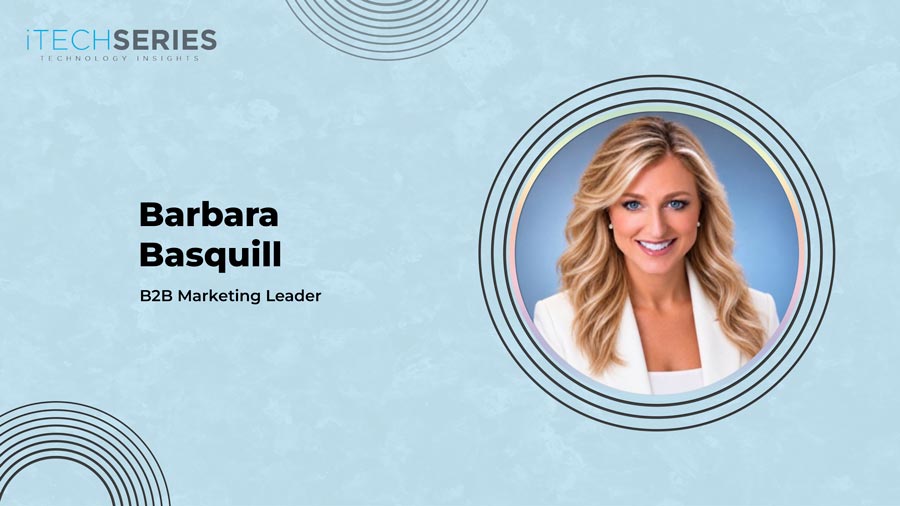
Attention fades. Momentum compounds. A B2B marketing leader on pairing AI-powered buyer intelligence with seasoned judgment to move buyers and revenue forward. With over a decade of experience building growth strategies, integrated demand generation programs, and revenue-focused go-to-market engines, Barbara Basquill, a senior marketing leader, shares her insights on crafting GTM strategies that drive pipeline and revenue growth across SMB, mid-market, and enterprise segments.
Welcome to the interview series, Barbara. Could you tell us about yourself and your marketing journey?
Thank you, I’m excited to be here. I call myself a momentum marketer. Getting attention is easy. Creating momentum, moving the right buyers forward until they become pipeline and revenue, is the real job, and it has been the focus of my entire career.
I started on the agency side at a global marketing agency known for data-driven customer engagement, where we won the BMW Connected Car, IBM, and Samsung accounts. That’s where I learned the rule that still guides me: understand the buyer, reach them at the right moment, and prove it worked. Since then, I’ve run GTM programs for global service providers across the US, EMEA, and APAC at a world-leading networking company, and earned a Top Gun Award as part of Red Hat’s global services marketing team. For the past several years, I’ve focused on cybersecurity and AI across identity security, data security, and agentic AI SaaS. Along the way, I’ve mentored teams on AI tools and built AI skills and workflows that help marketing teams move faster, work smarter, and operate at scale.
I lead with strategy and stay close to the work. I think about marketing as an investment portfolio: where to place budget, how to align teams around one revenue goal, and which programs deserve to scale. I use AI to research accounts, surface buying signals, map buying groups, and accelerate campaign planning and messaging. But AI informs the decision. It doesn’t make it. Instinct, judgment, and experience make the final call on which channels, tactics, and messages reach the buyer. That combination is what creates momentum. The era of spray and pray is over. Now it’s know and grow.
What are the key elements of a GTM strategy that drive pipeline and revenue growth across SMB, mid-market, and enterprise segments?
Momentum starts with clarity. Before any campaign launches, I align marketing, sales, product, and partners on who we’re selling to, why they would buy now, and which signals tell us an account is in market. AI sharpens that foundation by analyzing firmographic, technographic, and behavioral data to show which accounts truly fit and which are actively researching. Instinct then pressure-tests it: does this account list match what sales is actually hearing in the field?
From there, the motion has to match the segment. Enterprise deals involve large buying groups, long cycles, and heavy security and compliance scrutiny, so they call for ABM and ABX, executive engagement, field events, and tightly coordinated sales plays. Mid-market is where AI changes the economics: intent-driven, one-to-many programs deliver enterprise-level relevance without enterprise-level headcount. SMB rewards speed and efficiency through digital, product-led, and partner-led motions. Partners matter across all three, because the right channel strategy extends reach into segments a direct team can’t cover efficiently.
Finally, momentum needs one integrated plan. At an agentic AI SaaS company, I owned the Integrated Demand Plan for the security business, the GTM playbook that brought digital, content, ABM, field, events, and sales activations together, and I used AI to accelerate planning, messaging, and research across it. When every team runs one plan toward one revenue goal, momentum builds instead of resetting with every new campaign. A marketing leader’s job is to protect that plan, align stakeholders around it, and make the tradeoffs that keep it focused on revenue.
What makes a successful full-funnel campaign that engages enterprise buying groups and drives pipeline?
Enterprise deals aren’t won by one person. They’re won by a buying group. In cybersecurity, that might be the CISO, security architects, IT operations, compliance, procurement, and finance, each with different priorities and a different definition of risk. A full-funnel campaign succeeds when it moves the whole group forward together. If one stakeholder stalls, the deal stalls.
I focus on three things. First, persona-based storytelling. The CISO cares about business risk, the practitioner wants technical proof, and finance wants ROI. As a privileged access management leader, I defined our security leadership personas, buyer journeys, and ICPs, then built campaigns across search, email, paid media, social, webinars, virtual events, and ABM for each persona and stage. Today, AI can map a buying group and draft role-specific messaging in hours instead of weeks. Experience decides which story leads, and which proof point will land with a skeptical security buyer.
Second, orchestration around the moments that matter. At a global data security company, we ran major industry events as complete campaigns, with pre-event account targeting, onsite engagement, and post-event follow-up, and they drove significant pipeline growth. My very first field event there produced seven figures in opportunities and a significant ROI.
Third, sales is part of the campaign from day one, not the last step. I built an AI-powered sales enablement framework that turns complex security and AI solutions into seller-ready messaging, battlecards, discovery briefs, and objection handling, so sellers carry the campaign’s momentum into every conversation.
In what ways can intent signals and account intelligence improve targeting and personalize buying experiences?
One of the most important lessons I ever learned about intent came long before intent platforms existed. When someone walks onto a car lot, they’re going to buy a car, probably within the week. The worst thing you can do is let them leave the lot without the right follow-up. They’re actively shopping, and if you don’t reach them at the right time with the right car, someone else will.
B2B buyers are on the lot all the time. They’re researching, comparing vendors, and reading reviews, mostly anonymously and long before they talk to sales. Intent signals and account intelligence tell us who’s on the lot and what they’re looking at. At the data security company, I launched an intent-driven ABX pilot using 6sense, HubSpot, and Salesforce that delivered a substantial new pipeline. AI-powered account intelligence and automated workflows reduced manual GTM processes by 40% and accelerated account validation by 40%, so sellers spent their time on accounts that were genuinely in market.
Signals also make personalization real. An account researching Zero Trust needs a different conversation than one comparing data loss prevention vendors. At the identity security company, we combined product-usage signals, intent data, and lifecycle analytics to spot adoption gaps and trigger targeted customer journeys, which proves the same approach drives expansion as well as acquisition.
Here’s where instinct matters. A signal tells you an account is active. It doesn’t tell you whether that’s a new CISO building a strategy or an analyst writing a report. AI reads the signals at scale. Experience reads the context. Put them together, and marketing and sales act on the same accounts, at the same moment, with the same story. That’s how you keep the buyer on the lot.
Which strategies help maintain global brand consistency while adapting to local markets?
I think of it as a global spine with a local voice. The brand, core positioning, value proposition, and visual identity stay consistent everywhere. What flexes is how the story is told: the proof points, channels, partners, and timing that build momentum in each market.
At a world-leading networking company, I ran GTM programs for global service providers across the US, EMEA, and APAC, partnering with regional teams and a global partner ecosystem to tailor strategies to regional and account-specific needs while keeping marketing automation, content, customer journeys, and field execution aligned.
A few practices make it work. Build campaign kits, not finished campaigns, so regions get core assets plus clear guidelines for localizing them. Bring regional teams in early, because the best localization starts in planning, not translation. And treat partners as local amplifiers, equipped to run campaigns that are on-brand and locally relevant at the same time.
AI now adapts content, messaging, and assets for different markets in a fraction of the time, within brand guardrails. But local experts make the final call, because cultural nuance comes from instinct, not output. AI gives you scale. People keep it authentic.
Beyond lead volume, which performance indicators should guide campaign evaluation and marketing spend?
Lead volume tells you how loud you were. Momentum tells you whether you moved anyone. I guide campaign evaluation and spend with metrics that show forward motion toward revenue: pipeline sourced and influenced, lead-to-opportunity and opportunity-to-win conversion, and pipeline velocity, meaning how quickly accounts move from stage to stage.
For ABM, I add account-level metrics. How many members of the buying group are engaged? Are target accounts progressing from aware to engaged to in-market to opportunity? Buying-group engagement is often the earliest sign that a deal is real. I also track cost per opportunity and program ROI, and for customer programs, adoption, expansion, and renewal.
AI-assisted analytics now surface which accounts are accelerating and which programs are stalling, while there’s still time to act. Experience tells you why it’s happening and what to do about it.
In my data security role, I led North American field and channel marketing strategy, owned the KPI dashboards and Salesforce and Tableau analytics, and ran ABM strategy calls with sales and marketing leadership to drive GTM decisions. Leaders don’t just report results. They use them to make the next investment call. I managed seven-figure program and partner investments, and every investment decision came back to pipeline contribution, not activity. When a program wasn’t moving accounts forward, we shifted budgets to the ones that were.
What advice would you offer marketers looking to measure campaign success beyond lead volume?
First, agree on definitions with sales before you measure anything. At Red Hat, I founded and chaired our Marketing Advisory Council and Sales Advisory Council, and led biweekly Lead Council meetings that aligned Sales Enablement, Marketing Operations, Analytics, and Demand Generation around lead quality and reporting. When both teams agree on what a qualified opportunity looks like, the debate about lead quality disappears.
Second, measure accounts, not just people. In B2B, an account with five engaged stakeholders is worth far more than fifty disconnected form fills.
Third, make data a conversation, not a report. Monthly business reviews and QBRs should end with decisions about what to scale, fix, or stop. And invest in your team’s fluency: when I train marketers on AI and GTM best practices, the whole team measures and moves faster.
Fourth, celebrate together. When a marketing-sourced opportunity becomes a closed deal, marketing and sales should cheer together. Shared wins build shared accountability, and shared accountability builds momentum.
Finally, hold AI to the same standard. The value of AI isn’t how many assets it generates. It’s whether it creates more pipeline, faster cycles, and higher conversion. Spray and pray measures volume. Know and grow measures momentum. Attention fades, but momentum compounds.
About Barbara Basquill
Barbara Basquill is a B2B marketing leader and momentum marketer specializing in cybersecurity, SaaS, and agentic AI, with deep experience in integrated campaigns, ABM and ABX, demand generation, and field and channel marketing. She has driven go-to-market programs for global technology leaders across cybersecurity, agentic AI, networking, and open source, including Red Hat. Barbara pairs AI-powered buyer intelligence with seasoned judgment to help marketing and sales teams reach the right buyers at the right time, accelerate the pipeline, and drive measurable revenue impact.