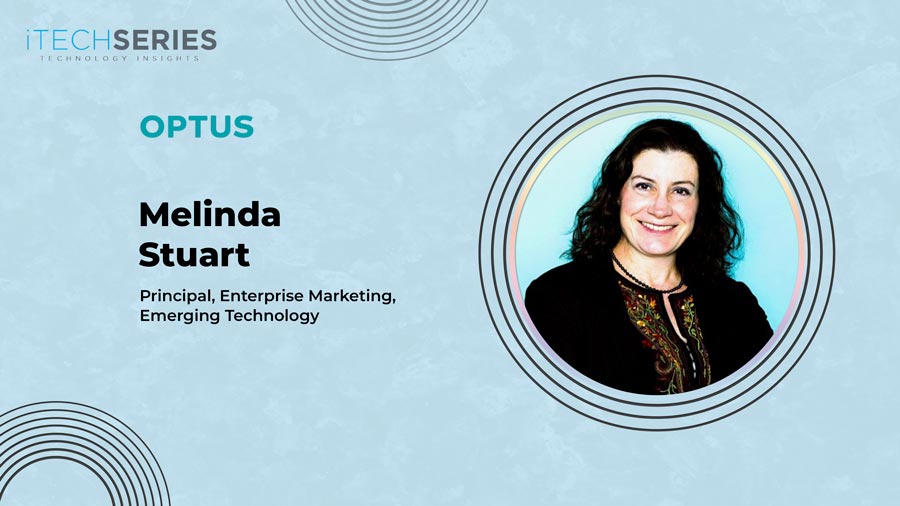
In this interview edition, Melinda Stuart, Principal, Enterprise Marketing, Emerging Technology at Optus, shares practical lessons on building successful GTM strategies through local market understanding, cross-functional alignment, and measurable business outcomes. She also explores scaling global ABM, leveraging AI beyond automation, earning stakeholder trust, and leading high-performing teams with strategic clarity.
Welcome to the interview series, Melinda. Could you tell us about yourself and your journey as a marketer?
Thank you for having me. My path into marketing wasn’t the conventional B2B tech route. I actually started in corporate communications and brand strategy in London and Prague, working with agencies like Saatchi & Saatchi, Ogilvy, and BBDO on brand translation for multinationals like Volkswagen and Nestlé as they entered post-1989 Eastern Europe. That early experience taught me something I’ve carried through my entire career. A brand narrative only works if it’s genuinely translated, culturally, politically, and commercially, not just copy-pasted into a new market.
When I moved into technology and SaaS marketing, that same instinct shaped everything I did. I spent years building demand-generation engines at Cornerstone and Macquarie Technologies, then took on regional leadership at InterSystems across Japan and Southeast Asia, and, more recently, at Optus, leading GTM for emerging technology portfolios. What ties it all together is a systems mindset. I’m as comfortable in the boardroom shaping narrative as I am in the operations layer building the attribution frameworks that prove it worked.
What have your global marketing experiences taught you about building successful GTM programs?
Global GTM lives or dies on local nuance, and there’s no substitute for doing the research into how buying decisions are actually made in that market. I learned that lesson the hard way, trying to open Switzerland.
I was orchestrating the launch from Sydney and chose the country’s largest banking summit to introduce us to the market. All of our materials were in English, and we sent a delegation over from New York, fully expecting a fairly standard enterprise audience. The entire two-day event was delivered in Swiss German and Swiss French. I’d spent years building the instinct to localise relentlessly for Southeast Asia—language, channel, messenger, all of it—and with Switzerland, I took that for granted.
That’s the trap. Assuming proximity to your own market means less translation work, when really it just means the nuance is quieter and easier to miss. Now I treat local research as a non-negotiable first step, no matter how familiar a market looks on the surface.
The second lesson, which compounds the first, is that pipeline is a lagging indicator of trust. In regulated, relationship-driven markets especially, you’re not just building demand; you’re de-risking a decision for someone whose name is on the line internally. Every GTM program I’ve built since starts with understanding how that trust actually gets built in-market, not how it got built somewhere else.
The third lesson is to know the difference between TAM and TSM, total addressable market versus total serviceable market. A Gartner report can point you to a multi-billion-dollar growth opportunity, and it’s tempting to build your business case and your stakeholder narrative around that headline number. But if you can’t actually service those customers, or service the rate of growth you’re promising, the numbers simply don’t add up. Setting realistic expectations upfront, grounded in what you can genuinely deliver rather than what the market theoretically holds, is what protects your credibility with stakeholders and your reputation in-market.
Global ABM isn’t easy to scale. What framework has helped you balance global consistency with local relevance?
I built and scaled a global ABM Centre of Excellence model, essentially a hub-and-spoke structure where the centre owns the strategic scaffolding (account selection methodology, attribution, and messaging architecture) and a decentralised network of field and digital marketers owns activation in-market. The discipline is in what stays centralised versus what gets handed off.
Centrally, we govern things like ideal customer profile criteria, the segmentation logic, and how we measure success, because if every region defines “engagement” differently, you can’t roll anything up meaningfully. Locally, the team owns channel mix, language, timing, and relationship mapping, because that’s where the on-the-ground judgment actually lives. The framework only scales if you resist the urge to centralise everything just because it’s easier to govern. Some decisions genuinely belong closer to the account.
What principles are key to a strong alignment between marketing, sales, and executive stakeholders?
Shared definitions, before shared dashboards. So much of the friction between marketing and sales isn’t about effort or intent; it’s that the two functions are quietly using the same words to mean different things. “Qualified,” “engaged,” “pipeline.” If you don’t align on those definitions early and explicitly, every conversation downstream becomes a negotiation.
The second principle is bringing sales and executives into the strategy while it’s still being formed, not once it’s polished. When I built the ABM program for tier-one accounts at Optus, the strongest alignment came from involving sales leadership in account selection itself, not just briefing them on the output. People defend what they help build.
And with executives specifically, the currency is commercial language, not marketing language. I’ve found the fastest way to earn a seat at the table is to talk in pipeline, ROMI, and risk and let the creative and channel decisions be the implementation detail, not the headline.
“A brand narrative only works if it’s genuinely translated, culturally, politically, and commercially, not just copy-pasted into a new market.”
Could you tell us about your most challenging yet successful go-to-market experience?
Singapore, without question. We were entering the market with a positioning that had to do two genuinely different jobs at once. On one side, large financial institutions are conservative and risk-averse, needing real confidence before they’d even take a meeting with a new entrant. On the other hand, Singapore’s FinTech community is tight-knit, fast-moving, and allergic to anything that smelled like a generic enterprise pitch.
A single message couldn’t serve both audiences, so I didn’t try to force one. For the financial institutions, we leaned heavily on B2B influencers and credibility-first messaging designed specifically to de-risk the conversation, giving executives social proof and context before our sales team ever walked in the door. For the fintech segment, it was almost the opposite muscle, getting embedded in local communities and hubs and building genuinely personalised messaging around what early-stage and scale-up founders actually needed, not what we wanted to sell them.
What made it work was treating those as two distinct go-to-market motions under one positioning umbrella, rather than diluting the message to be vaguely acceptable to both. It’s a principle I’ve carried into every market entry since. Precision beats breadth, even, especially when you’re tempted to keep the message broad enough to cover everyone.
Which aspects of marketing and GTM have experienced the most significant transformation due to AI?
I think the real shift isn’t where most of the conversation is focused. Everyone’s talking about AI saving hours, faster content, faster segmentation, faster reporting, and yes, that’s real. But the more interesting transformation is in what we can now measure at all. For the first time, qualitative signals—the tone of a sales conversation, the sentiment in an account’s engagement, and the quality of a narrative—are becoming legible at scale, not just the quantitative layer we’ve always defaulted to because it was easier to count.
That matters enormously for GTM and ABM specifically, because the things that actually predict whether an enterprise deal closes—trust, narrative resonance, and stakeholder confidence—have always been real but historically invisible to our measurement systems. We’ve been optimising for hours saved and cost reduced because that’s what was legible, not because it was what mattered most. AI gives us a genuine opportunity to reset that and start measuring the layer that was always driving the outcome.
The risk I’d flag to other marketing leaders is reaching for AI purely as a substitution tool, doing the same work faster, rather than as a transformation tool that lets you measure and act on signals you simply couldn’t see before. That’s the distinction I’d encourage every GTM leader to sit with right now.
What advice would you give to marketers who aspire to move into regional or global leadership roles?
Use AI to make your research faster. Synthetic market research, especially, has become a genuinely useful first pass for sizing up a market before you commit serious budget or headcount to it. It can surface patterns and save you weeks of groundwork. But always, always speak to whoever is on the ground. Every time, without fail, they teach you something you hadn’t even thought to ask about, the kind of nuance that doesn’t show up in a model, only in a conversation. Switzerland taught me that lesson directly. No amount of desk research would have told us that the summit was being delivered in Swiss German and Swiss French, but five minutes with someone local would have.
Beyond that, get genuinely close to the operations layer early: attribution, marketing technology, and governance, even if it’s not the glamorous part of the job. The leaders I’ve seen struggle in regional roles are often brilliant strategists who can’t prove their strategy worked in language the business trusts. Boardroom credibility is built on being able to connect a creative decision to a commercial outcome, consistently.
And lead the way you’d want to be led. My own approach is “lead by example,” give people clear strategic direction, and then back them with real support to navigate the matrixed, cross-functional mess that regional and global roles inevitably are. That’s what builds teams who can execute without you in the room, which is ultimately the whole point of the role.
About Melinda Stuart
Melinda Stuart is a B2B marketing leader with expertise in global go-to-market strategy, account-based marketing, and revenue growth. Known for her systems-thinking approach, she helps organizations build scalable marketing ecosystems that align strategy, data, and technology. Passionate about AI, executive engagement, and market expansion, Melinda specializes in transforming complex business challenges into measurable outcomes while building high-performing teams and sustainable marketing operations.