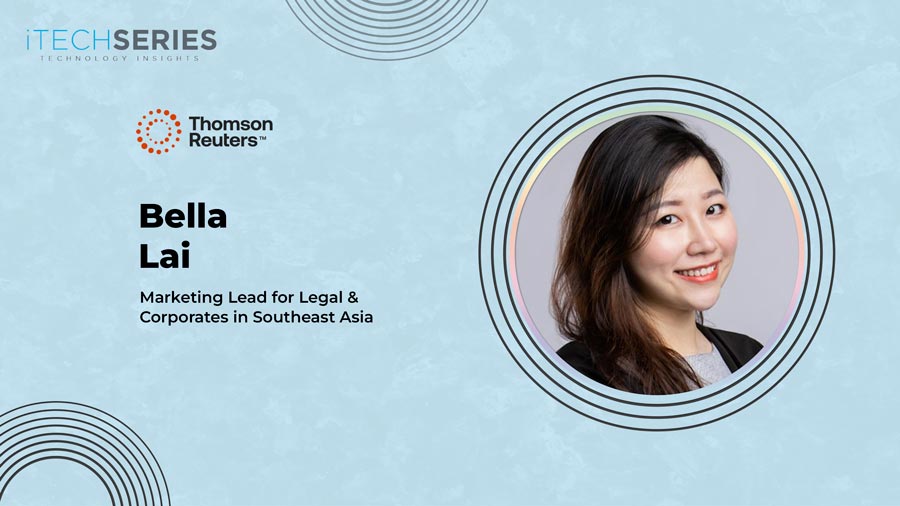
Bella Lai, Marketing Lead for Legal & Corporates in Southeast Asia at Thomson Reuters, shares her journey from conference producer to B2B marketing leader, shaping the full buyer journey across AI and SaaS solutions. She reflects on building confidence-driven marketing, aligning events with broader GTM ecosystems, and balancing brand, performance, and cultural nuance across diverse Asian markets.
Welcome to the interview series, Bella. Could you tell us more about yourself and your journey as a marketer?
Thanks for having me. I currently lead marketing for Southeast Asia at Thomson Reuters, where we work with legal and tax teams on AI and SaaS solutions. Alongside that, I’m also pursuing my MBA at Singapore Management University.
I always say I didn’t “choose” marketing. I kind of grew into it. I started my career as a conference producer. Back then, the job was simple (on paper): fill a room. But I quickly learned that the only way to do that was through the right topic and the right people. That was my first real lesson in marketing. You can’t force attention. You have to earn it.
Over time, I realised events are just one moment in a much bigger customer journey. What really shapes decisions is everything around them. That curiosity about the full journey is what pulled me into marketing. My daily role today is about designing and connecting that entire buyer journey, not just chasing individual touchpoints.
Outside of work, I’m balancing an MBA and raising a very energetic three-year-old. My days are full, but I enjoy the pace. For me, growth only feels uncomfortable when it stops.
What role does event marketing play in an overall brand and growth strategy, especially in B2B industries?
Events are a big bet in B2B. They require real investment and planning, so they’re expected to deliver.
I see events marketing less as lead generators and more as confidence checkpoints in the buyer journey.
They humanise the brand and give buyers a direct experience of your product and credibility. They also surface real insight. What buyers ask, where they hesitate, and what matters most.
But B2B decisions don’t happen in a single interaction. They build overtime across multiple touch-points & stakeholders, much of it outside direct sales.
So events don’t close deals. They create early convictions. The rest of your GTM engine carries the deal forward. Content, proof points, and consistent messaging need to reinforce the same story. In my experience, events influence around 30 to 35 percent of the decision.
That’s why alignment across online and offline matters. Buyers today aren’t short of information. They’re short of confidence proof. So your marketing machine should shift from competing for attention to competing for confidence across every touchpoint.
How do you curate conference content that is both educational for the audience and commercially viable for the business?
It always starts with conversations. Online (secondary) research is fast, but it reflects what is already known. It’s a lagging indicator. The real insight comes from speaking to people who are dealing with the problem day to day.
A good example is the ESG topic. Online, the narrative is dominated by regulations and frameworks. But when we spoke to in-house counsel, the real challenge was operational. Data collection across the supply chain, internal alignment, and limited resources. That gap between theory and reality is where meaningful content surfaces. And that gap is invisible unless you talk to real people.
Audiences today are extremely selective with their time, so relevance has to come first.
And how do you measure your content? In B2B, shareability is one of the clearest signals of value. People only share content when it helps them look informed or prepared. Case studies, practical reports, peer discussions, and webcast videos consistently outperform abstract messaging.
What does effective collaboration between marketing and sales look like in your experience?
For me, good collaboration starts with remembering that marketing and sales are serving the same clients and working toward the same goal.
Collaboration works best when there’s curiosity in both directions. Marketing can understand what happens in a real sales conversation. What questions come up when deals slow down? Sales, in turn, benefits from what marketing sees at scale. Campaign signals, channel performance, and patterns across accounts that aren’t always visible in a one-to-one conversation.
I personally enjoy working closely with sales. Many of my most successful GTM strategies are built from input across all client-facing teams. Sales, pre-sales, customer success, and trainers each see different parts of the customer journey.
Marketing’s role is to connect those insights and scale them. When that collaboration flows well, it’s not just more effective. It’s genuinely enjoyable, because everyone feels aligned and focused on the same goal – delighting the customers.
“Your marketing machine should shift from competing for attention to competing for confidence across every touchpoint.”
When working across different markets in Asia, how do cultural nuances influence your event and marketing strategy?
When you work across Asia, cultural nuance shows up in very practical ways.
The biggest one is clarity. In many markets, English is a second language, so people scan quickly and focus on what’s immediately relevant. People want to know straight away why this matters and how it helps them do their job better.
That’s why what works best here is directness. Clear value. Reliable outcomes. Clear positioning. You don’t need more words. You need solid ones.
Trust and familiarity are the second layer. Buyers pay attention to social proof, peer references, and established brands. In regulated or high-stakes environments, familiarity often outweighs experimentation.
As a result, consistency tends to outperform creativity. Saying the same clear thing well, over time, builds more trust than saying something new once.
How do you balance brand building with performance-driven metrics in your marketing approach?
This is the million-dollar question, and honestly, there’s no perfect formula. Even with the best tools and agencies, it’s almost impossible to track the full B2B funnel end-to-end.
I think of brand and performance as two sides of the same system. Brand defines what you stand for. Performance is how that gets delivered and activated. People often say brand can’t be measured, but in reality, a brand shows up in the organic pipeline, shorter sales cycles, and the spillover effect across channels that performance alone can’t explain.
The risk is over-indexing on short-term performance metrics. That’s where marketing myopia sets in, optimising for short-term results while missing how buyers actually decide. In B2B, trust and validation are built long before conversion.
The right balance depends on the maturity of the business, but as a general rule, I’d aim for at least 30 percent of the total pipeline to come from brand and organic activities.
A simple test I use is this: if performance numbers look strong but organic demand stays flat, the brand isn’t doing enough. Ultimately, strong performance is easier when the brand has already done its job.
How do you leverage the power of AI-enabled tools for your marketing programs?
I see AI as a last-mile accelerator rather than a substitute for thinking. It adds value in two areas. First, execution. It helps us move faster by adapting messages across segments, optimising formats and channels, and scaling what already works. Second, decision-making. It helps marketers process signals faster, spot patterns in performance data, surface audience insights, and make better calls on where to focus.
But the output is only as good as the input. Start with the menu and ingredients, not the tool. AI can help you execute faster, but it cannot replace customer insight, positioning, or judgement. Those ingredients are your unique advantage.
AI tools also need guardrails. I can usually tell when something is entirely AI-generated, and I’m sure audiences can feel that too.
Lastly, the bigger shift is recognising that AI is now part of the audience landscape. It’s not just your buyer researching, but their AI doing the filtering, ranking and evaluation. Marketing needs to adapt. GEO ensures your content is discoverable and credible in those AI-led journeys.
What advice would you give up-and-coming marketers on developing the right skill sets?
Buckle up and enjoy the ride. Marketing is one of the fastest-evolving professions out there, and that’s what makes it exciting. It’s a field that needs both creativity and strong number discipline. You’re constantly testing ideas, learning what works, and letting data guide your next move. You also have to be comfortable challenging your own assumptions and accepting that not every idea will land the first time.
At the same time, don’t lose sight of who you’re building for. Stay close to your ideal customer profile. A campaign that tries to speak to everyone is the campaign that speaks to no one. If you stay curious and anchored in your customer, you’ll always know what to do next, even when the tools change.
About Bella Lai:
Bella Lai is a Marketing Lead, SEA at Thomson Reuters with over 10 years of experience in B2B marketing across the legal and corporate tax and finance sectors. She leads GTM marketing and demand generation for AI and SaaS solutions globally, with a focus on owning and shaping the full buyer journey from market insight to pipeline conversion across Asia. With a background in economics and marketing from Singapore Management University, she has led cross-border campaigns across Asia, working closely with industry experts to address evolving legal and regulatory challenges.