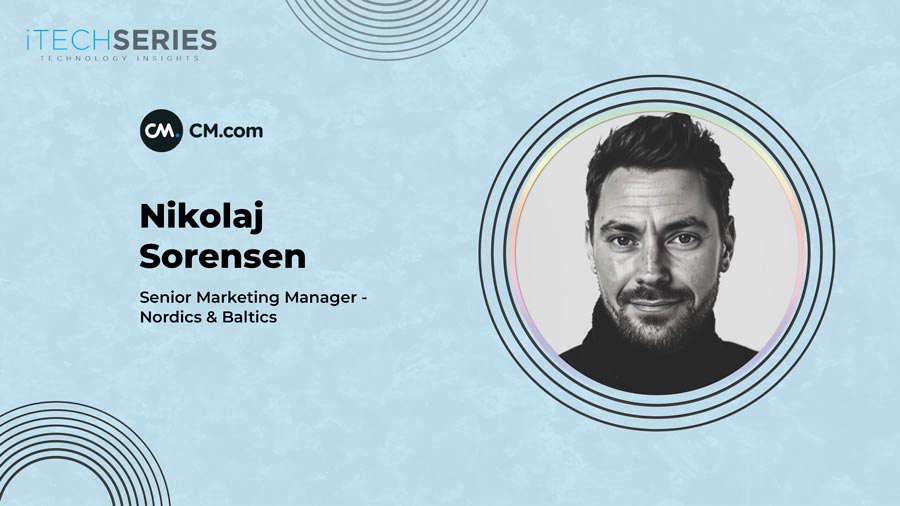
In this interview, Nikolaj Sørensen, Senior Marketing Manager for the Nordics and Baltics at CM.com, shares his journey from traditional B2B marketing execution to owning go-to-market impact. He discusses marketing’s evolving role as part of the commercial engine, the importance of alignment and accountability, and how trust-driven, account-centric GTM drives sustainable growth.
Could you tell us a bit about yourself and your journey as a marketer?
I started out in fairly classic B2B marketing roles, focused on campaigns, channels, and execution. Over time, it became clear to me that activity alone does not move a business forward.
What really changed my approach was getting closer to go-to-market decisions and revenue discussions. Today, I spend less time thinking about individual campaigns and more time on how marketing contributes to pipeline quality, prioritization, and alignment with sales. That shift from execution to impact has shaped how I work.
How has marketing’s role evolved over time, especially within an integrated GTM setup?
Marketing cannot operate as an upstream function anymore. In an integrated GTM setup, marketing is part of the commercial engine, not something that hands work over and steps back.
When marketing, sales, and product work from the same account view and are measured against shared outcomes, GTM becomes much more effective. When that alignment is missing, even strong execution struggles to scale. The real evolution is not about titles or strategy decks. It is about accountability.
What are some of the go–to–market challenges and opportunities in the Nordics region?
The Nordics are digitally mature, but they are also very trust-driven. Buyers are informed, buying groups are small, and expectations are high. That makes relevance and consistency across the entire GTM motion critical.
The opportunity is that when you get it right, relationships last. Account-based thinking is not a nice-to-have in this region. It is often the difference between being considered and being ignored.
Tell us about your most memorable experience as a marketer.
The moments that stand out the most for me are when marketing clearly influenced how the business chose to grow.
I have seen situations where marketing insights helped change which segments we prioritized, how we approached key accounts, and where commercial focus was placed. That had a direct impact on pipeline quality and revenue development, not because we ran more campaigns, but because we made better decisions earlier.
That is when marketing moves beyond execution and becomes a real input to business strategy. For me, that is what meaningful marketing impact looks like.
“Marketing cannot operate as an upstream function anymore. In an integrated GTM setup, marketing is part of the commercial engine, not something that hands work over and steps back.”
How do you balance short-term demand generation and long-term brand awareness?
I think the mistake is framing this as a trade-off. Demand generation without a brand quickly becomes expensive. A brand without demand loses relevance.
What matters is orchestration. Clear ICPs, focused GTM priorities, and consistency across the funnel. When those things are in place, short-term demand and long-term brand support help each other rather than compete, creating sustained momentum, stronger market perception, and more efficient growth over time across key accounts.
Where has AI played the biggest role in your marketing programs?
AI has changed how we think about go-to-market design, not just how we execute marketing.
Instead of building static campaigns and fixed journeys, we increasingly work with adaptive, account-driven setups. The focus shifts from asking which campaign to run next to understanding what the next best action is for a specific account at a given moment.
In practice, that means using AI and automation to prioritize accounts, adjust messaging based on behavior and intent, and keep marketing and sales aligned around the same signals. It leads to fewer generic touchpoints and more coordinated actions that actually support revenue progression.
The biggest shift for me is that AI is no longer just an efficiency layer. It enables a more intelligent GTM model where marketing contributes continuously to revenue, not just lead volume.
How do you build a culture where performance and relationships reinforce each other?
In my experience, performance and relationships only clash when expectations are unclear.
When teams share goals, success metrics, and responsibilities, trust tends to follow. Especially between marketing and sales, clarity is far more important than chemistry. Strong relationships are usually a result of alignment, not something you fix afterwards, and they scale naturally when accountability and communication are consistent over time.
What advice would you give marketers who want to move from campaign execution to owning growth and revenue impact?
Do not wait for permission to take ownership.
Start engaging earlier with sales, take responsibility for outcomes, and measure yourself on pipeline progression and revenue influence, not just activity. That shift in mindset usually comes before any change in title, and it is reinforced by consistently showing impact through better decisions, clearer priorities, and shared accountability.
About Nikolaj Sorensen
Nikolaj Sorensen is a marketing expert who works at the intersection of marketing, technology, and business growth, using data and AI to drive measurable impact. With over 10 years of experience in demand generation, revenue-focused marketing, and go-to-market execution, he has evolved from campaign-led roles to owning pipeline quality, prioritization, and sales alignment. His work focuses on making marketing a true commercial driver through smarter decisions, clearer focus, and accountable growth.