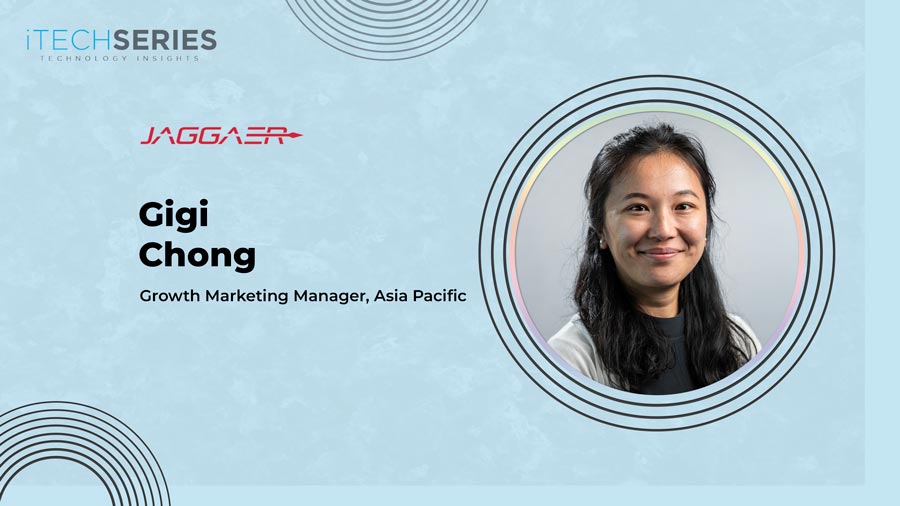
Gigi Chong, Growth Marketing Manager, Asia Pacific at JAGGAER, shares hard-earned lessons from leading growth marketing across APAC’s diverse markets. She explores how marketers can balance global scale with local relevance, align around revenue, build enduring brands, harness AI responsibly, and develop the skills needed to thrive in the evolving world of SaaS marketing.
Welcome to the interview series, Gigi. Could you tell us about yourself and your journey as a marketer?
Thank you for having me! If you’d told me at the start of my career that I’d go from marketing canned soup to marketing AI-powered procurement software, I’m not sure I would have believed you, but that’s exactly the journey I’ve been on, and I wouldn’t change a thing. That winding path has shaped how I think as a marketer and brought me to where I am today.
Today, I’m the Growth Marketing Manager for the Asia Pacific region at JAGGAER, where I lead demand generation and growth initiatives across the region for our AI-powered source-to-pay software.
I actually started in B2C, working in FMCG marketing at Campbell Soup and later in over-the-counter pharmaceuticals, before pivoting into B2B SaaS marketing with a Norwegian data management software company called dRofus. To be honest, I wasn’t sure I’d like the move at first, but it grew on me quickly, and a decade later, I’m still here and genuinely feeling fulfilled by it. Over the years, I’ve worked across demand generation, field marketing, branding and PR communications, digital marketing, and more, spanning markets as varied as Australia, New Zealand, Southeast Asia, and Greater China.
My latest move into procurement technology has been an exciting chapter; it sits at the intersection of finance, procurement, supply chain, and technology, which keeps the work intellectually challenging every single day. But what truly fuels my passion in marketing goes beyond any one industry: it’s the ability to be creative, to stay adaptable, and to keep pace with an industry that never stands still, with new channels, new technologies, and new ways of connecting with people. That’s exactly what keeps me energised after all these years.
You’ve worked extensively across APAC markets. What has been your biggest lesson from managing marketing across diverse regions?
That APAC is not one market; it’s a collection of very different markets that happen to share a time zone block. The biggest lesson I’ve learned is that you cannot simply translate a global campaign and expect it to land and get the same results.
Buying behaviours differ enormously even within this region. In Japan, for example, decisions are consensus-driven, and trust is built over long cycles, so relationship-led tactics and local proof points matter most. In Australia and Singapore, buyers are digitally more mature and respond well to self-serve content and peer reviews. In emerging Southeast Asian markets, education-first marketing often has to come before demand generation, because you’re building category awareness, not just brand preference.
The practical lesson: invest in local insight before you invest in local media. A campaign that performs brilliantly in Sydney can fall completely flat in Seoul, not because the message is wrong, but maybe because the channel, the format, or the cultural framing is. Listening to local sales teams, partners, and customers is the most direct and valuable research you’ll ever do.
As a Growth Marketing Manager, how do you approach building scalable growth strategies while adapting to local market needs?
I think of it as “global engine, local fuel.” The engine, your tech stack, data model, campaign frameworks, lead scoring, and reporting should be standardised and scalable. That’s what allows a lean regional team to operate efficiently across many markets without reinventing the wheel each time.
The fuel messaging, proof points, channels, and timing have to be local. At JAGGAER, our core value proposition around an AI-powered, integrated procurement process is consistent globally, but how we deliver it changes by market. A manufacturing audience in Malaysia cares about direct material sourcing and supplier collaboration; a public sector buyer in Australia cares about compliance, transparency, and value for money.
Three principles guide me: first, build modular campaign design assets and journeys so local teams can swap in regional case studies, languages, and offers without rebuilding from scratch. Second, let data decide where to localise deeply. Not every market justifies full localisation, so I prioritise based on pipeline potential and conversion data. Third, pilot, prove, then scale test a motion in one market; document the playbook and roll it out regionally. True scale comes from building repeatable playbooks, not from forcing every market to look the same.
“The biggest shift is that marketing no longer operates in a silo. The walls between marketing, sales, and customer success have come down, creating a shared revenue engine with shared metrics.”
Where have you seen the biggest shift in marketing’s role with greater alignment between the revenue functions?
The biggest shift is that marketing is no longer a function that works in a silo. The wall between marketing, sales, and customer success has come down, and in its place, we have a shared revenue engine with shared metrics.
Practically, that’s changed three things. First, the metrics conversation: MQLs as a vanity number are dead. The conversations I have with sales leadership now are about pipeline contribution, conversion velocity, and win rates, full-funnel metrics that both teams own together. Second, account-based thinking has become the default in enterprise SaaS. Marketing and sales now plan around the same target account lists, with marketing orchestrating air cover and intent-based engagement while sales works the relationships. Third, marketing’s remit has extended beyond the top of the funnel. In a subscription business, growth comes as much from expansion and retention as from net-new logos, so marketers increasingly partner with customer success on adoption, advocacy, and upsell programmes.
The healthiest revenue teams I’ve worked with don’t talk about “marketing leads” versus “sales leads” at all. They talk about one pipeline, one number, and who’s doing what to move it.
As a marketer, how do you balance the need to drive leads with the brand-building aspects?
I push back gently on the idea that they’re in tension; in fact, I think they are complementary to one another. Strong brand awareness lowers cost per lead, improves conversion rates, and shortens sales cycles, because buyers arrive already trusting you. The famous rule of thumb is that at any moment, around 95% of your market isn’t actively buying. Performance marketing captures the 5% in-market today; brand building ensures you’re on the shortlist when the other 95% enter the market.
In practice, I balance the two in a few ways. I protect a portion of the budget for brand and thought leadership, even in quarters when pipeline pressure is high, cutting brand to fund short-term leads is borrowing from next year’s pipeline. I also look for activities that do both at once: a well-executed industry report, customer story, or executive roundtable builds credibility and generates qualified engagement simultaneously. And I measure brand with leading indicators, branded search volume, direct traffic, share of voice, and win rates against competitors, so brand investment isn’t flying blind.
In a considered-purchase category like procurement technology, where deals involve large committees and long cycles, trust is the real conversion driver. Demand generation delivers the leads, but it’s the brand that amplifies every result you get.
How are AI and automation reshaping growth and demand generation strategies in marketing?
The impact has been profound, and I see it on two fronts: how we market, and what we market.
On the “how”: AI has compressed the cost and time of campaign production dramatically. Content drafting, ad variant testing, audience segmentation, lead scoring, and personalisation at scale are all faster and smarter. The teams winning right now use AI to handle volume and pattern recognition, surfacing intent signals, predicting which accounts are warming up, automating nurture journeys so humans can focus on strategy, creativity, and judgment. The differentiator is no longer who can produce the most content; it’s who has the sharpest insight and the most distinctive point of view, because AI has made generic content essentially free and therefore worthless.
On the “what”: working at JAGGAER gives me a front-row seat to this, because we’re applying AI to procurement itself using intelligent agents to automate sourcing, guide buying decisions, and move organisations toward what we call Autonomous Commerce. Marketing an AI-powered platform during an AI revolution means our buyers are simultaneously excited and skeptical. That raises the bar for us as marketers: we have to demonstrate real outcomes, not just sprinkle “AI” into headlines.
One caution I’d add: automation amplifies whatever you feed it. Automating a weak message just delivers a weak message faster. Strategy and customer understanding still come first.
What advice would you like to share with aspiring marketers looking to build a career in SaaS and growth marketing across APAC?
A few things I wish someone had told me earlier.
First, learn the business, not just the marketing. The marketers who advance fastest in SaaS understand the revenue model, ARR, CAC, retention, expansion, and can speak the language of sales and finance. Sit in on sales calls. Read the win/loss notes. Understand what your product actually does for customers.
Second, become genuinely data-fluent. You don’t need to be a data scientist, but you do need to be comfortable building a funnel analysis, questioning attribution, and defending your budget with numbers. In growth marketing, data fluency is table stakes.
Third, embrace APAC’s diversity as your competitive advantage. Marketers who can operate across cultures, navigate different buying behaviours, and build campaigns that work in Tokyo, Singapore, and Sydney alike are rare and valuable globally, not just regionally. Take the assignments in markets you don’t know yet.
Fourth, build your AI muscle now. Experiment relentlessly with the tools, but invest equally in the things AI can’t replicate: customer empathy, creative judgement, and strategic thinking.
And finally, stay curious and be patient with your path. Careers in this region rarely move in straight lines; mine certainly hasn’t. Every market, every role, and every campaign that didn’t work taught me something I still use today. The learning compounds.
About Gigi Chong
Gigi is a seasoned B2B marketer with over 14 years of experience, including eight years in SaaS marketing across the APAC region. As Growth Marketing Manager at JAGGAER, she leads demand generation and growth initiatives for AI-powered procurement solutions. Her career spans FMCG, pharmaceuticals, and B2B technology, with expertise in GTM strategy, account-based marketing, brand building, and driving growth across diverse international markets.