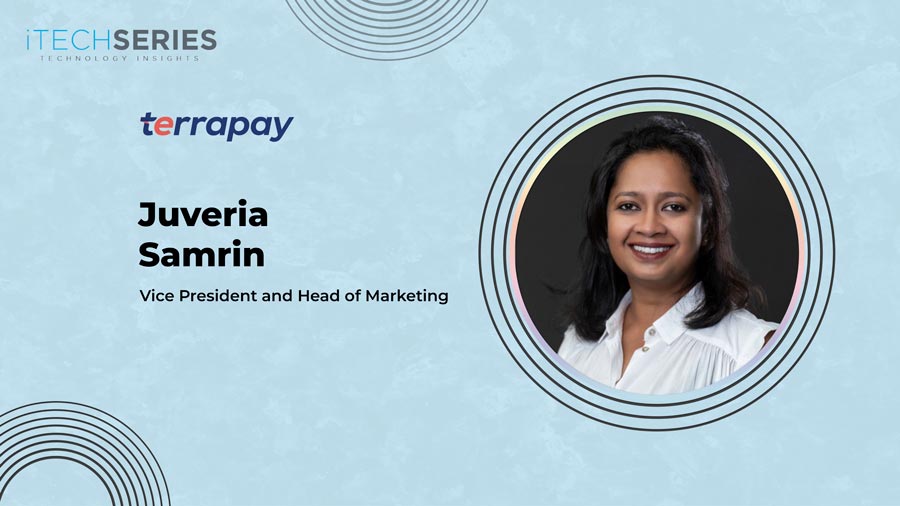
Juveria Samrin, Vice President and Head of Marketing at TerraPay, shares her perspectives on modern marketing leadership, brand building, revenue growth, and global strategy. She discusses aligning marketing with business goals, balancing global consistency with local relevance, measuring success beyond metrics, and why today’s marketers must think like business leaders to drive lasting impact.
Welcome to the interview series, Juveria. Could you tell us about yourself and your journey as a marketer?
I started my career in banking before moving into technology and eventually global payments. Looking back, there’s been a common thread across almost every role I’ve taken; I was usually joining at a point where the marketing function needed to be built or significantly transformed.
That’s probably been the most rewarding part of my journey. Building teams, establishing processes, creating demand engines, defining positioning, and helping businesses find their voice as they scale. I enjoy bringing structure to ambiguity and helping organisations mature their marketing capability in a way that’s closely aligned with business growth.
I was also fortunate to begin my leadership journey just as the marketing technology ecosystem was taking off. It was an exciting time because marketing was becoming measurable in entirely new ways. I loved experimenting with technology, data, and automation, not because they were new, but because they fundamentally changed how marketing could contribute to commercial outcomes.
Today, I lead global marketing at TerraPay, a company that enables cross-border money movement across banks, wallets, and financial institutions worldwide. Marketing here goes far beyond demand generation. Alongside supporting revenue, a significant part of our work involves category creation, helping shape conversations around interoperability, connected financial ecosystems, and the future of global payments. That’s perhaps what I enjoy most: when marketing isn’t simply communicating a market but helping define one.
Looking back, I realise I was also incredibly fortunate with the leaders I worked for. Each of them left me with something different: discipline, the ability to think and write clearly, a deep curiosity about customers, empathy, and the understanding that marketing ultimately exists to solve business problems. Those lessons have shaped my career far more than any title or campaign, and they are values I now try to pass on to my own teams.
In your experience, how has marketing’s role evolved over the last 10-15 years?
Marketing has become significantly more commercial than it was when I started.
There was a time when sales and marketing largely operated as separate functions. Today, the best organisations are almost maniacal about understanding the customer, and that naturally brings the two teams much closer together. Marketing doesn’t stop at generating awareness or leads; it contributes to customer understanding, revenue growth, product positioning, and long-term business strategy.
Leadership within marketing has evolved just as much. Today’s marketing leaders are expected to understand finance, operations, technology, product, and commercial strategy, not just communications. Increasingly, marketing leaders are expected to make business decisions, not just marketing decisions.
One area I still think many organisations underestimate, particularly in B2B, is brand.
In consumer businesses, the value of a brand is immediately visible. In B2B, it’s often treated as a secondary investment because buying decisions appear rational and measurable. But when customers are making multi-million-dollar technology or infrastructure decisions, they’re buying confidence as much as capability. A strong brand earns trust before the first meeting, shortens buying cycles, improves conversion, and opens doors that performance marketing alone simply can’t.
In B2B, brand isn’t the opposite of revenue marketing; it is one of its biggest multipliers.
When operating globally, how do you determine what parts of a marketing strategy should be aligned globally versus what should be customised locally?
Working at TerraPay has probably given me one of the best classrooms for this.
We operate across some of the world’s most diverse payments ecosystems, from Africa and the Middle East to Europe, Asia, and Latin America. Every market differs in regulations, customer maturity, competitive dynamics, and even how financial services are discussed. That makes global marketing both exciting and wonderfully chaotic.
Our positioning, visual identity, and core narrative always remain consistent because customers should recognise the same TerraPay wherever they encounter us. Consistency builds trust, especially in financial services where credibility is critical.
Where localisation becomes essential is in execution.
A good example is our Banking(x)change roadshow. The overarching objective remains the same everywhere: bringing banks together to discuss the future of cross-border payments. But the conversations are very different depending on the market. In Kenya, discussions naturally revolve around financial inclusion and mobile money interoperability. In Vietnam, they focus on real-time payments, ISO 20022, and international trade. In the Middle East, liquidity, compliance, and correspondent banking become much bigger themes.
The event remains recognisably TerraPay, but every discussion feels local because it addresses the realities of that market. That’s the balance every global brand should strive for: one consistent identity, delivered through locally relevant conversations.
What signals matter most when deciding a lead is ready to move from marketing to sales?
Data is absolutely the foundation.
Lead scoring, engagement history, buying intent, firmographics, and behavioral signals all help us understand where someone is in their buying journey. Marketing’s responsibility is to create the right sequence of interactions so prospects become increasingly informed, engaged, and confident over time. That’s where modern marketing technology has made an enormous difference.
But moving a lead from marketing to sales requires another layer of judgment.
At that stage, it becomes less about activity and more about intent.
Is there a genuine business problem to solve? Are multiple stakeholders involved? Has the prospect demonstrated enough trust in the brand to have a meaningful commercial conversation? Is there a relationship beginning to form?
Enterprise buying is still fundamentally human. Data tells us when to start the conversation, but people determine whether the conversation goes anywhere.
The strongest organisations don’t see marketing qualification and sales qualification as separate milestones. They see them as a continuum where data provides confidence and human judgment provides context.
“Successful marketing leaves an organisation in a better position than it found it. It doesn’t just create activity; it creates lasting business value.”
Could you tell us about your most memorable experience as a marketer?
One of the most rewarding parts of my career has been seeing marketing move beyond campaigns and become part of how a company is remembered.
As marketers, we often measure success through launches, leads, or awards. Those are important, but I’ve come to believe that the real goal is consistency. Great brands aren’t built through one brilliant campaign; they’re built through hundreds of interactions that reinforce the same promise over time.
One experience that really reinforced this for me was at one of TerraPay’s flagship industry events. During his keynote, an industry leader described the experience as being “typically TerraPay”. He was referring to the hospitality, the attention to detail, and the personalised experience we had created.
It was a simple phrase, but it meant a great deal because it reflected consistency rather than creativity. It showed that people had begun to associate a certain standard and experience with our brand.
Campaigns are temporary, but reputation compounds.
That, to me, is one of marketing’s highest goals, not just to create awareness, but to shape expectations. When customers, partners, and the industry begin to recognise your brand through its values, experiences, and consistency, you’ve created something that lasts far beyond a campaign.
As a marketing leader, how do you assess the success of a marketing program beyond the standard metrics?
Metrics will always matter; they tell us whether a programme is performing. But they rarely tell us whether it is making the business stronger.
Beyond the dashboard, I usually ask a different set of questions.
Has this made sales conversations easier? Has it changed how customers perceive us? Are analysts, partners, or customers beginning to use our language when they describe the business? Has it strengthened confidence internally, giving our sales teams a clearer story to tell? Most importantly, has it created momentum that continues after the campaign has ended?
Some of the most valuable outcomes in marketing don’t appear immediately in attribution reports. They show up months later in stronger partnerships, shorter sales cycles, improved customer trust, or increased executive credibility.
For me, successful marketing leaves an organisation in a better position than it found it. It doesn’t just create activity; it creates lasting business value.
What would be your advice to marketers looking to step into leadership roles?
My biggest piece of advice is to stop thinking of yourself as “the marketing person” and start thinking like a business leader.
Spend time with sales. Sit with product teams. Learn finance. Understand your company’s commercial model. Listen to customer conversations. The broader your understanding of the business, the better your marketing decisions become.
I’d also encourage marketers to stay curious. Our industry is evolving faster than ever, whether it’s AI, changing buyer behaviour or new technologies. The best leaders don’t try to have all the answers; they build the habit of continuously learning and adapting.
Finally, remember that leadership is less about having the best ideas and more about creating an environment where great ideas can thrive. Some of the best marketing leaders I’ve worked with weren’t necessarily the most creative people in the room; they were the ones who built strong teams, encouraged healthy debate, and gave others the confidence to do their best work.
Marketing may be the function we lead, but our real responsibility is helping the business grow. The sooner marketers start thinking that way, the stronger leaders they’ll become.
About Juveria Samrin
Juveria Samrin is a marketing leader with over 20 years of experience driving global go-to-market strategies across fintech, enterprise technology, and cybersecurity. She specializes in ecosystem-driven growth, category creation, and translating complex financial infrastructure into compelling market narratives. At TerraPay, she built the global marketing function and led strategic initiatives supporting revenue growth and cross-border payments. She also advises startups on marketing strategy and go-to-market execution.