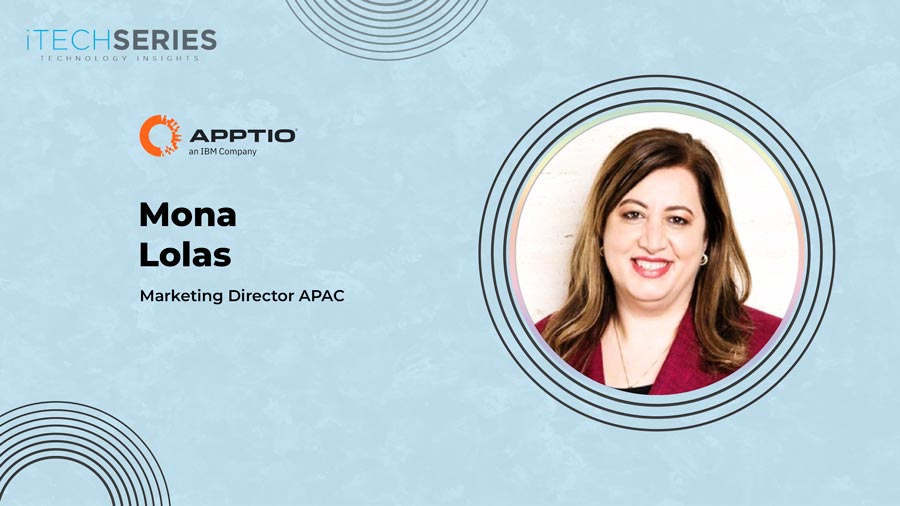
In this edition of the interview, Mona Lolas, Marketing Director APAC at Apptio, an IBM company, shares her insights on building GTM strategies that drive growth. She discusses segment-specific approaches, customer-centric revenue models, balancing brand and pipeline, leading regional transformation, and leveraging AI while preserving human judgment and creativity.
Welcome to the interview series, Mona. Could you tell us about yourself and your journey as a marketer?
My journey as a marketing and sales leader has been shaped by more than 25 years working across high-tech, SaaS, research, channel ecosystems, and enterprise transformation across APAC and global markets.
Starting close to the customer shaped everything. Early in my career, I was embedded with sales teams, partners, and customer-facing functions, which gave me a commercial foundation that I’ve never moved away from. That proximity forced me to think about marketing not as a creative function but as a growth engine.
Over time, I moved into regional and global leadership roles with companies including Gartner, Autodesk, Symantec, and IBM/Apptio and through advisory work with growth-stage and enterprise businesses across APAC. What remained consistent through all of it was a focus on growth that is both strategic and executable, not one or the other.
Today, my work sits at the intersection of go-to-market strategy, demand generation, customer lifecycle growth, partner ecosystems, and revenue enablement. I’m also a current Board Director with ICON APAC and a former Board Director of the Australian Marketing Institute, which has reinforced something I feel strongly about: marketing is no longer just about campaigns. It’s about commercial clarity, customer understanding, and the ability to lead organisations through change.
What key considerations should organisations keep in mind when developing GTM strategies for enterprise, midmarket, and SMB markets?
The biggest mistake I see organisations make is assuming one go-to-market model can serve every segment. It simply can’t, and yet so many teams try to stretch a single motion across enterprise, midmarket, and SMB, then wonder why it’s not landing. These customers have very different buying behaviours, decision cycles, and expectations. What works for one will frustrate another.
For an enterprise, you need to be deeply account-led. That means executive alignment, disciplined prioritisation, multi-threaded engagement across stakeholders, and a genuine long-term view of value creation. Enterprise buyers aren’t just evaluating your product; they’re evaluating whether they can trust you with their business. Confidence and risk reduction matter as much as capability.
In the midmarket, speed and relevance become your priorities. These customers want enterprise-grade outcomes but without all the complexity that comes with it. The GTM motion needs to be scalable but still personalised enough to speak to their specific pain points. That’s where strong segmentation, use-case messaging, and lifecycle nurture really do the heavy lifting.
For SMB, it comes down to simplicity. The value proposition has to be immediately clear, the buying journey has to be frictionless, and digital, product-led, or inside-sales motions need to be doing most of the work.
But honestly, the thing that ties all three together is alignment. Marketing, sales, customer success, product, and partners all need to be on the same page about who you’re going after, what the buying journey looks like, where the handoffs happen, and what success means. A GTM strategy only works when it’s actually operationalised, not when it’s sitting in a slide deck waiting to be discovered.
In an era of evolving customer expectations, what does true customer centricity look like for modern SaaS businesses?
It means designing the business around the customer’s lifecycle, not just the acquisition funnel. And that distinction matters enormously.
True customer centricity starts before the first conversation. It means understanding a customer’s industry pressures, buying triggers, internal decision dynamics, and desired business outcomes. It also means being honest with the customer and internally about where your solution creates real value and where it doesn’t.
The most customer-centric SaaS businesses I’ve seen are aligned across marketing, sales, customer success, product, and finance. They understand that growth doesn’t stop at acquisition. Retention, expansion, adoption, advocacy, and renewal are all part of the revenue engine, and they’re treated as such.
In practical terms, that means using data to identify risk and opportunity early, building stronger executive relationships, creating content that serves every stage of the customer journey, and ensuring customer feedback actually influences product and GTM decisions.
It also means consistency. Customers shouldn’t feel like they’re dealing with a different company at every stage of their journey. The promise made in marketing needs to hold through the sales conversation, the onboarding experience, and the ongoing value delivered. When it doesn’t, you feel it in your retention numbers.
Could you tell us about your most challenging yet successful go-to-market experience and the lessons it taught you?
One of the most demanding and ultimately rewarding experiences was leading regional marketing transformation across APAC, where the challenge was translating global strategy into meaningful local execution.
APAC is never one market. Australia, Singapore, India, China, Japan, Korea, and Southeast Asia all have different maturity levels, buying behaviours, channel dynamics, and customer expectations. A playbook built for one doesn’t travel cleanly to the others.
The work involved realigning marketing more closely with sales, sharpening account focus, and building programs that could support regional growth while still addressing local market realities. That meant moving away from activity-based marketing, where volume and output become proxies for impact, toward a more focused, account- and outcome-led approach. Better segmentation, stronger alignment with sales priorities, cleaner campaign architecture, better data, and more disciplined measurement.
It also required genuine change management. Bringing teams with you. Creating confidence. Making strategy feel actionable in the field rather than abstract at headquarters.
The lesson that stuck: GTM success is rarely about one campaign or one big launch. It’s about alignment, focus, execution discipline, and the ability to adapt without losing the thread of the strategy. And local insight is non-negotiable. A global playbook is a starting point, not a solution.
“A GTM strategy only works when it’s actually operationalised, not when it’s sitting in a slide deck waiting to be discovered.”
How can marketers strike the right balance between driving immediate pipeline results and investing in long-term brand building?
Marketers need to stop treating the pipeline and brand as competing priorities. They are connected. A strong brand creates trust, credibility, and preference, which makes demand generation more effective. At the same time, pipeline activity provides market feedback that can sharpen brand positioning.
The balance starts with understanding time horizons. Some programs are designed to create immediate opportunity; others build awareness, executive trust, or market authority over a longer arc. Both need to be measured, but not by the same KPIs.
For an immediate pipeline: clear segmentation, strong offers, sales alignment, intent signals, conversion pathways, and disciplined follow-up. For the brand: thought leadership, customer stories, analyst and influencer engagement, community, events, and consistent messaging over time.
The best marketing teams build an integrated system. They create a narrative in the market, activate demand around that narrative, enable sales to carry the conversation, and use customer proof to continuously strengthen the brand. Short-term pipeline keeps the business moving. Brand creates the conditions for sustainable growth. You need both, and they work best when they’re designed to reinforce each other.
With AI now embedded across marketing, how can leaders scale performance while protecting human insight, creativity, and judgment?
AI is reshaping marketing in ways that are hard to overstate, but the conversation needs more nuance. The most important thing I’d say to any marketing leader is this: AI is a tool. A powerful one, but still a tool. It doesn’t replace human judgment, and organisations treating it as a strategy rather than an enabler will eventually feel that gap. AI genuinely earns its place by removing the friction that slows teams down, whether that’s research, content development, data analysis, campaign optimisation, or repetitive aspects of sales enablement. Done well, it frees people to focus on work that requires human presence: strategy, customer empathy, brand voice, and commercial judgment. Those things still need a person in the room.
We’re already seeing AI agents manage parts of the demand generation workflow, monitoring intent signals, triggering nurture sequences, and routing leads based on behavior. That’s useful. But the moment an agent starts making decisions about how your brand shows up in conversations with senior buyers, without human guardrails, you’ve gone too far. The same applies to campaign execution. Agents can now plan, build, and optimise campaigns with minimal input. The efficiency gains are real, but efficiency without strategic direction simply means doing the wrong things faster. Someone still has to decide what story you’re telling and why it matters to a specific customer.
The biggest risk is using AI to produce more—more content, more campaigns, more output—without asking whether any of it is more valuable. Volume was never the goal. Relevance is, and setting that standard is a leadership responsibility. What often gets lost is the need to protect the skills that make marketing effective: curiosity, critical thinking, creativity, storytelling, and understanding customer needs. AI should amplify those capabilities, not erode them. Otherwise, we risk creating marketing that is faster and cheaper, but ultimately less human, less relevant, and less effective.
What would be your advice to up-and-coming marketers on developing the right skills and mindset?
My biggest piece of advice is to build both depth and range. Learn the craft of marketing well, but don’t stop there. Understand the commercial engine around it. Know how sales work. Understand what customer success actually does. Learn how revenue is created, measured, retained, and expanded. The marketers who move fast are the ones who can connect strategy to execution and speak the language of the whole business.
That last part matters more than most people realise early in their careers. Take the time to understand how the rest of the organisation measures success, how finance thinks, how the board talks about growth, and what operations care about. Don’t get so caught up in marketing metrics that you lose sight of the business metrics. Impressions and MQLs mean very little if you can’t connect them to pipeline, revenue, and retention. The marketers who earn a seat at the table are the ones who can have that conversation fluently.
Get comfortable with data, technology, and AI, but not at the expense of creativity and genuine customer understanding. The strongest marketers I’ve seen aren’t purely technical or purely creative. They’re commercially curious, and that combination is rarer than it should be.
Develop your leadership mindset early, too. Leadership isn’t about title. It’s about how you influence, how you communicate, how you solve problems, and how you bring others with you, regardless of where you sit in the org chart.
And through all of it, stay close to the customer. Marketing will keep evolving; the tools, the channels, and the technology will all change. But curiosity, strong relationships, and a genuine understanding of what customers are trying to achieve will always be valuable. No amount of automation changes that.
About Mona Lolas:
Mona Lolas is a growth-focused marketing and sales leader with more than 25 years of experience driving commercial success across APAC. She has held senior leadership roles at Forrester, Autodesk, Optus, Symantec, IBM, and Gartner, leading go-to-market strategy, market expansion, and cross-functional transformation. A Board Director at ICON APAC, Mona is also a global speaker and mentor passionate about customer-centric innovation, values-led leadership, and empowering women in STEM.