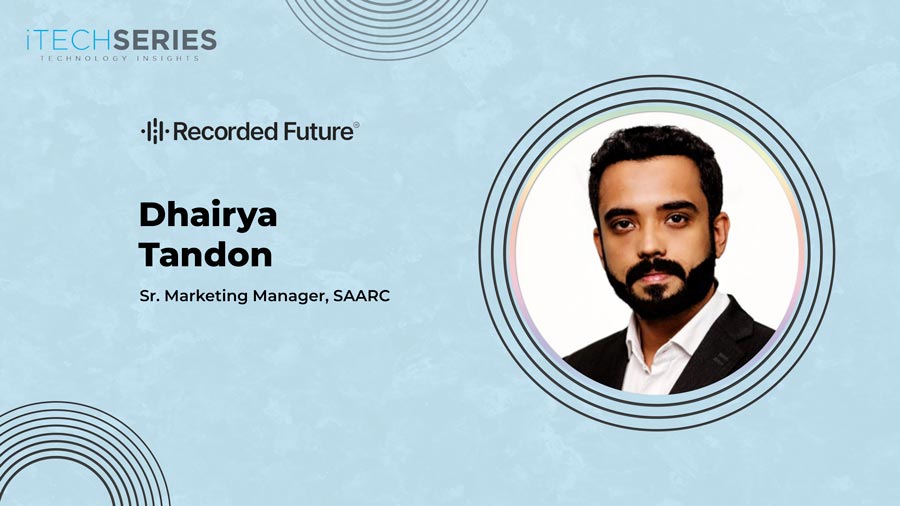
Dhairya Tandon, Sr. Marketing Manager, SAARC at Recorded Future, shares valuable insights on building pipeline-focused GTM strategies across diverse and evolving markets. He explores the evolution of field and demand generation, regional campaign execution, marketing-sales alignment, data-driven measurement, and AI’s growing role in helping marketers make smarter, more impactful business decisions.
Welcome to the interview series, Dhairya. Could you please tell us about yourself and your marketing journey?
Thank you for giving me the opportunity to be a part of this interview series.
I have spent close to a decade in B2B tech marketing, mostly in field and demand generation roles across APAC and SAARC in organizations like Gartner, SHL, Denodo, Recorded Future, and Mastercard. My journey started right after my MBA in Marketing, when I moved into pre-sales and marketing; that’s really where I learned how sales and marketing need to work as one engine, not two separate functions. Watching how a lead moves from a conversation at an event to an actual deal in the pipeline taught me early on that marketing isn’t just about creating awareness; it’s about creating momentum that sales can actually act on.
Over the years, that’s taken me across different markets and industries, working on everything from large-scale roadshows and roundtables to partner marketing, ABM programs, and flagship customer events. Each region has its own rhythm, and I have genuinely enjoyed adapting strategies to local markets while still trying everything back to a global GTM narrative.
One of the things I enjoy most about marketing is that it gets you to interact with people, business, and technology all at once. No two days look the same. One day you are deep in a budget conversation, the next you are on stage at an event, and the day after that you are sitting with a CXO trying to understand what actually matters to them.
But honestly, the thing I care most about is building marketing programs that sales teams actually want to use, not just programs that look good on paper. Because at the end of the day, the pipeline is the real scorecard, and if what we build doesn’t help sales close deals, it hasn’t done its job.
What major shifts have you seen in B2B marketing strategies with the rise of digital channels and automation?
The biggest shift, I’d say, is the move from broadcast marketing to intent-based marketing. Earlier, we would send the same email campaign to an entire database and hope for the best. Now, with platforms like Eloqua, Marketo, and HubSpot, we can track intent signals, behavior, and engagement, and personalize outreach at a level that just wasn’t possible before. Marketing has become far more data-driven. Every campaign is now tied back to pipeline and ROI in a way that’s tracked in real time through SFDC.
Channel fragmentation—a decade ago, email and events were basically it. Now you are managing social media, paid digital, ABM platforms, partner marketing, and community-led channels all at once, and the real skill isn’t running any one of them well; it’s orchestrating all of them so they tell one consistent story to the buyer.
And finally, automation has changed the role of the marketer. We’re spending less time on manual execution and more time on strategy, segmentation, and interpreting data. Ironically, even though everything is more automated, the human judgment of knowing which account to prioritize and which message will actually land with a CISO or a CXO matters more than ever.
How have your field marketing experiences across India and South Africa influenced the way you plan and execute regional campaigns?
Working across regions as different as India and South Africa taught me something early on: you simply cannot run a ‘one-size-fits-all’ campaign and expect it to land the same way everywhere. At SHL, I was responsible for field marketing across India and South Africa, and even within that mandate, the differences were stark. India is a high-volume, price-sensitive market where digital campaigns and webinars and in-person engagement generate strong traction. South Africa, on the other hand, still leans heavily on relationship-led, in-person engagement; trust is built face-to-face before a deal moves forward.
The first thing I do is localize the GTM strategy, not just the messaging. It’s not enough to translate an email or tweak a subject line. You have to understand the buying behavior, budget cycles, and even cultural nuances of decision-making in each market. A CXO in Mumbai and a CXO in Pretoria might have the same title, but their priorities, procurement processes, and even how they prefer to be engaged can be completely different.
Partner and vendor ecosystems: In markets like South Africa, third-party vendor relationships and local partner marketing often matter more than direct brand campaigns, because trust is intermediated through local players. That’s very different from India, where direct engagement and brand visibility tend to drive more traction.
What strategies have you found effective for connecting event marketing with broader demand generation and pipeline goals?
This is something I have refined over the years, because early in my career, events and demand generation were treated almost as separate work streams; events were about visibility and brand, while pipeline generation was a ‘sales’ problem. I have come to believe that’s the wrong way to think about it. Every event should be designed as a demand generation engine from the start, not just a brand activity that we hope produces leads as a side effect.
The first strategy that’s worked consistently for me is building pipeline intent into the event design itself. Before we even plan the agenda or the venue, we ask: who are we trying to reach, what stage of the funnel are they in, and what’s the next action we want them to take? Whether it’s a large flagship conference or a smaller roundtable, I make sure the format matches the intent. Roundtables and roadshows are great for warming up mid-funnel accounts through direct conversation, while larger conferences work better for top-of-funnel visibility and brand credibility.
The second is tight integration between events and CRM/marketing automation. Every event I run is tied directly into SFDC and platforms like Eloqua or Marketo from day one; registration, attendance, engagement, and follow-up are all tracked as part of a single campaign record. This lets us measure ROI against pipeline, not just against attendee counts or leads captured. A well-attended event that doesn’t convert into a tracked pipeline isn’t a success in my book, no matter how good the feedback was.
The third is BDR and pre-sales alignment before, during, and after the event. And finally, I always go back and close the loop on ROI. At the end of every quarter, I look at which events actually contributed to pipeline and revenue and use that to reallocate the budget for the next cycle.
“The pipeline is the real scorecard, and if what we build doesn’t help sales close deals, it hasn’t done its job.”
How do you align marketing and sales teams when executing integrated campaigns across multiple markets?
Alignment between marketing and sales is something I have had to actively build in every role, because left unmanaged, the two functions naturally drift apart; sales wants leads now, marketing wants to nurture properly, and without a shared framework, that tension just creates friction instead of results.
The thing I have found effective is establishing shared metrics from day one and involving sales and BDR teams early in campaign planning, not just at handoff. Whether it’s a regional roadshow or an integrated digital campaign, sales and marketing need to agree on what ‘success’ actually looks like before a campaign launches—not MQLs in isolation, but qualified pipeline and revenue contribution. At Recorded Future and Denodo, every campaign I build in SFDC is tracked against pipeline generated, not just leads captured, and that shared scoreboard removes a lot of the ‘marketing brought bad leads versus sales didn’t follow up’ arguments before they even start.
Which metrics do you use to assess the impact of marketing campaigns on pipeline generation and business outcomes?
Top-of-funnel engagement metrics, followed by pipeline-specific metrics, followed by conversations across the funnel, and finally cost per opportunity and ROI: things like event attendance, webinar registrations, email open and click-through rates, and social engagement. These matter, but only as leading indicators. I never treat them as success metrics on their own; they are just signals that tell us whether the campaign is generating enough initial interest to work with. The real measure comes from understanding how those signals translate into qualified conversations, pipeline progression, revenue contribution, and ultimately measurable business outcomes.
How has AI impacted the planning and execution of your marketing programs?
On the planning side, AI has made audience segmentation and targeting far more precise. Platforms like Marketo and Eloqua now layer in predictive scoring, so instead of manually guessing which accounts are sales-ready, we get AI-driven signals on intent and engagement that help prioritize where to focus limited budget and BDR time.
On content and execution, AI has compressed timelines dramatically. Copywriting, first drafts of campaign messaging, and even structuring webinar content or event follow-up sequences—a lot of that ideation now happens in a fraction of the time it used to. Overall, I would say AI hasn’t replaced the core skills of field marketing; it’s raised the floor. The baseline execution is faster and smarter, which means the real differentiator now is strategic thinking, market intuition, and relationship management—the things AI still can’t do for you.
About Dhairya Tandon:
With nearly a decade of experience in field marketing and marketing automation, Dhairya Tandon specializes in ABM, demand generation, CRM, email marketing, digital campaigns, and virtual events. He brings expertise across platforms, including HubSpot, Marketo, Eloqua, Salesforce, and Mailchimp, leading campaigns from strategy and execution through reporting. His strengths in database segmentation, campaign optimization, customer engagement, and cross-functional collaboration enable him to build scalable, data-driven marketing programs that deliver meaningful business outcomes.