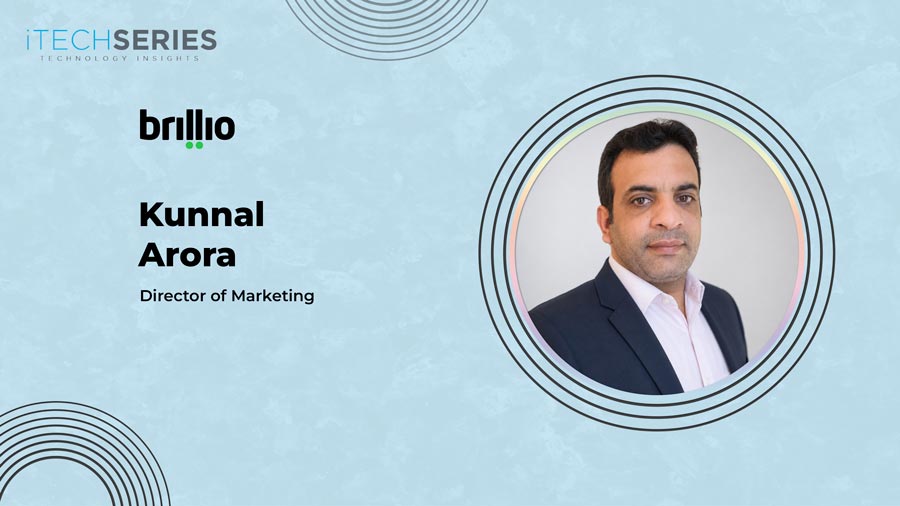
In this edition of the interview series, Kunnal Arora, Director of Marketing at Brillio, shares his perspectives on transforming marketing into a strategic growth engine. He discusses account-based marketing, go-to-market execution, sales alignment, AI-driven decision-making, customer expansion, and the leadership qualities modern marketers need to drive measurable business outcomes.
Welcome to the interview series, Kunnal. Could you tell us about yourself and your journey as a marketer?
Thank you. It’s a pleasure to be part of the iTech Series.
I’ve spent over one and a half decades helping technology organizations transform marketing into a strategic driver of business growth. During this time, I’ve seen marketing evolve from being viewed primarily as a brand and communications function to becoming a critical lever for revenue generation, market expansion, and competitive differentiation.
Throughout my career, I’ve had the opportunity to lead initiatives across product marketing, demand generation, field marketing, account-based marketing, go-to-market strategy, and marketing technology. That breadth of experience has reinforced one belief: the most effective marketing organizations are those that align every investment, every campaign, and every customer interaction with measurable business outcomes.
Today, as Director of Marketing at Brillio, I lead our global Field Marketing, Account-Based Marketing, and Marketing Technology strategy. I partner closely with sales, business leaders, and executive stakeholders to accelerate revenue growth, expand strategic accounts, strengthen our presence in priority markets, and maximize the commercial impact of marketing investments. My role is centered on shaping growth strategy, influencing enterprise buying decisions, and ensuring marketing catalyzes business performance.
I’ve always believed that marketing belongs at the center of business strategy. The role of a modern marketing leader extends far beyond building brand awareness. It’s about creating demand, influencing customer decisions, accelerating growth, and delivering measurable value to the business. That’s the philosophy that has guided my career.
Having built global ABM programs, which factors are most critical to creating meaningful engagement within strategic accounts?
The biggest misconception about Account-Based Marketing is that it’s a marketing initiative. It isn’t. It’s a business growth strategy.
Enterprise customers don’t buy because they receive better campaigns. They buy from organizations that demonstrate a deep understanding of their business, their industry, and the outcomes they’re trying to achieve.
Meaningful engagement begins with identifying the right strategic accounts and aligning marketing, sales, customer success, and business leadership around a shared account strategy. From there, it’s about developing deep account intelligence, understanding buying committees, identifying executive priorities, and delivering highly personalized engagement across every stage of the customer journey.
Technology and AI have made personalization scalable, but they haven’t changed what matters most. Trust, credibility, and relevance remain the foundation of every successful enterprise relationship.
Organizations also need to redefine how they measure success. Instead of focusing solely on marketing metrics, they should evaluate commercial outcomes such as account penetration, executive engagement, pipeline acceleration, customer expansion, and revenue contribution. That’s where ABM creates sustainable business value.
When entering priority growth markets, which go-to-market principles help accelerate adoption and pipeline creation?
Every market has its own customer expectations, competitive landscape, cultural nuances, and buying behaviors. One of the biggest mistakes organizations make is assuming that success in one market automatically translates into another.
Successful market expansion starts with understanding the market before trying to influence it.
Organizations need a compelling value proposition supported by localized execution, strong partner ecosystems, and close collaboration across marketing, sales, customer success, and business leadership. Sustainable growth happens when every commercial function is aligned around a common vision and shared business objectives.
Agility is equally important. Customer expectations evolve continuously, competitive landscapes shift rapidly, and organizations need the ability to adapt their messaging, investments, and execution based on real-time market insights.
The companies that consistently outperform aren’t necessarily those with the largest budgets. They’re the ones that understand their customers better, move faster, and execute with greater precision.
Marketing teams today have access to more data than ever before. Which insights best guide campaign and budget optimization?
The challenge today isn’t access to data. It’s knowing which insights actually influence business decisions.
Marketing leaders need to move beyond measuring activity and instead focus on indicators that predict commercial outcomes.
I look at the complete revenue journey, from buying intent and account engagement to pipeline quality, conversion velocity, customer acquisition cost, customer lifetime value, expansion opportunities, and revenue influence. These metrics provide a far more meaningful view of marketing performance than traditional activity-based measures.
AI and advanced analytics have fundamentally transformed how marketing operates. Today, we can predict buying behavior, identify whitespace opportunities, optimize investments, and improve customer experiences with far greater precision than ever before.
That said, data should strengthen decision-making, not replace leadership. Analytics provide evidence, but strategy comes from understanding customers, markets, and long-term business priorities.
“The biggest misconception about Account-Based Marketing is that it’s a marketing initiative. It isn’t. It’s a business growth strategy.”
Which practices most effectively drive sales and marketing alignment and shared revenue accountability?
Revenue growth has never been the responsibility of a single function.
The highest-performing organizations don’t think in terms of sales alignment or marketing alignment. They think in terms of commercial alignment.
That begins with shared objectives, common performance metrics, transparent visibility into the pipeline, and joint ownership of business outcomes. When every commercial function is accountable for pipeline quality, customer growth, and revenue contribution, collaboration becomes far more effective.
Equally important is maintaining proximity to customers. Marketing leaders should spend time understanding customer conversations, participating in strategic account discussions, and working alongside sales teams. The strongest strategies are built on customer insight rather than internal assumptions.
Ultimately, alignment isn’t about governance or process. It’s about creating a culture where every team is working toward the same commercial outcome.
As important as new customer acquisition, which strategies best drive growth within existing accounts?
One of the greatest growth opportunities for any enterprise already exists within its customer base.
Winning a customer is only the beginning. Long-term success comes from continuously creating value, strengthening relationships, and helping customers achieve new business outcomes.
Marketing has a significant role to play throughout the customer lifecycle. By working closely with sales and customer success, marketing can identify expansion opportunities, strengthen executive relationships, deliver industry insights, create thought leadership, and enable highly personalized engagement that supports long-term account growth.
The organizations that consistently outperform understand that customer expansion isn’t driven by selling more. It’s driven by creating greater value.
When customers view you as a strategic partner instead of a technology provider, growth becomes a natural outcome of the relationship.
You’ve built and mentored diverse marketing teams. Which qualities do you believe define high-performing modern marketers?
Marketing has become one of the most strategic functions within any organization.
Today’s marketers need to combine commercial acumen, customer empathy, analytical thinking, technological fluency, and creativity. Success is no longer defined by the ability to execute campaigns. It’s defined by the ability to solve business problems and influence growth.
As AI continues to reshape the industry, technical capabilities will become increasingly important. However, I believe the qualities that will continue to differentiate exceptional marketers are curiosity, adaptability, strategic thinking, collaboration, and a relentless focus on customer value.
I’ve always encouraged my teams to think beyond marketing. Understand the business model. Learn how customers create value. Spend time with sales. Study industries. Follow market trends. The more marketers understand the commercial realities of the business, the more influential they become.
The future belongs to marketers who can combine technology with strategic thinking, translate data into business decisions, and connect every marketing investment to measurable commercial outcomes.
Marketing has earned its place at the leadership table. The next generation of marketing leaders will not simply tell the brand story. They will shape business strategy, influence enterprise decisions, and become indispensable drivers of sustainable growth.
About Kunnal Arora
Kunnal Arora is Director of Marketing at Brillio, where he leads the company’s global Field Marketing, Account-Based Marketing (ABM), and Marketing Technology strategy. With over 18 years of experience in B2B technology marketing, he specializes in driving revenue growth through integrated go-to-market strategies, strategic account expansion, and data-driven marketing transformation.
A strategic marketing leader, Kunnal partners with executive leadership and sales to align marketing with business objectives, accelerate growth, and strengthen customer relationships. Passionate about building high-performing teams and measurable business impact, he believes modern marketing is a catalyst for sustainable enterprise growth and competitive advantage.