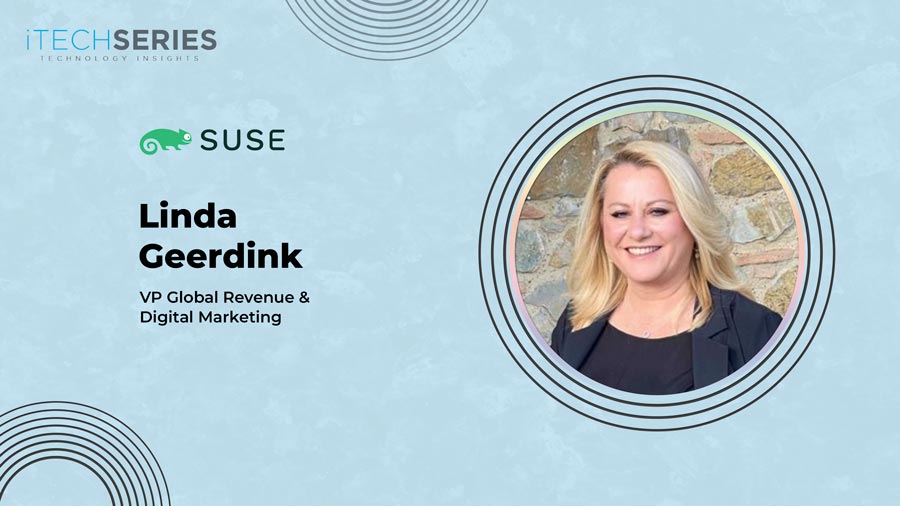
Linda Geerdink, VP Global Revenue & Digital Marketing at SUSE, shares how modern marketing is evolving into a revenue-driving engine. From aligning closely with sales and product to leveraging AI and intent-driven strategies, she explores building scalable demand programs, optimizing conversions, and redefining success through pipeline impact, buyer journey velocity, and measurable business outcomes.
Welcome to the interview series, Linda. Could you tell us more about your journey as a marketing leader?
My journey has been one of deliberate evolution—from starting in communications, through field marketing and program management, to building and leading a global revenue engine today. What’s stayed constant is my belief that marketing only matters when it moves business outcomes. I started my career in consumer brands—Mattel, Beiersdorf—where I learned the power of clarity, audience understanding, and brand discipline. Then I moved into B2B tech, first at Unit4, then VMware, and then SUSE, where I’ve been able to apply that rigour to demand generation and digital strategy at scale.
At SUSE, I built the global demand generation function essentially from scratch. Over a period of six years, we grew a marketing-driven pipeline by more than 5x—and I’m proud that this didn’t happen by accident. It happened through a clear strategy, building up a strong team and a state-of-the-art technology and data foundation, and a relentless focus on what drives revenue.
I’ve always led with curiosity. I’ve never been afraid to experiment, rebuild, or challenge the status quo—including my own assumptions.
How do you align marketing with sales, product, and regional leadership to accelerate scale performance?
Alignment isn’t a meeting cadence—it’s a shared language and shared goals. The moment marketing speaks in MQLs and sales speaks in pipeline, you have a translation problem. I’ve worked hard to eliminate that gap.
The way I approach it: sales targets feed into the marketing targets. If the business needs to grow a specific segment by 40%, that’s not just a sales ambition—that’s marketing’s ambition too. We work backwards from revenue goals to determine where marketing needs to play, how much pipeline we need to generate, and which accounts and personas we need to move. Marketing & sales need to work on ONE shared strategy.
Marketing’s campaign strategy centers around sales plays and product priorities. Every major campaign is co-designed with regional sales and product leadership. We run joint pipeline reviews and share the same data and dashboards.
I hold my team accountable to pipeline and revenue metrics—not just top-of-funnel volume. That shared accountability changes the dynamic entirely. Sales stops seeing marketing as a service function and starts seeing us as a growth partner.
Which digital channels or strategies have proven most effective in driving inbound and performance marketing globally?
The honest answer is that it depends on where your buyer is in the journey. But if I had to name the strategies that have consistently delivered, I’d point to three.
First, organic search is a long-term compounding asset. SEO done well now shifts to GEO for AI-driven discovery—it drives inbound at scale without proportional cost growth. We’ve invested heavily in web experience and content to make this work.
Second, intent-driven ABM. Combining intent data with personalised outreach to accounts showing active buying signals has been transformational. It stops the spray-and-pray and focuses energy where conversion probability is highest and where engagement is built with key targets and ideal customer profile accounts.
Third, the hand-raiser experience. We doubled our intake of sales calls, demos, trial requests, and pricing inquiries—not just by generating more traffic, but by obsessing over what happens when a prospect engages. Speed, relevance, and follow-up matter enormously. AI SDR capabilities (email and web-based) have been a game-changer.
The biggest lever most marketers underuse: conversion optimisation. You don’t need more traffic—you need to do more with the traffic you already have.
“Brand is the foundation that makes demand generation more efficient. When buyers already trust you, your cost-per-pipeline-dollar drops.”
As a marketing leader, how do you balance the need for long-term branding with short-term demand generation goals?
This tension is real. Long-term brand investment is hard to defend when pipeline targets are due next quarter. So I’ve learned to make brand work carry short-term weight—and make demand work carry brand equity.
The way I think about it: every piece of content, every campaign, every digital touchpoint is both a brand moment and a demand moment. The question is emphasis. A thought leadership piece builds authority—but it also captures intent. A performance campaign drives pipeline—but the messaging still has to reflect who we are as a company.
Brand investment needs to be connected to measurable outcomes: share of voice, organic search rankings, and net new logo engagement. And demand generation needs to be protected from short-termism by making sure we’re building audiences, not just harvesting them.
Brand is the foundation that makes demand generation more efficient. When buyers already trust you, your cost-per-pipeline-dollar drops.
How have AI tools transformed the way you engage prospects and accelerate conversions?
AI has genuinely changed what’s possible—and my team has been an early and deliberate adopter. We’ve implemented AI in two critical areas.
The first is inbound conversion. We introduced AI SDR capabilities to ensure that when a prospect engages in any campaign (online and offline), the follow-up is fast, relevant, and personalised—regardless of time zone or team capacity. Speed to lead is a known conversion driver; AI removes the human bottleneck without losing the human touch.
The second is content production at scale. We’ve built AI-powered content workflows that allow us to produce market-specific, persona-relevant content without proportionally growing the team. This is not about replacing creativity—it’s about removing the operational friction that slows campaigns down.
But the most important shift AI has enabled is in data-to-insights. We can now surface patterns in buyer behaviour, campaign performance, and pipeline health much faster than before.
AI doesn’t replace marketing judgment—it accelerates the cycle between insight and action.
That’s where the competitive advantage lives.
In competitive markets, how do positioning and differentiation guide your GTM approach?
In crowded B2B tech markets, the companies that win are the ones that can answer one question clearly: why us, specifically, for this buyer, right now? Generic positioning is invisible positioning.
At SUSE, we operate in enterprise open-source infrastructure—a space with strong and evolving buyer priorities. Our GTM is built around specific buyer contexts: regulated industries navigating digital sovereignty, enterprises modernising legacy infrastructure, and organisations adopting cloud-native at scale. Each of these contexts requires a different value proposition, different proof points, and different channel emphasis.
And this is not just in campaigns but in every touchpoint around the full buyer journey.
How do you gauge the success of your digital marketing programs beyond the standard metrics?
Standard metrics—MQLs, CPL, and conversion rates—are necessary but not sufficient. They tell you what happened; they don’t tell you why or what to do next.
Beyond the standard dashboard, I look at a few things that most teams undertrack. First, pipeline quality: not just how much pipeline marketing contributes, but how much of it progresses and closes. If marketing-sourced pipeline stalls at a higher rate than outbound, something is wrong upstream. Second, buyer journey velocity: Are prospects moving faster through the funnel over time? Faster is better—and velocity tells you whether your nurture and intent activation are working. Third, brand reach in target accounts: are we showing up in the conversations our ICP are having before they enter a sales cycle? Fourth, the hand-raiser experience score—internal feedback from sales on the quality and readiness of marketing-generated leads.
The metric I care most about: marketing’s contribution to closed-won revenue. Everything else is a leading indicator.
For leaders looking to transform their marketing organisations into strategic revenue engines, what are your top three recommendations?
One: Start with the revenue conversation, not the marketing conversation. Transformation fails when marketers advocate for marketing. It succeeds when marketers advocate for revenue. Get in the room with your CFO and CRO. Learn their language. Align your team’s goals to company-level outcomes—and make that alignment visible, not just assumed.
Two: Invest in your data and operations foundation before you invest in campaigns. I’ve seen too many teams run sophisticated ABM on a broken data model. If you don’t know which accounts to target, which campaigns are driving pipeline, or where leads are going dark, you’re optimising blindly. Fix the plumbing first.
Three: Build for learning velocity, not campaign perfection. The organisations that outperform are the ones that can test, learn, and adapt faster than their competitors. That requires psychological safety, clear experimentation frameworks, and leaders who celebrate intelligent failure. In a market that’s moving as fast as ours—with AI reshaping everything—adaptability is the most important capability you can build.
The best marketing organisations I know don’t just generate pipeline. They generate iinsight aboutbuyers, markets, and what’s next.
About Linda Geerdink
Linda Geerdink is a global marketing leader with over 20 years of experience, known for transforming marketing organizations into high-performing revenue engines. At SUSE, she leads a global team driving demand generation, digital strategy, and marketing operations, delivering significant pipeline growth and revenue impact. Passionate about data-driven strategy and AI-led innovation, she aligns marketing closely with business outcomes to accelerate scalable growth.