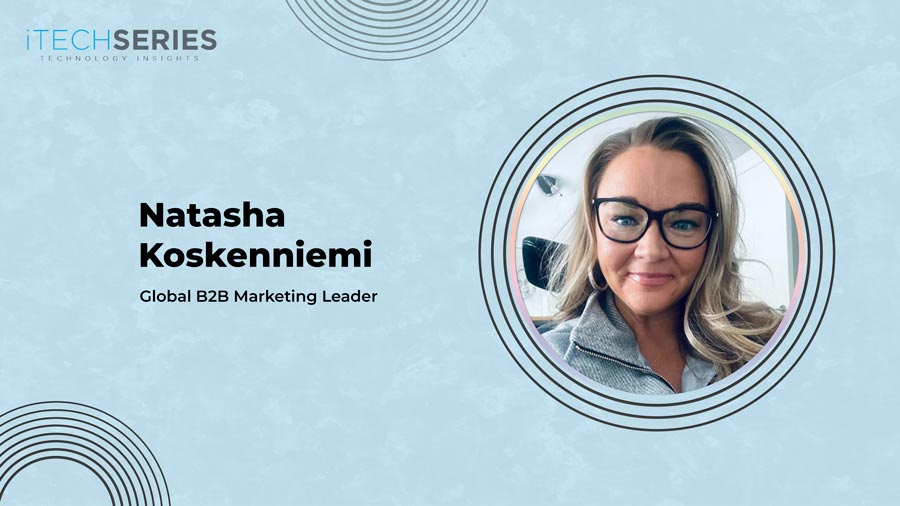
Natasha Koskenniemi, Senior Global B2B Marketing Leader, shares insights on transforming global GTM strategies into impactful regional execution, improving funnel performance, and building alignment across cross-functional teams. She discusses the importance of audience-centric thinking, AI’s evolving role in marketing, and creating campaigns that drive meaningful business outcomes beyond surface-level metrics.
Welcome to the interview series, Natasha. Could you tell us about yourself and your journey as a marketer?
My path into marketing started in high school through DECA, a student business and marketing competition that made marketing feel real and strategic rather than theoretical. I am American, born and raised, and by college, I knew exactly what I wanted to study. My personal life shaped my professional direction in unexpected ways. I met my now-husband in college while he was studying abroad from Sweden, and that relationship sparked a curiosity about living internationally. I spent my junior year in London, completed another international experience during a J-Term in China, and, after college, followed my husband to Sweden.
Moving there meant learning the language, building a network from nothing, and finding my footing in a country where I had no established path. Through Korta Vägen, a program that helps internationally educated professionals enter the Swedish workforce, I landed my first marketing role at Index Braille. Things have not always gone according to plan, but grit has always helped me move forward.
Professionally, that early chapter gave me something I did not fully appreciate until later. In my earlier roles, I owned both strategy and execution. I built campaigns, ran channels, wrote briefs, managed vendors, and analyzed results. That hands-on foundation gave me deep channel knowledge that became a genuine advantage as I moved into larger organizations.
At Juniper Networks (acquired by Hewlett Packard Enterprise), I was not implementing; I was the architect. Because I had spent years doing the work myself, I understood what was possible, where friction points existed, and what good execution required. My time there also gave me a strong appreciation for operations, automation, and AI. When the right systems work together, teams gain consistency, cleaner data, and more time for high-value thinking. That combination of strategic and executional fluency, supported by strong operational infrastructure, is where I feel most effective as a marketer.
How do you translate a global GTM strategy into consistent, high-impact regional execution?
When alignment, visibility, and planning are built in from the start with the right stakeholders, including sales, field, and partner marketing teams closest to customers, the global-to-regional translation becomes far more effective. Global teams build frameworks, and regional teams receive toolkits, but those toolkits work best when the people executing them help shape what goes into them.
I think of a well-run campaign like a heart monitor. There is always a steady rhythm of activity, always-on digital programs, nurture campaigns, content, and partner motions. The spikes are your major moments: a product launch, an event, or both. Everything leading up to that spike creates momentum so that by the time the announcement happens or the room fills, the audience is already primed. The effort does not stop there. Post-event activity is equally important for sustaining energy and converting momentum into pipeline. There will always be field programs that are not planned into global campaigns, and that is fine. Large campaigns should leave room for local activation. However, field and partner teams need to align regularly with global teams. Questions like: What activity is coming through digital channels? What can be localized? What existing traffic or brand activity can regions build on instead of duplicating? These are what separate teams working with the global engine from those working around it.
The relationship between marketing and sales is equally important. Sales often bring account-based requests, but marketing should operate as a strategic partner rather than simply a doer of tasks. Open conversations around global initiatives, localization opportunities, channel mix, and in-person engagement create stronger outcomes than a simple request queue. At Juniper, I supported this through a squad model where representatives from brand, campaign, product marketing, regional marketing, sales, and field teams worked together from the start. Regional input shaped strategy early, while modular playbooks and localization frameworks enabled faster execution. The foundation was a yearly campaign plan built on visibility and transparency, keeping large teams aligned around priorities and long enterprise buying cycles.
What are the most overlooked drop-off points in the funnel, and how do you address them to improve MQL-to-SQL conversion?
The most consistently overlooked area is the transition from early-stage engagement to sales-ready traction. Marketing teams often focus heavily on top-of-funnel volume or pipeline, while sales focuses on late-stage deal progression, leaving the middle of the funnel treated as someone else’s problem. That gap is where a significant amount of pipeline value gets lost. The question worth asking at every stage is simple: Why care? Why would this specific contact at this specific account care about what we are sending them? If marketing cannot answer that, the issue starts with the foundation, not the funnel.
One of the things I found when the Networking for AI campaign required us to market to a new audience was that our organic database was thin on marketable contacts within those target ABM accounts. We were creating engagement, but not with enough of the right people to build buying-group coverage. I led a shift in budget toward targeted contact acquisition focused on the right contacts at the right accounts. The goal was never volume; it was building a segmentation model that could support persona-level nurture. This work ran alongside a full rebuild of our email nurture architecture by persona and funnel stage. A technical buyer early in the journey received something very different from an executive further along in the process. Combined with multi-touch programs and our Brand-to-Demand campaign structure, we saw meaningful improvements in both MQL volume and quality.
On the SQL side, we worked much more closely with SDR teams through weekly alignment on account priorities, lead quality signals, and follow-up strategy. We built outreach sequences aligned with the prospect’s marketing experience and introduced bottom-of-funnel field activities like Executive Roundtables and Technical Test Drives, creating stronger engagement than digital programs alone. The common thread is that MQL-to-SQL conversion is never one lever. It comes from the right contacts, relevant content, coordinated channels, aligned outreach, and a GTM organization working together end to end. Underpinning all of it are strong Sales and Marketing alignment, shared KPIs, and deliberate decisions around what to scale and what to stop.
How do you ensure alignment across brand, product marketing, sales, and field teams in large-scale integrated campaigns?
The starting point is making sure everyone is working toward the same commercial objective, not just the same campaign brief. Brand focuses on perception and narrative, product marketing on positioning and differentiation, sales on accounts and quota, and field teams on events and regional activation. Every perspective is valid, but without a shared definition of success, each naturally pulls in a different direction.
I create alignment by anchoring the entire team to a shared commercial outcome before execution begins. That becomes the reference point when priorities inevitably conflict. When people lose sight of it, I bring them back by asking a simple question: Why do they care? Why does this program matter? What commercial outcome does it support? And how does each contribution connect to that result? That question quickly cuts through competing agendas. The squad model makes alignment structural rather than dependent on goodwill. Representatives from brand, product marketing, campaign, regional marketing, sales, and field teams are embedded from the start instead of being brought in after decisions are made. In matrixed organizations, this matters because alignment is built through influence rather than authority. You cannot force a product team to prioritize your webinar, but you can help them understand what is at stake.
After the Networking for AI launch, we had enough data to identify webinars as a high-performing channel. The challenge was that building a webinar required significant time before promotion even began, and conflicting priorities repeatedly created bottlenecks. Deadlines slipped, promotion windows narrowed, and performance reflected it. We did not solve it by escalating issues or chasing stakeholders. Instead, I brought previous webinar data to the entire squad: live session performance, audience personas, conversion rates, and pipeline impact. Once everyone could clearly see the commercial value at stake, it stopped becoming a scheduling conflict and became a shared challenge worth solving together. When people reconnect with the why, the how usually follows.
“Marketing teams often focus heavily on top-of-funnel volume, while sales focuses on late-stage deal progression, leaving the middle of the funnel treated as someone else’s problem.”
Could you tell us about your most memorable experience as a marketer?
Without question, it was the Networking for AI campaign at Juniper, which became the Networking for AI pillar within the broader New Way to Network Brand-to-Demand initiative.
When I stepped into the GTM Performance Architect role, one challenge was that Data Center and AI were being treated as separate conversations, while the market was increasingly viewing them as inseparable. Enterprise customers investing in AI infrastructure needed to understand that networking was not simply a commodity beneath that investment; it was a critical performance factor. The narrative needed to shift, and it needed to happen quickly because the opportunity to position Juniper as a leader in that space would not remain open forever. What made the project memorable was the scale of what we had to bring together. This was not a traditional campaign. It required aligning brand, product marketing, demand, field, and sales around a single company point of view, then translating that into a program that could land consistently across AMER, EMEA, and APAC. We built the messaging architecture, content framework, channel strategy, and field activation model to operate as one integrated system.
The campaign contributed to $1.92 billion in pipeline influence. What was especially rewarding was hearing C-suite leaders and sales teams naturally using the Networking for AI narrative in their own conversations. When messaging evolves from campaign assets into how an organization naturally talks about its products, you know something meaningful has happened. Even today, if you search for Networking for AI or ask an AI tool about it, the concept remains present. That level of category impact does not happen by accident. Beyond the results, being part of the AI revolution at that moment felt like a once-in-a-career experience. I imagine it felt similar for people who experienced the early internet boom. You could sense that you were part of something significant. We worked incredibly hard, but it was energizing, exciting, and brought out the best in us as a team. That is something I still carry with me.
Beyond the standard metrics, what tells you whether a campaign has succeeded or not?
Earlier in my career at a startup, the CEO I worked for had a habit of challenging me with two words: why care. What he meant was, why should my audience care? He used it when reviewing content, but it became a lens I apply to everything, including metrics. When leadership is celebrating vanity clicks and impressions, I find myself asking the same question. Why care? Those numbers do not tell you who sat behind them, what they were thinking, or whether they are anywhere close to a buying decision.
That question is what developed into what I would call an obsession with the middle of the funnel, and I think it is the most under-discussed problem in B2B marketing. On one end you have your awareness metrics, impressions, clicks, share of voice, and keyword rankings. On the other end, you have your north star metrics, meetings held, pipeline, and revenue contribution. Leadership tends to gravitate to one end or the other because those are the easiest stories to tell. Sales is down your neck about the pipeline, so marketing instinctively reaches for brand-level awareness and thought leadership to show traction. Those metrics matter, but they do not lead directly to pipeline and treating them as if they do create a dangerous gap.
There is a principle that a buyer needs to interact with a brand multiple times, going progressively deeper into their research, before they are ready to have a real conversation. Seeing a TV commercial repeatedly is not enough because it never takes them anywhere. It is our job to meet the prospect in the right channel, at the right time, with the right content for their persona, speaking directly to their business challenges. That is a middle of the funnel problem, and it requires someone to own it explicitly.
The audience question is where I see teams fall short most consistently. We rally around an ABM list, agree on the titles we are going after, and then assume that strong metrics mean we are reaching the right people. But apply the why care test, and the picture often changes. Why should the CMO care about 500 webinar attendees? Show them why. Because 100 of those attendees were analysts and media who serve their own strategic purpose. 150 were partners actively selling your products. And 250 were technical personas representing accounts on your priority ABM list. That breakdown tells a completely different story than the headline number, and it is the story that matters. In paid channels, especially, failing to ask this question does not just cost you relevance. It literally costs you money.
The accountability question matters here, too. Full funnel metrics should be tracked and owned by someone from the beginning, even when they are not the north star. It does not matter which function owns the middle of the funnel as long as that decision is made explicitly at the start. In my Juniper years that sat with me as campaign architect, but no junior marketer would have known to pick it up without it being called out. If it is not assigned, it disappears, and then everyone wonders why the pipeline is light.
What advice would you give marketers on developing the right skill sets in an increasingly AI-driven world?
Stay curious. That is the foundation of everything else.
AI is a remarkable tool, but it is only as smart as the prompt you give it or the agent you teach it to be. And I will be honest, I appreciate when an individual or a brand does not sound like a chatbot wrote their content. There is a real risk that, as generative AI becomes ubiquitous, everyone starts sounding identical. If you are going to use it, and you should, take the time to build agents that reflect your own unique brand voice. Keep answering the right questions yourself. Keep asking better questions of the AI. Challenge it, push back on its first response, give it more context, test whether its output reflects your thinking or just resembles it. That back and forth is where the value is. Critical thinking is not something AI has, and in a world where everyone has access to the same tools, your thinking is your differentiation.
What I have found personally is that the most powerful combination is staying genuinely curious and innovative while using AI to handle the work that does not require my full attention. Repetitive tasks, derivative content, scaling a core idea across multiple verticals, partner audiences, or personas without rebuilding from scratch every time. When those workflows are handled well, I get to spend my time on the things that actually require judgment and creativity.
The marketers who will struggle are the ones who use AI to produce more of the same thing faster. The ones who will thrive are the ones who use it to operate at a greater scale while keeping their own point of view at the center of everything they put out. Stay curious, protect your thinking, and never let a tool do the job that only your experience and judgment can do.
About Natasha Koskenniemi
Natasha is a global B2B marketing leader with 15+ years of experience driving growth across AMER, EMEA, APAC, and the Nordic region. She specializes in building full-funnel GTM engines that transform global strategy into regional impact and measurable business outcomes. Known for creating clarity in complex environments, she combines strategic vision, cross-functional leadership, and data-driven execution to align teams, accelerate pipeline growth, and scale high-performing marketing ecosystems.