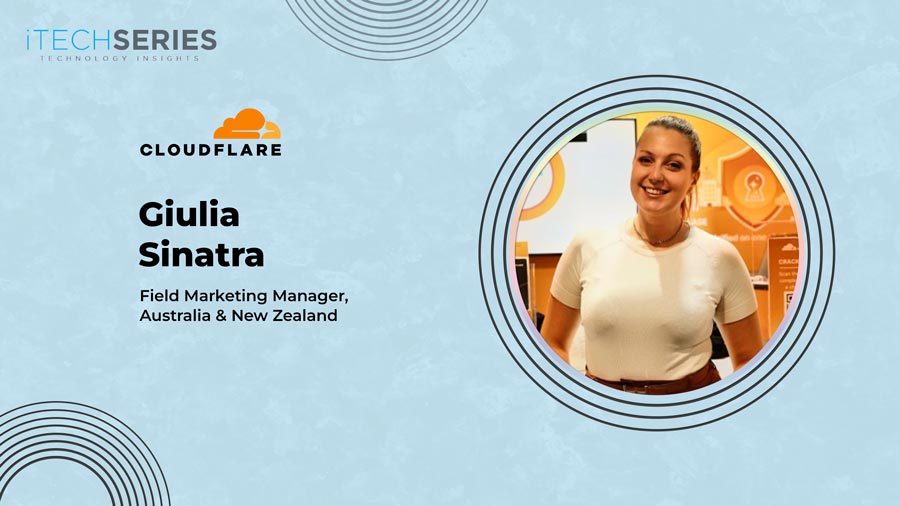
Giulia Sinatra, Field Marketing Manager, Australia & New Zealand at Cloudflare, shares her perspective on building revenue-focused marketing programs across diverse markets. She explores how to align sales and marketing, balance brand and demand, measure campaign impact, leverage AI responsibly, create memorable experiences, and develop the adaptability, curiosity, and commercial mindset needed for modern marketing leadership.
Welcome to the interview series, Giulia. Could you tell us about yourself and your journey as a marketer?
My marketing journey started through two different doors: events and anthropology. Early in my career, I worked in Milan across fashion, events, and later music. I was fascinated by how an idea becomes an experience shared by hundreds or thousands of people.
During my Bachelor’s degree, I also fell in love with anthropology and archaeology, studying people, cultures, and behaviour. What seemed like a detour from marketing became foundational to how I think about it today. Archaeology taught me to observe, identify patterns, understand context, and recognise that human behaviour rarely makes sense outside the culture surrounding it. I realised I loved analysing but was most energised by being in the field—creating, connecting, and co-creating with people.
During COVID, I moved to Oxford to pursue a Master’s degree in Marketing and Business. I later returned to the music industry, but my thesis research deepened my interest in the strategic and commercial side of marketing.
That curiosity eventually brought me into technology. I have now been with Cloudflare for around four years, working across field and regional go-to-market programs, first across EMEA and now in Australia and New Zealand. I have been fortunate to experience two extraordinarily different markets. Working across EMEA taught me that markets are never simply territories on a map. Culture influences communication, relationship-building, sales engagement, and how demand-generation or partner programs should be designed. Moving to Australia challenged me again, making me more resilient, commercially aware, and conscious of understanding a market before trying to market it.
I also bring positive psychology into my work, a long-standing personal and academic interest that was central to my Master’s research. Field marketing is highly cross-functional, involving sales, product, engineering, partners, agencies, executives, and customers. Understanding what motivates people and creating an environment where collaboration feels psychologically safe—where people can challenge ideas, admit mistakes, and solve problems together—can dramatically improve execution.
Some of my most valuable lessons have come from things that did not work and from exceptional mentors who gave me the space to learn. Technology evolves incredibly quickly, but people do not always evolve at the same speed. Behind every pipeline number, campaign, and technology decision is still a person deciding whether to trust you, engage with you, or remember you. Keeping that in mind has been one of the most important lessons of my career.
How do you align field marketing with sales and product teams to ensure campaigns accelerate pipeline growth?
For me, one of the biggest misconceptions about field marketing is that an event begins when people walk into the room. In reality, by that point, much of its potential success has already been determined. If the objective is pipeline acceleration, I work backwards from the commercial outcome we want to create. Who are the accounts? Where are they in the buying journey? What is preventing progression? What conversation should the campaign create, and what needs to happen after that conversation?
Planning is therefore critical. I normally include a pre-mortem early in the process, because understanding what could prevent a program from succeeding is often as valuable as defining what success looks like. Two practices are particularly useful for cross-functional alignment. The first is a shared campaign charter with clear decision rights and RACI ownership: objective, target audience, messaging, success metrics, responsibilities, and follow-up expectations are agreed before execution. The second is a closed-loop revenue cadence. Sales, marketing, and product align on priority accounts before the campaign, then review engagement and opportunity movement together afterwards rather than allowing the lead hand-off to become the end of marketing’s involvement.
I also think communication needs to be translated rather than simply transmitted. Sales, product, and marketing often speak slightly different professional languages. Part of my role is understanding those differences and making the process simple enough that everyone knows what matters, what they own, and what happens next.
As a marketer, how do you ensure the right balance between brand awareness and lead generation?
I come from a lead generation background, so I naturally have a strong bias towards measurable commercial outcomes. However, over time I have stopped thinking of brand and demand generation as two completely separate disciplines. Brand creates memory and trust; demand gives that memory somewhere to go. A strong lead generation campaign inevitably creates some degree of brand awareness because every interaction leaves something behind: a conversation, a piece of content, an experience, a direct mail package, or simply a clearer understanding of what the company stands for. At the same time, demand generation becomes much harder if the market has no familiarity or confidence in your brand.
The balance therefore depends heavily on market maturity and the objective. In a newer market, I may invest more heavily in thought leadership, strategic events, partnerships, and digital visibility to establish credibility. With mature or high-value accounts, I may shift towards highly targeted ABM, executive programs, workshops, or direct mail designed to create a specific next action.
I try not to ask, “Is this a brand activity or a demand activity?” Instead, I ask, what do I want this audience to remember, and what do I want them to do next?
Could you tell us about your most memorable experience as a marketer?
One of the most fulfilling experiences of my career has been contributing to the development of one of Cloudflare’s customer event brands.
I first became involved when the concept was still relatively local, with an edition in Barcelona in 2022. The original vision and execution came from two exceptional marketers I had the privilege of working with: my former manager Luisa and my former colleague Kyra. I was then able to contribute to the project as it evolved, helping improve elements of the execution, operational framework, and tools supporting the experience. What has been particularly rewarding is watching something that began at a relatively local level develop into a global event platform, reaching completely different markets and audiences around the world. This literally shows you that we would never be able to imagine how much good architected campaigns can scale up!
Something is fascinating about seeing an idea become a system without losing the original human experience that made it successful.
Watching later editions take place in markets such as Bangalore, at an entirely different scale, has been incredibly rewarding. It is also a reminder that great marketing is rarely the work of one person. The strongest programs become bigger than their creators because different teams continue to improve them, reinterpret them, and carry them into new markets.
“Data tells me whether a campaign created movement. Human behaviour tells me whether it created meaning. I think strong field marketing needs both.”
How do you measure the success of your field marketing initiatives, and what data-driven insights guide your optimisation?
I believe measurement needs to begin before execution. When I build a regional strategy, I start with the commercial problem: the pipeline or revenue contribution we need to create, the markets and accounts that matter most, and where the gaps exist. From there, I work backward to determine the right program mix, expected contribution, and investment. Naturally, I look at metrics such as sourced and influenced pipeline, opportunity progression, conversion rates, target-account engagement, ROI, and cost efficiency. But I do not believe the success of field marketing can be captured by one dashboard alone.
Earlier in my career, while working in the live entertainment industry, a leader told me something that stayed with me: the most important part of an event is often what people remember once they have gone home. That idea still influences how I design campaigns. For example, for a Christmas campaign, we created a direct-mail experience around lava lamps. They are immediately recognisable within Cloudflare’s story because physical randomness from lava lamps has been used as an additional source of entropy for cryptographic systems.
The campaign reached more than 300 recipients across Australia and New Zealand, but for me the interesting part was not simply delivery volume. The object itself became a conversation: it could sit in someone’s home or office, remain associated with the brand, and introduce a surprisingly technical concept such as entropy through something physical and memorable.
Data tells me whether a campaign created movement. Human behaviour tells me whether it created meaning. I think strong field marketing needs both.
How has AI most significantly impacted field marketing planning and execution?
AI has already changed almost every stage of my day-to-day work, from campaign development and research to audience analysis, content iteration, budget modelling, and post-campaign insight. The next evolution I find particularly interesting is agentic AI: creating specialised agents that can support parts of the marketing workflow, analyse information across multiple inputs, identify patterns, or automate repetitive processes. Used correctly, it can give marketers back an extraordinary amount of time for strategy and creativity. However, speed cannot come at the expense of judgement. One of the lessons from the wider technology industry is that even highly sophisticated AI systems can confidently produce incorrect outputs. During the early rollout of Google’s AI Overviews, for example, unusual and inaccurate answers appeared in production, and Google subsequently made more than a dozen technical improvements, including stronger handling of nonsensical queries and limitations around certain user-generated sources.
For marketers, the principle is the same: AI should accelerate thinking, not replace accountability. I therefore see the most effective model as human-in-the-loop. Let AI analyse, challenge, summarise, and automate, but maintain strong human validation around data, customer context, brand decisions, and anything that ultimately represents the company externally. The competitive advantage will not simply belong to the teams using the most AI. It will belong to the teams that learn where AI should make decisions and where humans still need to make meaning.
What advice would you share with marketers who aspire to move into senior field or regional marketing leadership positions?
My advice would be to resist becoming too comfortable with the version of marketing you already know. The industry is evolving extraordinarily quickly, and organisations are becoming leaner, which means senior marketers increasingly need to operate as force multipliers. It is no longer enough to be excellent at events, demand generation, digital marketing, or any single channel. You need to understand how marketing connects to revenue, sales, product, customer behavior, finance, and the broader commercial strategy. I would also encourage marketers to think carefully about the kind of leader they want to become. Leadership is not only about managing people. It is the ability to create clarity when things are ambiguous, bring different functions towards the same objective, and help people perform at their best. Stay curious.
Experiment with new tools before you are forced to learn them. Understand AI and data. Learn how sales thinks. Develop commercial and financial literacy. Ask questions outside your immediate remit. And perhaps most importantly, do not build your value around a particular tool or channel, because those will continue to change. Build it around judgement, adaptability, and the ability to connect things that other people still see separately. In a market that keeps reinventing itself, curiosity may be one of the few advantages that does not become obsolete.
About Giulia Sinatra
Giulia Sinatra is a field and events marketing professional specialising in high-impact campaigns and experiences. With years of experience across EMEA, she has led 20+ quarterly events and delivered up to 25× ROI through targeted campaigns and strong sales alignment. Her expertise spans strategic planning, storytelling, analytics, and creative execution. She holds an MSc in International Events Management from Oxford Brookes University and a Google Project Management Certificate.