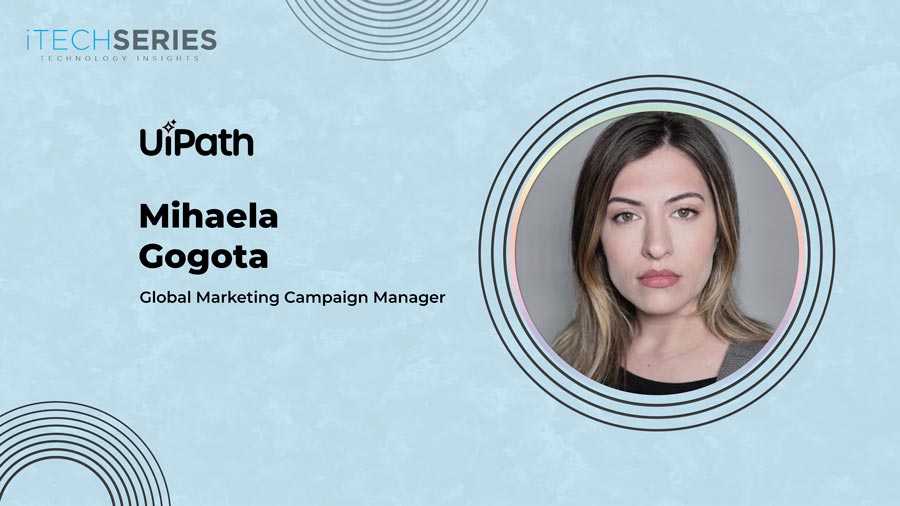
Mihaela Gogota, Global Marketing Campaign Manager at UiPath, shares insights from over a decade of experience in B2B marketing, spanning execution to strategy. She discusses global campaigns, cross-functional alignment, ABM, data-driven decision-making, and MarTech. Her practical, hands-on approach highlights how simplicity, adaptability, and continuous learning drive meaningful marketing impact and sustainable business growth.
Welcome to the interview series, Mihaela. Could you tell us more about yourself and your journey as a marketer?
I’ve been in B2B marketing for over 10 years, mostly in enterprise tech. I started in email marketing and marketing automation, then moved into global campaign management. I didn’t begin with a big strategy; I learned by doing: launching campaigns, fixing what didn’t work, and understanding how everything connects behind the scenes.
Over time, I moved closer to strategy, but I’ve always stayed hands-on. That’s important to me. It’s easy to build a strategy in slides, but the real learning comes from seeing what works in the market.
What keeps me motivated is that marketing is never really “done”. Channels evolve, buyer behavior shifts, and you constantly have to adjust. It keeps you sharp and on a constant learning journey.
In global campaigns, what principles guide the balance between brand consistency and regional flexibility?
You must be clear about what cannot change and what should.
The core message, your values, and your brand identity should stay consistent everywhere. That’s how people recognize and trust you over time.
But how you bring that to life should change depending on the region. Different markets respond to different things. Even small details, like tone or channel choice, can make a big difference.
One thing I’ve learned: if you control everything centrally, campaigns can feel disconnected from the market. If you give full freedom, things can become messy. The sweet spot is giving teams a strong direction, then trusting them to adapt it.
How do you align marketing with sales, product, and other departments to drive shared goals?
Alignment must start early, at the strategy level, and then carry through into execution. If you wait until a campaign is already built to bring in sales or product, you’re already playing catch-up.
It also becomes much easier when everyone is working toward the same outcomes. Shifting the focus from “leads” to “pipeline” or “revenue” changes the dynamic, and people stop working in silos and start pulling in the same direction.
I try to bring the right people in from the start, having a quick cross-functional chat early on, especially when we’re defining the audience, the goals, and the problem we’re trying to solve. Then others get involved as it becomes relevant for their role.
And honestly, it’s not about complex frameworks or long PowerPoint plans. Simple, regular conversations make a bigger difference. A short weekly check-in can do more for alignment than a perfectly crafted strategy deck.
Within a global organization, what does an effective go-to-market and ABM framework look like in practice?
You need a clear idea of who you’re targeting, what you’re saying, and why it matters TO THEM. That’s your foundation. Then, for your most important accounts, you go deeper, with more tailored outreach, closer collaboration with sales, and more relevant content.
Not everything needs to be highly personalized. Focus your effort where it really counts.
The best framework is not the most complex one; it is the one teams can follow without overthinking.
It also requires alignment on metrics, continuous feedback loops, and agile execution to refine strategies based on real market response.
“Shifting the focus from ‘leads’ to ‘pipeline’ or ‘revenue’ changes the dynamic, and people stop working in silos and start pulling in the same direction.”
How do you approach advanced segmentation and personalization while ensuring data quality and compliance?
I always start with a reality check: Is our data usable? Where are the gaps?
Before doing anything advanced, you need clean data and shared definitions. If you don´t have that, personalization just becomes guesswork.
Also, sometimes a clear, well-written message to the right audience works better than something personalized but confusing. So, more personalization isn’t always better; it needs to come with relevance.
On compliance, especially in global teams, you can’t treat it as an afterthought. It needs to be part of how you design campaigns from day one.
Which KPIs do you prioritize when reporting marketing performance to leadership, and why?
I focus on what the business cares about.
Pipeline is usually the main one: how much we’re generating and influencing. Then I look at how that pipeline is moving. Are deals progressing? Are we reaching the right accounts?
I still look at engagement, but more as a signal. High engagement is good, but it doesn’t always mean business impact. I also check the profile of our most engaged accounts.
At the end of the day, leadership wants a simple answer: Is marketing helping growth?
If your reporting is too complicated to answer that, it needs to be simplified.
What criteria indicate that your MarTech stack is driving scalable, multi-channel growth rather than adding unnecessary complexity?
The MarTech stack assessment. Though the reality makes it more complex than that, to me, it should come down to a few simple questions:
Are the teams using the tools?
Can we launch campaigns faster than before?
Do we trust the data we’re seeing?
If the answer is no to any of these, the stack probably needs to be reviewed.
I believe that teams with too many tools spend more time managing systems than building and working towards the business goals. That happens in big companies, and it is usually a sign to step back and simplify.
A good stack should feel almost invisible; it should support the work and the decision-making process, not slow them down.
How would you advise aspiring marketers on developing the right skill sets for today’s world?
First, understand how the business works. Marketing is about contributing to growth; that’s the goal behind the campaigns.
Second, get comfortable with data. You should understand what’s working and why.
And third, stay close to real work for as long as possible. It’s tempting to move into strategy quickly, but without hands-on experience, I think it’s harder to make good decisions.
Also, be curious and keep learning. The tools and trends will keep changing, but curiosity is what helps you adapt.
Build strong collaboration skills, seek feedback often, and learn to communicate impact clearly to stakeholders across functions and leadership teams.
About Mihaela Gogota:
Mihaela Gogota is an experienced B2B marketing leader with over 10 years of driving revenue growth through data-driven strategies, innovative campaigns, and marketing technology. She excels at leading cross-functional teams, optimizing operations, and translating complex data into actionable insights. Passionate about scaling impactful marketing programs, she thrives in fast-paced global environments, leveraging collaboration and technology to deliver meaningful business results while continuously learning and evolving.