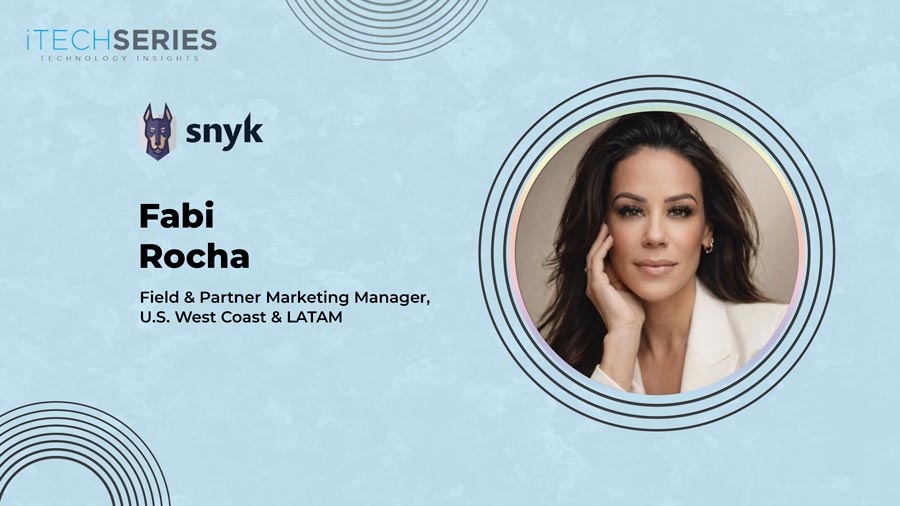
In this exclusive interview, Fabi Rocha, Field & Partner Marketing Manager, U.S. West Coast & LATAM at Snyk, shares how field marketing has evolved from event execution to a strategic revenue driver. She explores global strategy, sales alignment, pipeline impact, and the role of AI in building programs that deliver measurable business outcomes across regions and modern go-to-market execution.
Welcome to the interview series, Fabi. Please tell us a bit about yourself and your journey as a marketer.
I’ve spent over 15 years in marketing, with most of my career focused on field and partner marketing for B2B SaaS companies. My journey started in Brazil, where I was born and raised, and over the last 14 years, I’ve built my career in the U.S., working across North America, EMEA, and LATAM.
What has always drawn me to marketing is the blend of creativity and business impact. I love building programs that bring people together, but what really excites me is turning those moments into measurable business outcomes. Over time, I evolved from executing events into building strategic go-to-market programs that align closely with sales, accelerate pipeline, and influence deals across regions.
Today, I view field marketing as one of the most powerful growth engines in B2B when I apply it strategically.
What defines a strong field marketing strategy across regions like North America, EMEA, and LATAM?
A strong global field marketing strategy starts with one principle: global consistency and regional relevance.
What works in North America doesn’t automatically translate to LATAM or EMEA because buyer behavior, trust dynamics, urgency levels, and partner influence vary significantly by region. The mistake many companies make is assuming localization is just language translation, when in reality it’s market translation.
For me, the strongest regional strategies are built on:
- Deep partnership with regional sales leaders
- Understanding local buyer journeys
- Adapting messaging to cultural and commercial realities
- Balancing global brand consistency with local execution flexibility
Global strategy fails when it ignores regional nuance. Because at the end of the day, deals are closed in regions.
Tell us about your most memorable experience as a marketer.
One of the most memorable moments in my career was seeing a complete shift in how sales and marketing worked together around events.
Earlier in my career, events were often measured by lead volume alone. But I helped reshape that mindset by creating tighter alignment with sales before, during, and after events, focusing on target accounts, pre-booked meetings, pipeline influence, and deal acceleration instead of badge scans.
Watching sales teams begin to view field marketing not as “the events team” but as a true strategic partner was incredibly rewarding. That shift changed how the company valued field marketing and made our programs much more impactful.
What does it take to turn event engagement into real pipeline and revenue impact?
It starts before the event even begins.
Real pipeline impact happens when events are built around account strategy, not attendance volume. That means:
- Identifying target accounts in advance
- Aligning with sales on who needs to be there
- Booking meetings before the event
- Creating personalized follow-up based on buyer stage
- Measuring performance beyond lead capture
One strong conversation that accelerates a six-figure opportunity is worth more than 100 unqualified badge scans.
Events generate revenue when they are treated as pipeline acceleration moments, not standalone marketing activities.
“A strong global field marketing strategy starts with one principle: global consistency and regional relevance.”
Beyond MQLs, what metrics do you look at to gauge the success of a demand generation campaign?
MQLs are only one signal (and often an incomplete one).
I focus on metrics that show true business impact:
- Meetings booked
- Net new opportunities
- Pipeline created
- Pipeline influenced
- Opportunity acceleration
I also look at qualitative indicators like whether campaigns are moving strategic accounts closer to a decision.
The question isn’t “How many leads did we get?”
It’s “Did this field campaign help create or move revenue?”
What best practices have helped you maintain strong alignment between marketing, sales, customer success, and product teams?
Cross-functional alignment happens when everyone is tied to shared business outcomes, not departmental outputs.
What works best for me:
- Bring teams into planning early
- Align around shared revenue goals
- Create clear ownership before launching events
- Keep communication transparent throughout execution
- Share post-event performance broadly
I also believe marketing becomes far more effective when we understand what matters most to each function. Sales cares about closing deals. Customer success cares about expansion and retention. Product cares about adoption insights. Strong marketers learn how to connect their work to all three.
How have you incorporated AI into your overall marketing planning and execution?
AI has become a major force multiplier in how I work.
I use AI in several ways:
- Analyzing pipeline patterns to identify revenue leaks
- Improving account prioritization for ABM campaigns
- Speeding up event planning workflows
- Generating faster field initiatives reports
- Streamlining event operations through Slack-based automations
For example, I’ve built AI-powered Slack workflows that help reduce event prep time, centralize event briefs, automate task visibility, facilitate collaboration, and surface real-time insights for sales teams.
The biggest value of AI isn’t replacing marketers; it’s giving marketers more time to think strategically.
What would be your advice for marketers looking to grow into managerial or leadership roles?
Stop thinking only about execution and start thinking about business outcomes:
- Understand revenue metrics
- Learn how sales teams think
- Communicate strategically with executives
- Develop the ability to influence cross-functional decisions
Also, speak up. Some of the biggest growth moments in my career came from being willing to share ideas before I felt 100% ready.
Leadership starts long before the title does.
About Fabi Rocha
Fabi Rocha is a seasoned B2B SaaS marketing leader with over 15 years of experience in field marketing and demand generation. She specializes in building integrated, revenue-focused programs that drive pipeline, accelerate sales cycles, and strengthen brand presence across North America, EMEA, and LATAM. Her expertise spans event strategy, ABM, and cross-functional alignment, with a strong focus on turning engagement into measurable business impact.