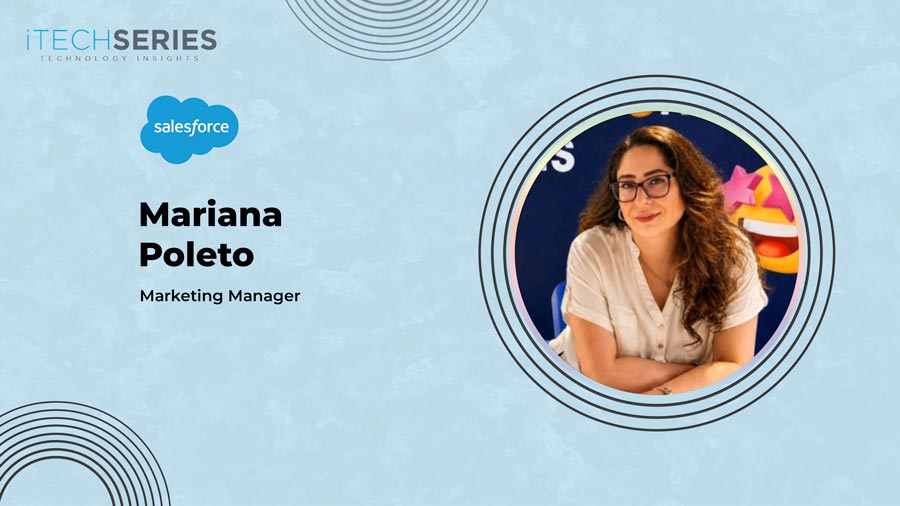
With more than 20+ years of experience across B2B and B2C marketing, Mariana Poleto, Marketing Manager at Salesforce, brings a growth-focused perspective shaped by global and regional leadership. Prior to Salesforce, she served as a Global Marketing Director at a global IT company. In this exclusive interview, she discusses evolving GTM strategies, AI-powered marketing, partner ecosystems, demand generation, and how marketing leaders can connect strategy, technology, and execution to drive sustainable growth.
Welcome to the interview series, Mariana. Could you tell us about yourself and your journey as a marketer?
Thank you for having me. It is a pleasure to be part of the iTechSeries Unplugged interview series.
I am a Marketing, Growth and Business Development executive with more than 24 years of experience across technology, services, retail and telecommunications, working with both B2B and B2C businesses and with organizations operating locally and globally.
My career started in traditional marketing, communications and brand management, but over time I became increasingly focused on a much broader question: how can Marketing directly contribute to business growth?
That question shaped my career.
I moved progressively from communications and brand into demand generation, digital, events, channel and partner marketing, Go-to-Market strategy, business development, revenue growth, and business transformation. Along the way, I had the opportunity to lead regional and global initiatives, build new business models, develop partner ecosystems, and work closely with Sales and executive leadership.
One of the most important transitions in my career was realizing that Marketing cannot operate as an isolated function. The strongest marketing organizations are deeply connected to the commercial strategy. They understand customers, markets, revenue, technology, and the sales cycle, and they can translate all of that into growth.
Today, my focus is on connecting strategy, people, technology, and execution to create sustainable business growth.
With years of experience across B2B and B2C markets, how have you seen GTM strategies evolve in the technology sector?
The biggest change I have seen is that Go-to-Market has evolved from being primarily a launch and campaign exercise into becoming a business growth system.
In the past, companies could often separate Product, Marketing, and Sales. Marketing would communicate value, Sales would sell it, and Product would develop it. Today, those boundaries are much less effective.
Technology markets are faster, buying journeys are more complex, and customers are much more informed before they ever speak with a salesperson. As a result, GTM needs to start with a deep understanding of the customer, the problem being solved, and the economic value created.
I have also seen a significant evolution from product-centric marketing toward customer-centric and outcome-oriented strategies.
My experience at Alvaria was a particularly strong example of this evolution. We developed a new Go-to-Market approach around areas where the business had competitive advantages, including Workforce Management, Outbound and Analytics/Automation. At the same time, we transformed the commercial model by building a modern partner ecosystem and shifting toward a high-growth partner-driven business model.
The result was very tangible: partner-driven sales grew by 50%, while regional partner sales increased by 30%.
For me, modern GTM is therefore not simply about getting a product to market. It is about creating an integrated growth engine around customer needs, commercial strategy, data, technology, and the right ecosystem.
How do you balance global GTM consistency with the need to adapt campaigns for different regional markets?
I believe in a principle I often describe as global strategy, local relevance.
The global organization should provide the strategic architecture: positioning, value proposition, brand principles, objectives, governance, technology, and measurement framework.
But execution needs to reflect the reality of each market.
Latin America is a good example. Even within LATAM, countries can have very different levels of technological maturity, purchasing behavior, partner ecosystems, competitive environments, and business priorities. A campaign that performs extremely well in one country cannot simply be translated and replicated in another.
The key is to distinguish between what must remain consistent and what should be adapted.
The brand, strategic narrative, and business objectives should be consistent. The messaging nuances, channels, content, partnerships, events, customer proof points, and activation strategy can, and often should, be localized.
My experience across regional and global roles has taught me that local teams should not be treated simply as execution arms of a global organization. They should be strategic contributors because they are closest to the market.
The best global GTM strategies create a framework that is strong enough to maintain consistency but flexible enough to allow local teams to create relevance.
Could you share your most challenging and successful go-to-market experience?
One of the most challenging and ultimately rewarding experiences was at Alvaria, when we were transforming the channel strategy and moving from a predominantly direct business model toward a partner-driven growth model.
This was not simply a marketing campaign. It required a fundamental change in the commercial ecosystem.
We needed to build new relationships with VARs, technology companies, influencers, and other strategic partners, while also transforming the channel and marketing organization, developing partner enablement programs, creating co-marketing initiatives, and building a global partner portal.
The challenge was particularly significant because the business had experienced several quarters of stagnation.
We were able to reverse that trajectory and generate more new customers in the first quarter than during the entire previous year, while also exceeding EBIT targets.
The broader results were equally meaningful: partner-driven sales increased by 50%, the channel team became the number-one sales team, and LATAM, Europe, and APAC ranked first, second, and third globally in 2023. We also achieved 100% utilization of MDF funds with ROI.
What made this experience particularly valuable was that it reinforced something I strongly believe today: the most successful GTM transformations happen when strategy, people, partners, technology, and commercial execution move together.
“Go-to-Market has evolved from being primarily a launch and campaign exercise into becoming a business growth system.”
In your experience, which demand generation strategies or channels have delivered the strongest results?
I don’t believe there is one universally successful demand generation channel. The strongest results come from an integrated system where each channel has a clear role in the customer journey.
In B2B technology, I have seen particularly strong results when demand generation combines targeted campaigns, partner ecosystems, events and webinars, sales enablement, digital channels, CRM, data, and continuous performance measurement.
Partners can be particularly powerful because they bring trust, market knowledge, relationships and access to customers. That was clearly demonstrated in my Alvaria experience, where the partner ecosystem became a significant growth engine.
Events and content can also be extremely effective when they are designed around business problems rather than simply product promotion. At AML Group, for example, I led more than 10 webinars and seven in-person events in one year, reaching more than 10,000 participants. I also led the IPLD Congress, which attracted more than 8,000 attendees and seven sponsors.
But the most important factor is what happens after the lead is generated.
Demand generation should not be measured only by impressions, clicks, or MQLs. It needs to connect to pipeline, opportunity creation, conversion, revenue, and ultimately customer value.
At AML, integrating Marketing, Sales, CRM, and Business Intelligence contributed to a 50% increase in qualified leads and sales opportunities and a 25% reduction in the average sales cycle.
That is the evolution I believe Marketing needs to continue making: moving from activity metrics to business impact.
How can automation and AI improve marketing efficiency while maintaining personalization?
AI and automation should not make Marketing less human. They should give marketers more time to be human where it matters most.
Automation is extremely valuable for removing repetitive work: segmentation, lead management, campaign orchestration, CRM workflows, reporting, data organization, and parts of the customer journey.
AI adds another layer because it can help marketers analyze large volumes of information, identify patterns, accelerate content development, improve targeting, and support more relevant customer experiences.
But there is an important distinction between personalization and simply adding someone’s name to an email.
True personalization comes from understanding context: what the customer is trying to achieve, where they are in the buying journey, what challenges they face, what information they need, and what is relevant to their business.
I see AI as an amplifier of human intelligence rather than a replacement for it.
This is also why I chose to deepen my own knowledge in the field, completing an MBA in Artificial Intelligence alongside an MBA in Management and Leadership in 2025.
The future belongs to marketers who can combine technology, data and AI with empathy, strategic thinking and strong business judgment.
What would you advise marketing leaders to prioritize today to drive sustainable business growth?
I would prioritize five things.
- First, understand the business before optimizing marketing.
Marketing leaders need to understand revenue, margins, customer economics, sales cycles, retention and the company’s strategic priorities. If Marketing cannot connect its work to business outcomes, it will always struggle to demonstrate its value.
- Second, build a strong Marketing-Sales partnership.
The traditional divide between Marketing and Sales is increasingly counterproductive. Both functions are responsible for the same customer and, ultimately, the same business outcome.
- Third, invest in data and measurement.
Marketing leaders need a clear line of sight from investment to pipeline to revenue. At AML Group, for example, I implemented a Business Intelligence function and integrated CRM and marketing automation to improve visibility into performance and decision-making.
- Fourth, build ecosystems, not just campaigns.
Strategic partnerships, communities, customers, influencers, technology alliances, and internal teams can become powerful growth multipliers. The 50% increase in partner-driven sales I experienced at Alvaria reinforced this lesson for me.
And finally, keep the customer at the center.
Technology changes quickly. Channels change. AI will continue transforming how we work. But sustainable growth still comes from understanding customers better than competitors do and creating meaningful value for them.
Ultimately, I believe the role of the modern marketing leader is no longer simply to promote the business.
It is to help design the business’s growth.
That requires strategic thinking, commercial discipline, technological fluency, creativity, and, above all, the ability to turn complexity into action.
About Mariana Poleto
Mariana Poleto is a Marketing, Growth, and Business Development Executive driving revenue growth, market expansion, and business transformation across global technology, software, telecommunications, and professional services organizations. She specializes in Go-to-Market strategy, demand generation, revenue marketing, partner ecosystems, and business development. Mariana has led cross-functional initiatives across Latin America and global markets, aligning Marketing, Sales, and Channel teams to build scalable revenue engines and drive sustainable growth through strategic innovation and transformation.