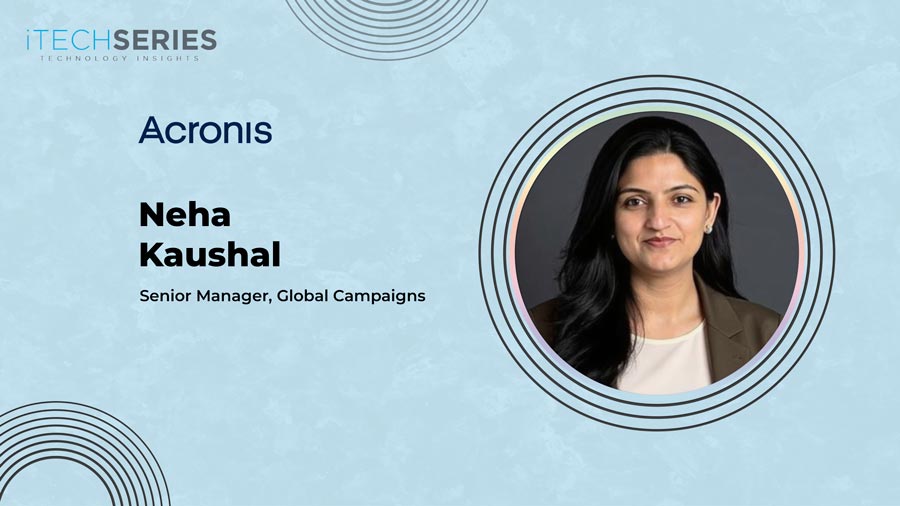
Neha Kaushal, Senior Manager, Global Campaigns at Acronis, explores how modern marketers can build global GTM strategies that balance consistency with regional relevance. She shares insights on aligning marketing with pipeline and revenue, adapting to AI-driven buyer journeys, leveraging intent signals and AEO, and developing the cross-functional skills needed to lead future-ready, customer-focused marketing organizations.
Welcome to the interview series, Neha. Could you tell us about yourself and your marketing journey?
I often say my career has been less about marketing and more about understanding people.
I was born and raised in India, studied in Canada, and have spent most of my professional career in the United States. Living and working across three countries has shaped how I approach business. It taught me that while technology scales globally, people don’t. Every market has different expectations, communication styles, buying behaviors, and cultural nuances, and those differences matter when you’re bringing products to market.
Professionally, I’ve spent more than 15 years in B2B technology marketing, with experience spanning brand marketing, integrated campaigns, partner marketing, demand generation, and global GTM strategy. My career began in brand and creative marketing, where I learned the importance of storytelling and customer experience. Over time, I became increasingly interested in the business impact behind every campaign, which naturally led me toward GTM leadership.
Today, I lead global GTM and integrated marketing initiatives across North America, EMEA, and APJ, partnering with Product, Sales, Marketing, and regional teams to launch products, drive pipeline, and accelerate partner-led growth.
Looking back, living across cultures has probably influenced my leadership as much as any job title. It reminds me to stay curious, listen before assuming, and build strategies that provide global consistency while leaving room for regional relevance.
How do you build a global GTM strategy that balances consistency with regional market needs?
One lesson I’ve learned from both my career and my personal journey is that there is no such thing as a truly “global” customer. Every region brings its own business culture, buying preferences, and ways of building trust.
Having lived in India, Canada, and the United States, I’ve experienced firsthand how communication styles and decision-making vary across cultures. Those experiences have influenced how I approach global GTM. Rather than trying to standardize everything, I focus on creating a strong global framework that regional teams can adapt with confidence.
The global strategy should establish the product positioning, messaging, launch framework, campaign architecture, and success metrics. That creates consistency across markets.
Regional teams then bring the local intelligence. The partner ecosystem in North America may be very different from EMEA. APJ markets often have different buying cycles, customer expectations, and channel preferences. Even the way executive buyers consume content or participate in events varies by region. Giving local teams the flexibility to tailor messaging, channels, and execution makes campaigns much more effective.
For me, successful GTM isn’t about headquarters dictating strategy. It’s about creating a two-way partnership where global teams provide direction, and regional teams continuously improve that strategy with market insights. That’s how you build programs that scale while still feeling relevant to customers wherever they are.
In what ways can revenue and pipeline data strengthen GTM performance and forecasting?
For many years, marketing was measured by inquiries, MQLs, and lead volume. Those metrics still have value, but they don’t necessarily tell you whether the business is growing.
I’ve found that the most productive conversations happen when Sales and Marketing align around the pipeline instead of individual departmental metrics.
We’ve all seen the classic scenario. Marketing says, “We generated plenty of leads.” Sales says, “The pipeline isn’t high quality.” Marketing responds that Sales isn’t following up quickly enough, and the conversation goes in circles. Nobody wins because each team is measuring success differently.
Pipeline changes that dynamic. It creates a shared definition of success and encourages both teams to work backward from revenue instead of defending their own KPIs.
That also changes how marketing operates. Rather than simply generating more leads, marketing starts asking better questions. Which campaigns are creating qualified opportunities? Which partner motions accelerate deals? Where are opportunities stalling? Which buying committees are actually progressing?
Forecasting becomes much stronger as well because pipeline data reflects the health of the entire revenue engine rather than isolated marketing activities. When Marketing, Sales, and Operations are all looking at the same dashboards and working toward the same outcomes, conversations become far more collaborative and much more actionable.
“There’s no such thing as a truly global customer. Every region has its own business culture, buying preferences, and ways of building trust.”
As AI, intent signals, and AEO evolve, what changes are you seeing in demand generation and buyer engagement?
The biggest change is that buyers are discovering vendors long before vendors even know those buyers exist.
We’re hearing more about the dark funnel, where prospects educate themselves through AI assistants, peer communities, Reddit, podcasts, analyst reports, YouTube, Slack groups, and technical documentation without leaving traditional attribution signals. By the time someone fills out a form or speaks with Sales, much of the buying journey has already happened.
That has important implications for marketers.
Instead of focusing only on gated assets and lead capture, organizations need to build a strong digital knowledge footprint. Technical blogs, implementation guides, product documentation, comparison pages, customer stories, thought leadership, and educational content all contribute to establishing authority that AI search engines can discover and reference.
This is where Answer Engine Optimization, or AEO, becomes increasingly important. It’s no longer enough to rank well in traditional search. We need to create content that AI platforms recognize as trustworthy, technically accurate, and helpful enough to surface when buyers ask complex questions.
Intent signals add another layer by helping identify which accounts are actively researching specific problems. Combined with AI, they allow marketers to personalize engagement based on where buyers are in their journey rather than relying on broad campaigns.
Ultimately, I don’t see AI replacing demand generation. I see it changing what good demand generation looks like. Success will come from building technical authority, earning trust long before a sales conversation begins, and making sure your expertise is present wherever buyers are seeking answers, even inside the dark funnel.
What advice would you offer aspiring marketers looking to build careers in GTM and integrated marketing?
One piece of advice I always give is don’t stay in your lane for too long.
Early in your career, it’s easy to become known as the email marketer, the events marketer, the social media expert, or the campaign manager. Those are valuable skills, but GTM leaders understand how all of those functions connect to create business outcomes.
Seek opportunities to work across demand generation, product marketing, field marketing, partner marketing, operations, analytics, content, and sales enablement. The broader your perspective, the better you’ll understand how marketing contributes to growth.
I would also encourage marketers to embrace AI rather than fear it. AI is already making many executional tasks faster, whether it’s drafting content, summarizing research, building reports, or analyzing campaign performance. Those capabilities will continue to improve.
What AI cannot replace is curiosity, judgment, empathy, creativity, and the ability to build relationships across teams. Great GTM leaders bring people together, navigate ambiguity, understand customers, and make strategic decisions that technology alone cannot.
The marketers who will thrive over the next decade won’t necessarily be the ones who know every new AI tool. They’ll be the ones who combine technology with business acumen, customer empathy, and a deep understanding of how every part of marketing works together to drive growth.
About Neha Kaushal:
Neha Kaushal is a global GTM and integrated marketing leader with 15+ years of experience building multi-region GTM engines, scaling integrated campaigns, and driving partner-led growth. Her expertise spans GTM strategy, demand generation, ABM, AI-enabled marketing, pipeline acceleration, and data-driven decision-making. She has led high-impact initiatives across North America, EMEA, APJ, and LATAM, helping technology brands accelerate adoption, expand market presence, strengthen partner ecosystems, and drive predictable revenue growth.