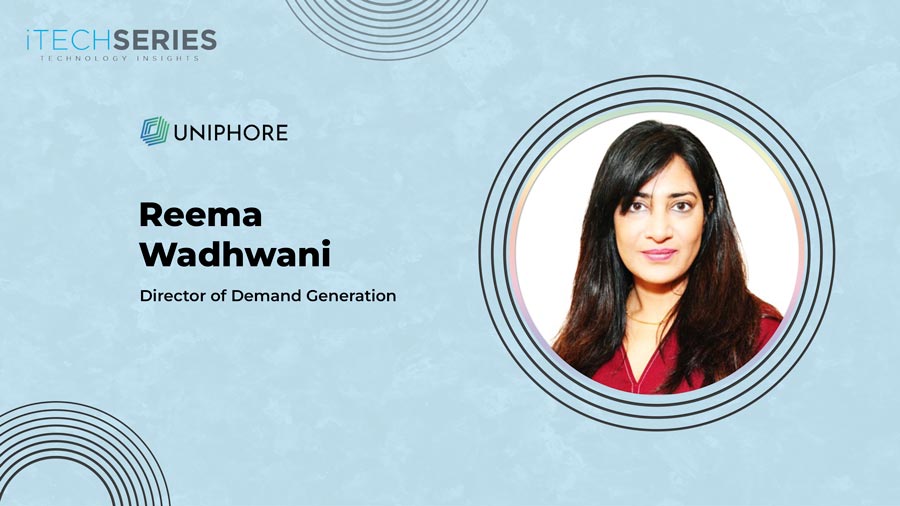
In this edition of the interview series, Reema Wadhwani, Director of Demand Generation at Uniphore, shares her perspectives on building revenue-driven marketing strategies through buyer-centric demand generation, effective ABM, and AI-powered customer intelligence. She discusses aligning marketing with sales, creating sustainable pipeline growth, and why relevance, precision, and commercial thinking are essential to modern B2B marketing success.
Welcome to the interview series, Reema. Could you tell us about yourself and your journey as a marketer?
There wasn’t really a five-year plan behind how I got into marketing. I didn’t map it out that way. I just took the work seriously wherever I was, and that shaped the direction over time. If I’m honest, I’ve always been a bit obsessed with what actually makes someone act. Early on, it showed up more in sales for me, not in a transactional way but in how immediate it is. You say something, and you can see pretty quickly whether it lands or not. I liked that feedback loop. It forces you to be honest about whether what you’re doing is working. When I moved into marketing, I didn’t see it as a separate discipline from that. It just felt like a different environment for the same question but less direct and more layered. What I’ve naturally gravitated towards in marketing is not the output itself, but the moments when hesitation turns into clarity. So, for example, I’ve always been more interested in things like where people drop off in a journey, what questions keep coming up in sales conversations, and which objections repeat themselves. That’s usually where the real signal is. And that’s also shaped how I think about marketing work. I’ve never been that interested in campaigns in isolation. I care more about whether something is actually removing friction or addressing a real issue that’s stopping a decision. If it doesn’t do that, it doesn’t really matter how good it looks. So I’d say it’s less been a planned path and more that I’ve kept following the same instinct—just applying it in different environments as my role has grown.
What are the key elements of a demand generation strategy that consistently drive pipeline growth?
Most B2B teams aren’t losing because they lack tools, data, or channels. They’re losing because they’ve built efficient systems to measure the wrong things and messaging that focuses on products while buyers are thinking about business problems.
Teams optimise for activity because it’s easy to measure. A pipeline is harder to explain. So MQLs increase, dashboards look healthy, and the business still misses its targets. That’s not a resourcing problem; it’s an architecture problem.
I’ve seen campaigns generate thousands of views but almost no pipeline. The targeting was right, but buyers don’t care how your product works. They care about what their problems are costing them in lost revenue, risk, and inefficiency. When messaging shifts from product features to measurable business impact, the conversation changes.
Consistent pipeline growth comes down to four elements working together, not operating in silos.
The first is combining intent and trigger data with a single business-value narrative that aligns every campaign, channel, and sales conversation. Without this foundation, everything else leaks.
The second is creating demand among buyers who aren’t actively looking yet. Only about 5% of your market is in-market at any given time. If your strategy focuses only on capturing that audience, you’re competing with everyone else. Strong demand generation invests in the other 95% through educational content, thought leadership with a clear point of view, and events that strengthen long-term account relationships.
The third is capturing demand with precision. Trigger-based outreach around funding rounds, executive hires, or product launches makes conversations timely and relevant. Paid media and SEO help reach buyers already searching. Success isn’t about reaching more people—it’s about reaching the right people at the right moment with a message that matters.
The fourth is aligning the entire revenue function. Shared goals should focus on pipeline, not MQLs. Attribution should reflect buying groups rather than individual leads, since B2B purchasing decisions involve multiple stakeholders. Most importantly, sales insights should continuously inform marketing so messaging evolves with real customer conversations.
When these four elements work together, buyers experience a consistent, compelling story across every touchpoint. That’s not just a campaign—it’s a demand generation system that consistently drives pipeline growth.
What separates successful ABM programs from those that fail to deliver results?
ABM is a human discipline, not a tech stack.
Most programs fail before they send a single piece of outreach. The platform gets bought, the account list gets built, and teams move straight to execution without answering the most basic question: what does this account actually care about right now?
The result is generic messaging sent to a list of accounts with a personalised first name. That’s not ABM. That’s spray and pray with a higher price tag.
Signals tell you when to show up, not what to say. Funding rounds, leadership changes, and intent spikes are valuable, but they’re only prompts. Teams that mistake signals for strategy end up with fast outreach and irrelevant messaging. The tools find the door. Execution is what happens when you knock.
The account list isn’t a target—it’s a commitment. If your list has thousands of accounts, you’re not doing ABM. Real ABM means a deliberately small list and a genuine understanding of every account: what they’re trying to achieve, what’s competing for their budget, and where you fit. Messaging should reflect that by vertical, account, and business problem.
Most programs also engage only one or two people, even though nearly seven stakeholders influence the average B2B purchase. Map the full buying committee and speak to each stakeholder’s priorities instead of sending the same message to everyone.
Since 94% of buying groups rank preferred vendors before speaking to sales, and the top-ranked vendor wins 80% of the time, success depends on showing up with something meaningful to that specific account—not simply showing up first.
ABM rewards teams willing to do the slow, human work. It punishes those who expect technology to think. Signals identify who to approach. Account-specific, vertically aligned execution determines whether they engage.
The same principle applies globally. Localisation isn’t translating assets or changing logos. Your core positioning and value proposition should remain consistent across markets, but the stories, customer examples, industry references, and framing should reflect local realities. A CFO in Singapore and one in Frankfurt may share the same challenge, but not the same context. Global provides the spine. Local provides the story. You need both to deliver messaging that’s consistent, relevant, and credible.
What frameworks have helped you create stronger collaboration between marketing, sales, and customer-facing teams?
The most effective collaboration frameworks aren’t complicated. But they require marketing to do something uncomfortable: get out of the campaign room and into the customer conversation.
Three things have made the biggest difference.
Joint planning sessions. Marketing is not presenting a plan to sales. Both functions in the room build from the same starting point: the accounts, the verticals, and the specific problems they’re trying to solve. When sales have shaped the plan, they own it. When they own it, they use it. That shift alone changes the dynamic.
Marketing sits in on sales calls. This is the fastest way to close the gap between what marketing says and what buyers respond to. You hear the real objections. The language buyers use to describe their problems. The moments where your messaging lands, and the moments where it clearly doesn’t. No research report replaces it. An hour on a sales call is worth a month of assumption-based campaign planning.
Regular win/loss reviews. Real conversations about why deals were won and why they were lost with marketing in the room, not just sales leadership. When marketing understands why the last ten deals closed or didn’t, everything changes. The messaging, the content, the campaigns—they stop being generic and start being uncomfortably accurate.
The intelligence to make all this work already exists in most organisations. It lives in sales calls, in customer advisory boards, in social listening, and in the unfiltered conversations buyers have when they think no one is watching. The problem isn’t access. It’s that it never gets shared.
“Buyers care about what their problems are costing them in lost revenue, risk, and inefficiency.”
AI is reshaping how marketers engage buyers and measure performance. Where do you see the biggest opportunities for marketers today?
Most teams are using AI to do more of the same. More emails. More content. More outreach. Faster, cheaper, at scale. And in doing so, they’ve industrialised the very thing that was already broken: generic messaging sent to the wrong people at the wrong moment, just with greater efficiency.
The opportunity isn’t volume. It’s precision.
AI gives every marketer the ability to understand their market at a depth that was previously only possible for the biggest teams with the biggest budgets. Know which accounts are showing buying signals before your competitors do. Understand the language buyers actually use to describe their problems. Measure what’s really driving pipeline, not just what’s driving clicks. Personalise at the account level without an army of people doing it manually.
That’s not a content problem. That’s a customer intelligence problem. And AI solves it, if you let it.
The teams pulling away from the field aren’t the ones using AI to produce more. They’re the ones using it to get closer to the customer faster, more precisely, and more consistently than was ever possible before. They’re using it to do the slow, human work of understanding buyers at scale.
AI doesn’t change what great marketing looks like. It just removes the excuse for not doing it.
What advice would you give to marketers looking to build high-performing growth and demand generation programs?
The best demand gen marketers I’ve seen aren’t the ones who execute the playbook perfectly. They’re the ones trusted to know when the playbook is wrong.
Too many programmes are built around process compliance, the right cadences, the right channels, and the right metrics while nobody is asking whether the strategy underneath it is actually working. Autonomy matters. The marketers who build high-performing programmes are the ones given the space to think, not just execute.
Here’s what that looks like in practice.
Build for the long game and the short game simultaneously. Most programmes are built entirely around buyers in the market right now. That’s not a growth strategy; it’s a queue. The programmes that compound invest in both. Creating demand with buyers who aren’t looking yet, while capturing the ones ready now. One fills the pipeline today. The other makes sure it never runs dry.
Own a revenue number, not a marketing metric. Most programmes lose credibility with the business because they optimise for marketing metrics while the organisation is asking revenue questions. The pipeline should be 4x to 5x the ARR target. Marketing-sourced opportunities should be closing at a rate sales trust. And the conversation shouldn’t stop at a new logo: what’s the retention plan? What’s the expansion motion? Demand gen that hands off at the closed deal is leaving money on the table. Not “we generated 400 MQLs.” But “marketing contributed to 35% of closed revenue, the pipeline is at 4.2x, and expansion from existing accounts is up.”
Let data lead, but let judgement decide. Data tells you what happened. Judgement tells you what to do next. The best demand gen leaders connect marketing activity to revenue outcomes, not just engagement metrics. They’re honest when something isn’t performing and pivot fast. But they also know which channels compound over time and when to hold their nerve through a slow quarter rather than abandon a strategy that’s working.
Analytical rigour and commercial sharpness. You need both. But neither replaces the confidence to back your own thinking.
About Reema Wadhwani
Reema Wadhwani is a transformative marketing leader with deep expertise in demand generation, ABM, and digital strategy. She has helped SaaS, AI, and enterprise technology companies accelerate growth and strengthen market position. Passionate about turning complex technology into measurable business outcomes, Reema has led high-impact, multi-channel marketing programs that boost pipeline, improve conversion rates, reduce acquisition costs, and foster strategic partnerships that drive sustainable revenue growth and customer engagement.