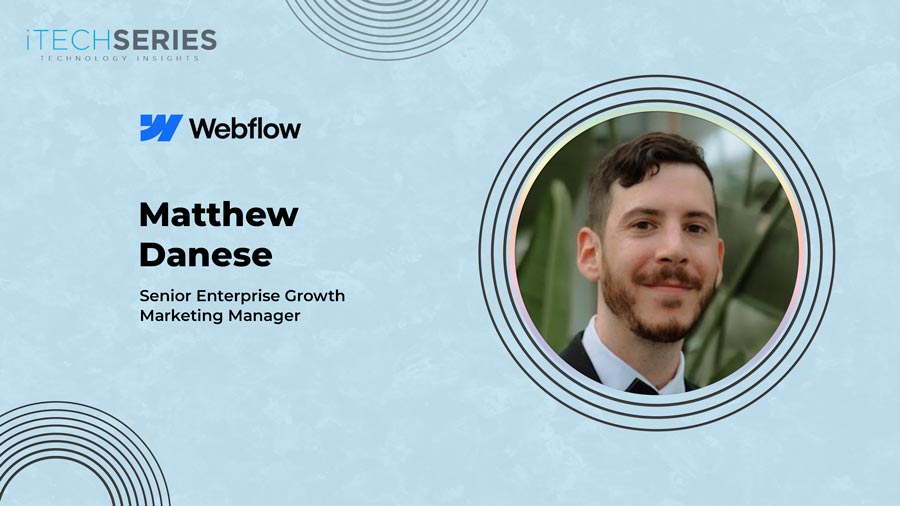
Matthew Danese, Senior Enterprise Growth Marketing Manager at Webflow, shares his perspective on building demand generation programs that drive real pipeline growth. He discusses the importance of ICP clarity, full-funnel accountability, scalable global growth strategies, evolving enterprise buying journeys, AI-powered personalization, and cross-functional alignment in modern B2B marketing.
Welcome to the interview series, Matthew. Could you tell us about yourself and your journey as a marketer?
So I started my career writing copy for a rug and furniture company, which was not exactly a glamorous entry point, but I knew marketing was where I wanted to be, and I needed a foot in the door. From there, I moved to a law firm where I handled digital marketing, and about a year and a half out of college, my two other marketing colleagues quit at the same time, so overnight, I became a one-person department with no real idea what I was doing.
That forced education was probably the most valuable thing that happened to me early on. I had to figure out SEO, paid media, CRO, content, PR, and traditional marketing simultaneously. And not because it was a growth plan, but because there was no one else to do the job. That generalist foundation has followed me through every role since and helped me really expand the width of my T-shaped marketing experience.
I spent the years after that moving through tech startups, going deeper into each discipline, and eventually narrowing into paid media as my core. Now I run enterprise paid media at Webflow. Brand and Demand Gen across LinkedIn, Google, Meta, Reddit, and YouTube (and more experimental channels like ChatGPT Ads) to drive real pipeline, not just impressions.
The thing I keep coming back to is that this field never stops changing. AI has genuinely transformed how I work. The pace at which I can analyze, test, and iterate looks nothing like it did three years ago. That constant evolution is what I’ve always loved about marketing.
You’ve built demand generation programs across multiple organizations. What core principles have consistently driven pipeline growth?
A few things have held up regardless of company size or channel mix.
First: get the ICP right before touching the budget. The most expensive mistake in demand gen is spending efficiently against the wrong audience. High CTRs and low CPLs don’t mean anything if the leads don’t convert to pipeline.
Second: own the full funnel, not just the top. Demand gen doesn’t end at the lead. I’ve always pushed to understand what happens after a form submit, how leads are scored, how they’re routed to sales, and where they drop off. If I’m generating MQLs that sales is ignoring, that’s my problem to fix, not theirs.
Third: Platform data is directional, not the truth. This is something I’m pretty firm on. LinkedIn and Google will tell you what you want to hear if you let them. I always reconcile against CRM data (Salesforce and Tableau currently) before drawing any conclusions. The delta between platform-reported conversions and actual MQLs in the database is often where the real insight lives.
And fourth: test with structure. Not random experimentation, structured tests where you know what you’re changing, why, and what outcome would change your decision. Most “testing” I see is just spending money in different places and calling it a test.
As a Growth Marketing Manager, how do you build scalable growth strategies while adapting to the unique needs of local markets?
The core tension in international expansion is that what scales globally often misses locally, and what works locally doesn’t always tell you anything useful at scale.
My approach is to treat regional markets as distinct audiences first, not as footnotes to a global strategy. At Webflow, EMEA is always segmented separately from NAMER before any analysis. That’s not just a reporting preference; it’s because EMEA leads have historically shown different SAO pull-through rates, different creative response patterns, and different buying timelines. If you lump them together, you mask NAMER performance and draw the wrong conclusions about what’s working.
Concretely, that means separate campaign structures, separate budgets, and separate creative work where the buying context differs. It also means being honest about where you have enough data to optimize versus where you’re still in learning mode. I’d rather acknowledge uncertainty than over-index on a small EMEA sample and build a strategy on shaky signals.
The scalable layer is usually the framework, not the execution. Audience architecture, attribution logic, and funnel stage sequencing are the principles that translate. The messaging, the creative angles, and sometimes the channels need to flex by market.
Enterprise buying journeys have become more complex. How has your demand generation strategy evolved to engage modern B2B buyers?
The biggest shift I’ve made is moving away from thinking about demand gen as a lead-capture exercise and toward thinking about it as a buying environment you’re building over time.
Enterprise deals don’t happen because someone clicked an ad and filled out a form. They happen because a buying group (usually five to ten people) independently encountered your brand, formed a point of view, and eventually reached a moment where the problem was urgent enough to act on. My job is to be present in as many of those moments as possible, not just to capture the ones at the bottom.
That’s changed how I think about channel mix. LinkedIn isn’t just a lead gen platform for me. It’s where I’m building familiarity with buying committees who might now convert for six months. Brand awareness campaigns, thought leadership content, sponsored messages to specific account lists, etc. Those aren’t soft plays; they’re infrastructure for the demand that shows up later.
It’s also changed how I evaluate what’s working. I pay attention to pipeline velocity and SAO quality, not just MQL volume. A high-volume quarter that produces a low-quality pipeline is worse than a lower-volume quarter where the leads close. That downstream orientation has to be built into how you measure and report, not just how you think.
“When you anchor the conversation on what we’re all trying to accomplish rather than defending your lane, alignment gets a lot easier.”
How are AI and automation reshaping growth and demand generation strategies in marketing?
Honestly, it’s less about AI replacing workflows and more about AI removing the excuse for not doing the high-value work.
The things that used to take days, like pulling performance data, synthesizing cross-channel reports, writing creative variations, and building audience logic, can now happen in hours. That’s meaningful, but only if you use the time it frees up to think harder about strategy, not just move faster on the same tasks.
Where I think the real shift is happening is in personalization at scale. Enterprise buyers expect relevance. The right message for their industry, their role, their stage in the buying journey. That was hard to operationalize before. AI makes it tractable. Dynamic landing pages, account-specific ad sequencing, and real-time creative adaptation aren’t experiments anymore; they’re becoming table stakes.
The other piece I’m watching closely is AI’s impact on search behavior. Buyers are increasingly getting answers from AI assistants rather than clicking through to search results. That changes the demand capture game. If your brand isn’t being cited in AI-generated responses, you’re invisible in a growing share of the discovery journey. Answer engine optimization is something I’m building into our paid strategy flywheel now.
The risk with AI and automation is using it to go faster without getting smarter. Automation amplifies whatever strategy you put into it, and if the strategy is wrong, you just fail faster. The fundamentals (ICP clarity, offer relevance, down-funnel measurement) still determine whether any of this works.
Could you tell us about your most memorable experience as a marketer?
Two very different experiences come to mind, and I think together they capture the full range of what makes this job interesting.
The first is being part of the Kustomer acquisition by Meta. Going from a scrappy startup into one of the largest companies in the world was genuinely eye-opening. The scale is one thing, but what stuck with me was the access. Being surrounded by hundreds of incredibly talented marketers and being able to just reach out to anyone across the business to learn. That internal network was something I’d never experienced before, and it reshaped how I think about building connections and investing in the people around me.
The second is a lot harder to explain on paper. I once stood outside Madison Square Garden during the Westminster Dog Show, getting strangers to talk to an AI dog. Experiential marketing at its most unhinged, but there’s something about being that close to real people reacting to something in real time that no dashboard can replicate. You learn things about how people actually respond to ideas that you’d never pick up from platform metrics.
One experience taught me the value of being inside a world-class machine. The other reminded me that marketing is ultimately about human reaction, and sometimes you have to go stand outside a dog show to remember that.
How do you build strong cross-functional alignment across sales, product, content, and marketing teams?
The honest answer is that alignment is mostly a communication design problem, not a relationship problem. Most cross-functional friction comes from people operating with different information, different success metrics, or different timelines, not from bad intentions.
The thing that’s worked best for me is radical specificity about what I own and what I need from others, delivered proactively. If I’m launching a campaign, sales need to know what the lead criteria are, what the follow-up SLA expectation is, and what they should say when a lead references the ad. If I don’t tell them that, I can’t blame them when the handoff breaks.
With the product, the key for me has been timing. Campaigns that launch before product UX is ready, or that promise a capability that’s two releases away, create downstream trust problems that are hard to recover from. I try to build a direct line to the product early, not to get a seat at every meeting, but to have enough visibility that I’m not caught off guard.
With content, the alignment question is usually about intent match, so is the content we’re promoting the right offer for where this audience is in the funnel? That conversation goes better when you show up with data (“this asset drives 3x the MQL pull-through of that one”) rather than opinions.
The throughline is leading with shared outcomes. Sales wants a pipeline. Marketing wants a pipeline. Product wants adoption. Content wants to build authority that drives the pipeline. When you anchor the conversation on what we’re all trying to accomplish rather than defending your lane, alignment gets a lot easier.
About Matthew Danese:
Matthew Danese is a B2B demand generation and growth marketing leader with over nine years of experience building full-funnel programs across startups and enterprise organizations. Currently leading enterprise paid media at Webflow, he specializes in demand generation, paid media, ABM, CRO, and AI-powered growth strategies. Known for his data-driven approach, Matthew focuses on driving measurable pipeline growth, optimizing buyer journeys, and aligning marketing efforts with business outcomes.