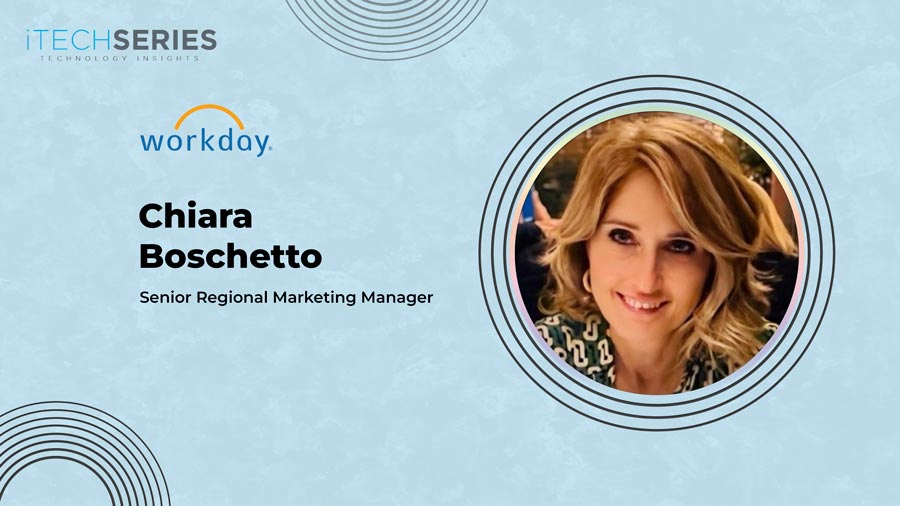
Chiara Boschetto, Senior Regional Marketing Manager at Workday, shares how her journey from global agencies to SaaS and consulting has shaped a modern B2B marketing approach rooted in integration and impact. She discusses balancing brand building with demand generation, aligning marketing with revenue teams, leveraging AI and data, and adapting global strategies to local market realities.
Welcome to the interview series, Chiara. Could you tell us about yourself and your journey as a marketer?
Curiosity, adaptability, and continuous learning to undertake new roles and responsibilities have been the drivers of my journey. Over the last decade, I have worked primarily in B2B and international environments, navigating a wide variety of industries and markets that have each left their mark on how I think about communication, strategy, and the role that marketing truly plays within an organisation.
My real beginning, and for more than 10 years, saw me take my first step in PR and events, working for the main global marcom companies like Omicom and WPP, managing multi-country projects for global companies. After that experience, it happened that I became a sales marketing manager with a trading company where I had to deal with the Russian steel market. It was a big bet in a completely different scenario, which allowed me to stay closer to customers and learn a lot about negotiations and field marketing.
I have also created my own business in consultancy and ran it for 7 years before landing at Workday as a Marketing leader for Italy, coordinating with many cross-functional teams.
Here I met with the tech industry during the very challenging time of the AI Revolution. I built a transversal skill set spanning digital channels, email marketing, social media, content strategy, and data analysis—not because I set out to master every discipline, but because each project I took on demanded that I expand my toolkit. In complex B2B environments, you quickly learn that no single channel tells the full story and that the most effective campaigns are the ones that connect the dots across multiple touchpoints, and the new AI tools are the best ally and assistant you can have.
Perhaps the most defining aspect of my professional development has been the ability to manage the full lifecycle of a marketing project while maintaining a clear, unwavering connection to business objectives. That means good relationships and a listening attitude with the full extended sales team. I have always believed that marketing should never operate as a silo. It is, at its best, a function that bridges different teams, translates complexity into clarity, and gives voice to what an organisation stands for in ways that resonate with the people it is trying to reach.
Every role I have taken on, and it continues to inform how I approach new challenges today.
How do you maintain the right balance between long-term brand building and short-term lead generation in a competitive B2B environment?
In B2B, especially in complex and technical sectors, I believe this balance comes from integration and adapting to local needs.
It is not just a matter of program execution and campaign translation but something like building your house with respect to the Master Plan and with solid foundations.
Solid foundation and Master plan are given by long-term brand building and should be your North Star, but in your everyday life you need to generate interest of your local leads every day to create a rich and appropriate funnel from top to bottom through tactical campaigns and events, which I usually put in place with the support of salespeople and Customer Success, tailored to their needs.
Short-term lead generation works better when it is supported by consistent brand positioning. That is why I prefer to focus on building content that has both immediate and long-term value; for example, third-party high-level content or educational content can nurture trust over time while also being used as a lead-generation asset.
At the same time, I continuously monitor performance data to understand where we are and adjust the actions to be taken to reach our goal. The final goal is to ensure that every campaign contributes to both pipeline and brand equity.
Where has marketing’s role changed over the last few years, especially with more integration with the other revenue functions?
Marketing has become much more accountable and integrated thanks to the new technology and AI.
Today, it plays a key role across the entire customer journey, not just in awareness. Customer must be at the core; we can have data on their engagement on a daily basis, and we can adapt our plan day by day.
This means working closely with sales, customer support, and product teams, sharing insights, and aligning on common goals.
In my experience, this shift requires marketers to be more data-driven and business-oriented. Understanding pipelines, customer needs, and feedback loops is essential to creating campaigns that are not only creative but also impactful in terms of revenue and customer experience.
The risk? I see the main risk in staying at your desk all day long and forgetting to connect with real people, your customers, and partners and losing contact with the market. So, my alert is let’s use data, new tools, and AI, but let’s stay connected with humans, customers, other marketers, and colleagues to stay in touch with our market’s needs and trends.
“Marketing should never operate as a silo. It is, at its best, a function that bridges different teams, translates complexity into clarity, and gives voice to what an organisation stands for.”
How do you factor in regional considerations while planning or executing a marketing program?
Working in international contexts has taught me that localisation is not just about language but about culture and relevance.
I usually start from a global strategy but then choose only the campaign I consider relevant for my market, adapt messaging, channels, and priorities based on the specific characteristics—such as maturity, cultural context, and customer expectations.
Collaboration with local teams is essential: they bring insights that data alone cannot provide. This approach allows me to maintain consistency while ensuring that campaigns resonate at a local level.
Can you tell us about your most memorable experience as a marketer?
One of the most memorable experiences was a multichannel campaign I designed around spare parts and preventive maintenance.
Instead of using a purely technical approach, I developed a storytelling concept based on irony and real-life scenarios. We even involved the technical team as actors to make the message more authentic and engaging.
The campaign ran organically over several months and led to a +20% increase in spare parts orders. Beyond the results, it was a great example of how creativity can make a difference even in very technical B2B contexts.
Beyond the traditional metrics, what is a good indicator of whether the marketing campaign has been successful?
Beyond traditional KPIs, I look at how marketing impacts real business interactions.
For example:
- Whether sales teams actively use marketing content and involve you in their plans.
- The informal conversations with prospects and customers about your company/brand.
- The customer engagement and emotional response.
If a campaign helps create better conversations, improves understanding, and supports decision-making, then it is truly successful.
What would be your advice to marketers who are starting their careers?
My advice is to build a hybrid mindset and be ready for the future.
Marketing today requires both creativity and analytical thinking, so it is important not to specialise too early in just one area. Try to understand how different channels work together and how marketing connects to the broader business.
Learn by doing. Real projects—especially the challenging ones—are where the most valuable learning happens.
And most importantly, never stop studying. When you finish your university or Master it’s just the beginning!
About Chiara Boschetto:
Chiara Boschetto is Marketing Leader at Workday, driving strategic and executional success across Italy. With experience spanning global agencies, commodities trading, consultancy, and tech, she has led field marketing, communications, and demand generation roles across B2B and consumer industries. Her career reflects a strong focus on integration, adaptability, and connecting marketing to business outcomes through data, storytelling, and cross-functional collaboration.