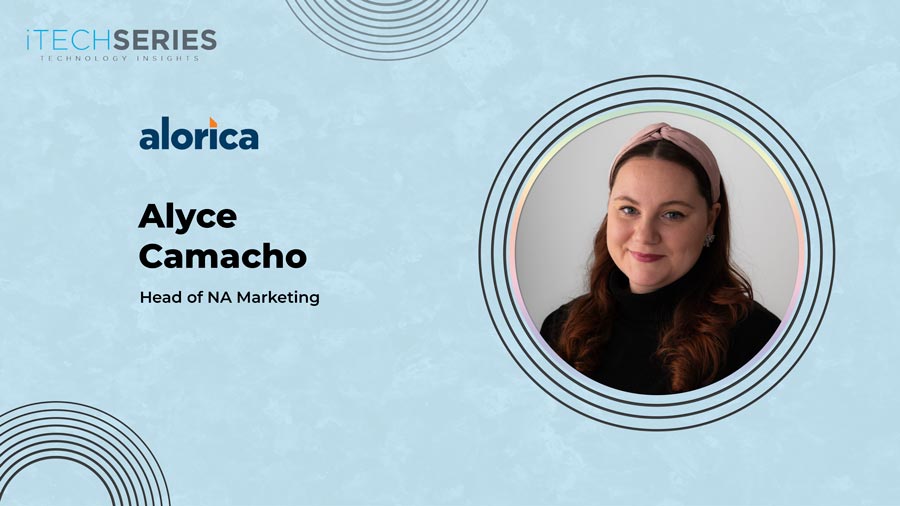
In this ITech Series Unplugged interview, Alyce Camacho, Head of NA Marketing at Alorica, shares her unconventional journey from teaching and hairdressing to leading marketing expertise. She dives into aligning strategy, technology, and execution; balancing ROI; and leveraging AI, while keeping the human touch at the core of modern marketing and building impactful, scalable growth strategies.
Welcome to the interview series, Alyce. Could you tell us about yourself and your journey as a marketer?
My marketing background is pretty untraditional. My life plan was originally to be an English teacher during the school year and be a hairdresser during the summer. But after high school graduation, I was always helping small businesses with their marketing, and that passion bled into my life as a teacher and a hairdresser.
When I was a teacher, I would go to recruiting events and try to recruit other teachers. Then, when I was a hairdresser, I would go to brand events for our hair care lines and help promote their products, or I would assist other hairdressers with the marketing of their book of business.
It felt like no matter what I did, I was doing marketing.
When COVID hit, and I was no longer able to teach in a school, it made me slow down and rethink my career trajectory. It was then that I decided to pivot my career toward a corporate environment. That’s when I became a recruiting strategist at Kelly Education.
It was a lot of fun, and from that role, I took on my current position as NA Recruitment Marketing Manager at Alorica, where I really evolved into a regional leader and got the full depth of what it is to be in a corporate environment in a more senior marketing role.
Now I’m building my own business in a larger way, and I’m helping businesses—no matter their size—achieve better marketing through branding, strategy, and AI automation.
In your experience, across strategy, technology, and execution, how is alignment maintained in real-world campaigns?
I think all of these things work in tandem naturally, but with strategy being the overarching theme. Without a strategy, we have nothing—we can’t anchor ourselves to the technology if we have no path to follow, and execution is the bridge between the technology and the strategy.
The goal, though, should be to always make sure any technology or execution is supporting your strategy and feels like it’s enhancing your strategy, not just adding additional steps for the sake of more.
How do you measure and balance ROI when managing advertising budgets across multiple recruitment campaigns?
I love this question simply because, between my business and corporate role at Alorica, I feel this tension to my core, but what helps me keep everything balanced is good organization, strong systems, and impeccable follow-up.
Then, with all this in balance, I always make sure to take what I learn from one account and apply it to others.
I saw someone on LinkedIn recently say that marketing is changing so fast it’s hard to anchor yourself in knowledge or a steady process, and partly it’s true, but part of why so many of us are attracted to this industry is because we are evolutionary learners—we love to evolve.
So the way we measure ROI will change, and the way we balance will change, but the framework doesn’t.
When evaluating multiple go-to-market campaign ideas, how do you determine which ones are worth pursuing?
I have been known to dream, so this question really hits home for me.
When you’re working with a lot of different ideas, I like to break them into short-term wins and long-term wins. Understanding the dynamic of your GTM strategy is critical—what are your clients requesting, what situation are they in, and what does their timeline look like?
I always aim to include a few short-term wins while making sure they are protected long-term.
And to be honest, one question has always made my clients feel confident in the direction I advise: “From this conversation, is there anything left to be desired?”
By asking that question throughout my career, I’ve been able to align entire teams probably like 99% of the time.
How do you strike the right balance between long-term brand building and short-term demand generation in your marketing strategy?
This is another great question. With some brands, building long-term consistency can feel like a moving target, especially in today’s economy and landscape.
But I always keep the long-term destination in the forefront of my mind and make sure that all the short-term decisions we’re making stack up to that.
Being anchored in recruitment marketing, I understand the necessity of short-term demand generation. However, I like my clients to flex their mind muscle and envision what things will look like long-term.
I think a lot of leaders have a habit of living in the now, but brands are built in the long run. They’re built through depth and patterns, and it’s critical that, as a marketing leader, I help my clients correlate the two.
“Understanding the dynamic of your GTM strategy is critical—what are your clients requesting, what situation are they in, and what does their timeline look like?”
Where has AI had the most impact in your marketing strategy and execution?
It’s funny because throughout this whole interview, you can see that there’s this element of change. This isn’t something we run from—it’s something we embrace.
If you had asked me this question in 2025, I would’ve said AI is seeping into every single aspect of business. Now, I think we’re being much more intentional and methodical about where AI enters marketing, mainly because it’s changing so often.
We’re trying to understand where our point of difference is.
In recruitment marketing, that point of difference is the human touch. You still want the process to feel human.
In my business, where I’m helping retail and service industry leaders, it’s more about ease and experience—whether that’s a chatbot helping someone pick the right product or creating a seamless booking experience.
AI looks different in every industry, and it will be used in different ways.
Where I caution marketing leaders is in creativity. If we continue to rely on AI heavily in a creative capacity, I do wonder what happens to the creator. So… food for thought.
What advice would you give to marketers who are just starting?
These are such great questions.
My number one tip is don’t be intimidated. What you learn today, you may have to unlearn tomorrow.
There are so many people in this industry, and it can feel overwhelming, but most marketers have a focus. I’ve come across very few true generalists—everyone has a fingerprint.
You’ll have a specific niche, a specific way you help people, and through that, you’ll develop your own individuality.
There’s this ongoing joke that marketing departments often fall on one very well-rounded person—but it’s true. Marketing is a large-scale concept. It includes sales, advertising, social media, and now AI, which adds another layer.
My biggest piece of advice is don’t let the amount of knowledge overwhelm you, and don’t let people make you feel like you have to be everything.
It’s okay to start specialized. It’s okay to become a generalist. It’s okay to move back and forth. Wherever you fall on that spectrum is fine—just don’t be intimidated, and be willing to learn.
My second tip is to find a mentor—someone who will advocate for you, help you upskill, and give you honest feedback.
Early in my career, I was constantly reading case studies and building brand decks.
Marketing is all around us.
One of my favorite theories is that the world is just one big marketing campaign… so have fun with it. That’s how you find your personality in marketing.
About Alyce Camacho
Alyce Camacho is a marketing leader with over a decade of experience building and leading a consulting and advertising agency. She currently heads Marketing for North America at Alorica, driving data-driven strategies at scale. Her expertise spans strategy, technology, and execution, with a strong focus on people, systems, and sustainable growth. She is also passionate about mentoring and helping businesses achieve meaningful marketing outcomes.