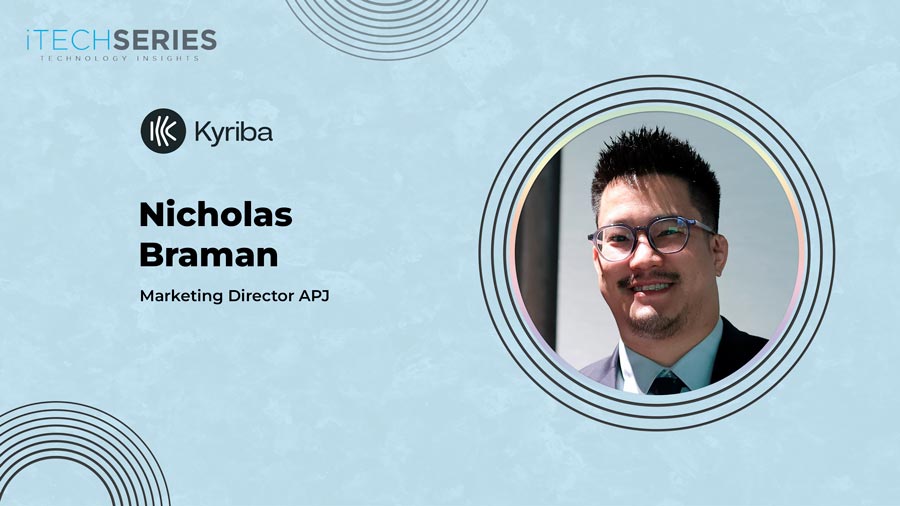
As AI reshapes marketing and enterprise teams prioritize revenue alignment, marketers must rethink how they create value. In this interview, Nicholas Braman, Marketing Director APJ at Kyriba, shares insights on aligning marketing with sales, leveraging AI for strategic advantage, building scalable demand generation and ABM programs, measuring meaningful outcomes, and developing the leadership mindset for long-term success.
Welcome to the interview series, Nicholas. Could you tell us about yourself and your journey as a marketer?
When I land in a new role, the work usually starts the same way. A region or a category where the marketing playbook hasn’t been built yet, and I build it.
I came across Shanghai and Singapore, then spent four years at Ingram Micro Cloud running channel marketing across ASEAN and Hong Kong. That’s where I first learned the true meaning of regional execution by building cross-market programs in areas that had previously been treated as isolated geographies.
After Ingram, I moved vendor-side and stayed there. BitTitan. Dataiku. Now Kyriba, where I’m Marketing Director APJ. At Kyriba I’ve been building demand generation and ABM across a region that historically hadn’t run as a coordinated marketing motion. KyribaLive X, our regional flagship, has grown from 80 attendees in its first year to 300 in its third. The companies are different; the categories are different. The job is always roughly the same. Walk into something that doesn’t have a working version yet, and figure out how to make it work.
I didn’t plan for that pattern, but I’ve come to suspect I’m drawn to it for a specific reason. The work where the playbook already exists is the work where the upside is bounded. The places where it doesn’t yet exist are the places where what you build can still matter.
The pattern is the career. I’m not sure if I chose it or it chose me.
What are the most important elements of a successful marketing and sales alignment strategy in enterprise B2B organizations?
A shared scoreboard, and the right one. If marketing measures itself by MQLs and sales measures itself by closed-won, you’re already misaligned, and no amount of process will fix it. The only metric that produces real alignment is pipeline and bookings, owned jointly.
Yes, marketing tracks its own sourced and influenced contribution. That’s how we judge our performance and where we lean in. But mature teams don’t live and die by attribution arguments. The number we’re chasing is the same number sales is chasing. If you find yourself in monthly meetings fighting over whether a deal was marketing-sourced or sales-sourced, the issue isn’t your attribution model. The issue is that marketing and sales aren’t actually working toward the same goal yet. Fix that first.
Second, language. Marketers default to marketing language: funnels, channels, engagement scores. Sales talks about deals, stages, and pipeline coverage. The fix is for marketers to learn to speak in sales terms, fluently, by default. Pipeline stages. Deal velocity. Forecast risk. Account intent signals. If you cannot translate your work into those terms unprompted, you are not aligned. You’re just adjacent.
Third, frequency of real conversations. Not status meetings. Sit with the AEs. Listen to what they’re actually telling prospects. Notice when their language drifts from yours and figure out why.
The rest is theater.
How do you see the role of marketers evolving as AI becomes more integrated into daily workflows?
The cost of execution is collapsing. Creating a landing page, a sequence, a webinar abstract, and a first-pass campaign brief—all of it is getting close to free. Which means the work that used to define a marketer’s value, producing the output, is no longer where the value sits.
Judgment is where it sits. Taste. Knowing what not to do.
I think we’re heading into a period where the marketers who win are the ones who can look at a sea of plausible AI-generated options and pick the one with the most signal in it. The ones who can say “no, this is the wrong campaign, even though it scored well on the rubric” have a different muscle than the ones most marketers have spent the last decade training.
There’s a real risk on the other side: AI flooding the commons. Everyone uses the same models, prompts converge, output converges, and the entire category starts to sound the same. If your strategy is to ship more AI-generated content faster than the next person, you’re not building an advantage. You’re contributing to the flood.
The role evolves toward editor, curator, and operator with taste. Less typing, more deciding.
“We’re heading into a period where the marketers who win are the ones who can look at a sea of plausible AI-generated options and pick the one with the most signal in it.”
Where do you see AI delivering the most value today within demand generation, ABM, content, or analytics?
The easy, obvious place to point is content, because that’s where visible AI usage has exploded. But more isn’t better. Doing more doesn’t mean what you’re doing is more valuable. So I’d push back on the framing.
The way I think about it is two tracks.
Track One is Save Time. This is where most marketers are today: copywriting and content production, data analysis, and reporting. Real efficiency gains, no question. We’re all faster now. But this is also exactly where the commons get flooded. If your entire AI strategy lives on Track One, you’re saving time on activity that increasingly looks like everyone else’s activity. That’s a productivity gain, not a strategic one.
Track Two is Do New Things. This is where AI delivers value humans literally could not deliver before. Personal agents that run synthesis and prep work overnight so a marketing leader walks into the morning with the analysis already done. Per-account intelligence at the depth a CFO conversation actually requires, refreshed continuously across hundreds of accounts. Translation between markets at a quality that’s actually usable, not just readable. Account-level personalization at scale that was impossible by hand.
Track One is table stakes. Every marketing team will have it inside the next eighteen months, and no one will get credit for it.
Track Two is where the real advantage compounds. The marketers and teams investing in things they couldn’t do at all before AI are building muscle the rest of the field doesn’t have yet. That’s where I’d point anyone asking where AI delivers the most value today.
Could you tell us about your most memorable experience as a marketer?
KLX Singapore last year. Not because it was the biggest thing I’ve ever built, but because it was the first time so many separate pieces of what I’d learned over my career came together in one event.
We aimed for 150 attendees. We hit 220, more than doubling the previous year’s number. We secured a big-name motivational speaker, someone with no connection to our industry, through a network I’d built through personal projects entirely outside of work. Bringing in voices unrelated to our category was something I’d been advocating for since year one of running the program. My belief: the best B2B events stop pretending the audience only wants to hear about the product. They bring in people who change how the room thinks about itself. The venue was beautiful. The branding was sharp. Deals closed afterwards.
What made it memorable wasn’t any single piece. It was the recognition mid-event that almost every executional skill and instinct I’d built up over the last decade was load-bearing in that room. The vendor management muscle from Ingram. The ABM thinking from BitTitan. The roundtable program design from Dataiku. The brand instincts and personal network from years of work I’d been doing on my own time.
Most events, you’re executing someone else’s idea. That one was mine, top to bottom.
Beyond the standard metrics, what additional indicators do you track to evaluate the effectiveness of your marketing strategies?
I’m wary of “additional indicators” because in most marketing teams that phrase is code for vanity metrics dressed up as rigor. MQL counts, content downloads, social impressions. I don’t track those, and I don’t let my team be measured on them.
Beyond pipeline and bookings, what I do watch is sales conversation rate per program touch. If we run a roundtable for 20 CFOs and none of them convert into a sales conversation in the next 60 days, the program failed regardless of how good the room felt. Repeat engagement matters too. Are the same accounts coming back to our second event, our third? That tells me whether we’re building relationships or just renting attention. And verbatim feedback. What prospects actually say in surveys and Gong calls. Not the NPS score. The language they use.
I also treat new initiatives differently from mature ones. For anything we’re running for the first time, I’m pilot-first. The advice to “fail fast” is clichéd, but I believe in it. The way I operationalize it: don’t overinvest in something the first time you do it. Run it quick and dirty. Validate that there’s a signal before you spend real budget or build out the surrounding machinery. If the pilot shows promise, then you scale it, formalize it, and replicate it across regions. Most teams I’ve worked with skip the pilot stage and overbuild on day one, which means when the idea doesn’t work, the failure is expensive and slow to diagnose.
The personal one I track: am I getting better at predicting which programs will work before we run them? That’s the leading indicator of whether my judgment is improving, which is the only KPI I really care about over a five-year horizon.
What advice would you give to marketers aspiring to move into leadership roles?
Four things. None of them are comfortable.
One. Own a number, not an activity list. The fastest way to stay junior is to be the person who “ran the campaign.” The fastest way to move up is to be the person whose name is attached to a pipeline target and who can speak to it without a deck.
Two. Get range. I’ve worked across channel, demand gen, ABM, events, content, and partner marketing across consumer, B2B SaaS, and enterprise software. Not because I planned it, but because I said yes when something needed doing, and I didn’t know how. Range is the credential that actually matters at the leadership level. Specialists get hired. Generalists get promoted.
Three. Don’t optimize for the title. Optimize for the scope. A “Manager” role in a region where the playbook doesn’t exist will teach you more in 18 months than a “Senior Manager” role inside a mature function will teach you in five years.
Four, and this one is current. Get ahead of AI, but don’t rely on it. The marketers who’ll lead in five years are the ones treating AI as something to understand deeply right now, not as a shortcut to ship faster. Lean on it as a crutch, and you’ll be replaced by it. Get ahead of it, and you’ll lead the team that uses it well.
One last thing. Ship the work. The good leaders I know never stopped writing, never stopped editing, never stopped getting their hands on the artifact. That’s not nostalgia. That’s where judgment is built.
About Nicholas Braman:
Nicholas Braman is Marketing Director APJ at Kyriba, based in Singapore. He has spent a decade building marketing functions across Asia-Pacific, at leading technology companies in regions and categories where the playbook didn’t yet exist. His current work focuses on pipeline-disciplined demand generation, sales-marketing alignment, and applying AI to the parts of marketing that couldn’t be done before, rather than the parts that can already be done faster.