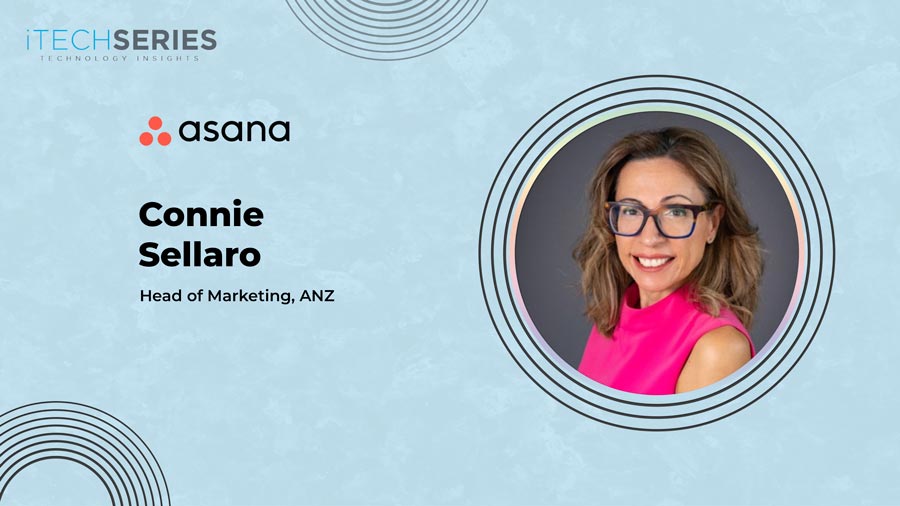
Building sustainable growth requires more than generating leads. Meet Connie Sellaro, Head of Marketing, ANZ, at Asana, who shares her insights on building go-to-market strategies that deliver sustainable revenue growth. She discusses sales and marketing alignment, revenue-driven field marketing, enterprise GTM in ANZ, strategic leadership, and how AI is reshaping modern B2B marketing and driving business growth.
Welcome to the interview series, Connie. Could you tell us about yourself and your journey as a marketer?
I’ve spent more than 20 years in B2B technology marketing, working across global organisations including IBM, Cisco Systems, Salesforce, and now Asana, where I lead marketing across Australia and New Zealand. Throughout my career, I’ve been fortunate to work alongside CEOs, sales leaders, and marketing teams to build go-to-market strategies that drive growth, customer engagement, and category leadership.
What has kept me passionate about marketing is that it sits at the intersection of strategy, storytelling, and commercial impact. Early in my career, I was heavily focused on execution—campaigns, events, and demand generation. Over time, I became increasingly interested in the bigger questions: How do companies create markets? Why do some growth strategies scale while others stall? How do you align people, process, and technology to drive sustainable growth?
Today, I see marketing as far more than a lead generation function. The best marketers are business leaders. They understand customers deeply, shape strategy, influence product direction, and create alignment across the entire organisation. That’s what has drawn me into broader GTM advisory work and why I’m so excited about the future of marketing, particularly as AI transforms how organisations operate and collaborate.
As a GTM advisor, what early signals do you look for to understand whether a company’s go-to-market motion is working or broken?
The first thing I look at is alignment. If sales, marketing, and customer success can’t clearly articulate the same ideal customer profile, value proposition, and growth priorities, it’s usually a sign that the GTM motion isn’t working.
The second signal is pipeline quality. You can generate a lot of leads and still have a broken GTM engine. I look at conversion rates between stages, sales velocity, and whether the pipeline is coming from repeatable motions or one-off wins.
The third is customer feedback. If customers struggle to understand your differentiation or if every deal requires significant customisation, you probably have a positioning problem.
Finally, I look at operational friction. Are teams constantly creating workarounds? Are handoffs between functions inefficient? Often, broken workflows within the business manifest externally as inconsistent customer experiences.
You’ve driven a significant pipeline through field marketing in ANZ. What were the key levers that actually made that success possible?
The biggest shift was treating field marketing as a revenue function rather than an events function.
There were four key levers:
- Deep sales alignment—We built plans together and agreed on target accounts, success metrics, and follow-up motions before any campaign launched.
- Quality over quantity—Smaller, highly targeted experiences often outperformed larger events because they created deeper engagement with the right stakeholders.
- Customer-led storytelling—Prospects trust peers more than vendors. Our highest-performing programs consistently put customers at the centre of the conversation.
- Integrated follow-up—Events don’t create pipeline on their own. Pipeline is created through the follow-up motions, content journeys, and account-based engagement that happen afterwards.
The lesson is simple: events should never be treated as a one-day activity. They’re a catalyst within a much larger GTM motion.
You’ve worked closely with sales in enterprise roles. What does strong sales-marketing collaboration look like in practice, and where does it usually break down?
The strongest relationships happen when both teams are accountable for the same outcomes.
Marketing should understand the commercial realities of the business-deal cycles, account priorities, and revenue targets. Equally, sales should understand the role marketing plays in building awareness, creating demand, and accelerating opportunities.
Where it typically breaks down is when teams optimise for different metrics. Marketing celebrates MQLs while sales focuses on revenue, or campaigns are launched without sales input and then judged on pipeline performance.
The best organisations have shared goals, regular operating rhythms, and complete transparency around what’s working and what’s not.
“The best marketers are business leaders. They understand customers deeply, shape strategy, influence product direction, and create alignment across the entire organisation.”
What separates high-performing event marketing teams from those that focus mainly on execution rather than driving pipeline impact?
High-performing teams start with business outcomes, not logistics.
Anyone can run an event. The best teams ask:
- Which accounts are we trying to influence?
- Which stakeholders need to be in the room?
- What action do we want attendees to take afterwards?
- How will we measure commercial impact?
They also think beyond the event itself. One event can generate customer stories, executive content, videos, social engagement, partner relationships, and months of follow-up activity.
The highest-performing event teams are essentially running mini GTM campaigns, not simply managing experiences.
ANZ is often seen as a challenging but high-value enterprise market. How does GTM in this region differ from the US or other global markets?
ANZ is incredibly relationship-driven.
The market is smaller, networks are tightly connected, and reputation matters enormously. Buyers want to see proof, hear from peers, and build trust before making significant investments.
Enterprise sales cycles can also be longer because organisations often have leaner teams and multiple stakeholders wearing several hats.
What works in the US doesn’t always translate directly? Large-scale volume motions are often less effective here than highly targeted, account-centric approaches.
The upside is that once you’ve established credibility and strong customer advocacy in ANZ, those relationships can become incredibly powerful growth engines.
What advice would you give to marketers who want to move from execution roles into strategic GTM leadership?
First, learn the commercial side of the business. Understand revenue models, pipeline mechanics, and how decisions are made in the boardroom.
Second, become deeply customer-obsessed. Strategic marketers spend as much time understanding customers as they do running campaigns.
Third, build cross-functional influence. GTM leadership isn’t about having authority – it’s about aligning teams around a common objective.
Finally, think beyond activities and focus on outcomes. Instead of asking, “How do I execute this campaign?” ask, “What business problem am I trying to solve, and what’s the most effective way to solve it?”
The marketers who leap to leadership are the ones who stop thinking like marketers and start thinking like business operators.
About Connie Sellaro
Connie Sellaro is a seasoned B2B SaaS marketing and go-to-market leader with over 20 years of experience driving enterprise growth across the ANZ region. As the ANZ Marketing Lead at Asana and a trusted GTM advisor, she helps organizations strengthen sales and marketing alignment, optimize demand generation, and build a predictable pipeline. Previously, Connie held senior leadership roles at Salesforce, Twilio, Dell/EMC, IBM, and Cisco, leading strategic growth and regional expansion initiatives.