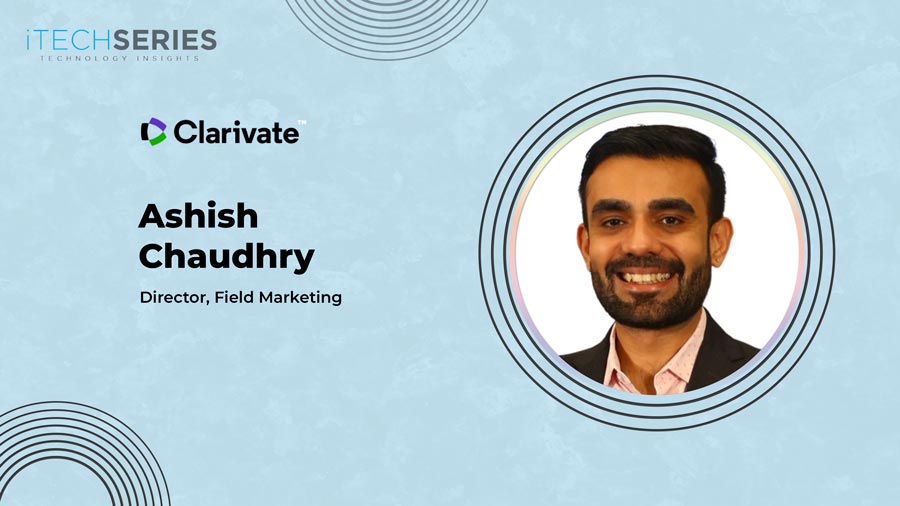
In this edition of iTechSeries Unplugged, Ashish Chaudhry, Director, Field Marketing at Clarivate, shares his journey from execution-focused marketing to orchestrating strategic growth. He explores the evolving role of field marketing, the importance of alignment across GTM teams, and how brand, demand, and data-driven insights come together to drive real business impact in today’s complex B2B landscape.
Welcome to the interview series, Ashish. Could you tell us about yourself and your journey as a marketer?
Thank you—it’s great to be part of this series.
I started in an execution‑heavy role, focused on campaigns, visibility, and doing work that could be seen and measured quickly. Success was defined by activity—launches, events, outputs.
The real shift came when I moved closer to the field and began working directly with sales and regional leadership teams. That exposure changed how I viewed marketing.
I saw firsthand that activity alone doesn’t move the business—alignment does. Great campaigns fail without follow‑through.
As my role expanded across multiple regions, I started operating in markets at very different levels of maturity. That forced me to evolve—from running campaigns to building systems, from asking, “Did this execute well?” to, “Did this change buying behavior?”
Today, I see marketing as a growth discipline, not a function. One that requires judgment, collaboration, and long‑term thinking as much as creativity.
That journey—from execution to orchestration—continues to shape how I build teams, partner with sales, and define impact.
How has field marketing evolved in today’s GTM‑driven environment?
Field marketing has undergone a fundamental shift. It’s no longer a downstream execution function centered on events and regional tactics. Today, field marketing plays a strategic role in orchestrating go‑to‑market execution at a regional and segment level.
In a GTM‑driven environment, field marketing connects enterprise strategy to regional marketing objectives. It aligns sales priorities, demand programs, account focus, and brand narrative, assuring that what we do locally supports the broader business objectives.
The role today is less about “running activities” and more about driving coordinated market impact. This evolution demands stronger cross-functional collaboration, data-driven decision-making, and the ability to quickly adapt strategies based on market feedback and performance insights.
As a marketer, how do you ensure the right balance between brand awareness and demand generation?
I don’t see brand and demand as opposing goals—they are inherently linked. Brand builds trust and credibility, and demand generation converts that trust into action.
The balance depends on the market context. In emerging markets, brand and education take precedence. In mature markets, the focus shifts toward intent capture and pipeline acceleration.
What is most important is consistency—demand programs must reinforce the brand promise, not operate in isolation. When brand and demand work together, marketing becomes both credible and effective. It supports sustained growth, strengthens customer relationships, improves conversion rates, and builds a more resilient and competitive market position over time.
How do you approach attribution in complex B2B buying journeys?
Attribution in B2B is rarely precise—but it can still be useful if approached correctly.
I tend to move away from single‑touch models and instead focus on influence and contribution.
I look at attribution across the buyer journey: early engagement, mid-funnel acceleration, and late-stage momentum. The real question isn’t “Which campaign closed the deal?” but “Which interactions helped move the buyer forward?” This perspective leads to better insights, stronger sales alignment, and more informed investment decisions. It helps teams prioritize channels, refine messaging, and continuously optimize campaigns based on real buyer behavior and evolving data signals.
“Demand generation isn’t about one standout campaign—it’s about building a repeatable, scalable system that drives consistent business impact over time.”
What are the key elements of a high‑performing demand generation engine based on your experience?
From experience, five elements consistently stand out:
A well‑defined ICP and prioritization strategy
Strong alignment with sales on follow‑ups and success metrics
A multichannel approach where digital, field, ABM, and content work together
Operational discipline around data, cadence, and handovers
A continuous learning mindset, refining, and adapting based on outcomes
Demand generation isn’t about one standout campaign. It’s about building a repeatable, scalable system that improves over time. It also requires clear ownership, consistent feedback loops, and strong visibility into pipeline performance to ensure every effort drives measurable business impact.
You’ve led distributed teams across multiple geographies. How do you ensure alignment, accountability, and performance?
Alignment starts with clear goals, clear ownership, and an in-depth understanding of what success looks like. I place strong emphasis on context, ensuring teams understand not just what they’re doing but why it matters.
Accountability is built through consistent operating rhythms—regular reviews, transparent reporting, and shared learning.
At the same time, performance improves when teams feel trusted and empowered. The balance is in maintaining global consistency while allowing enough flexibility for local markets to operate effectively. Clear communication channels, documented processes, and strong leadership support further ensure teams stay aligned and motivated and consistently deliver measurable results across regions.
With the rapid rise of AI tools, what must marketers do now to stay competitive over the next 2–4 years?
AI will increasingly handle execution, optimization, and speed. What it won’t replace is judgment, strategic thinking, and leadership.
To stay competitive, marketers must evolve beyond executional excellence. They need stronger business acumen, a clearer understanding of the growth levers, and the ability to translate insights into decisions.
AI should augment thinking, not replace it.
Ultimately, the next phase of marketing belongs to those who can combine technology leverage with human judgment and strategic clarity. This also means continuously upskilling, embracing experimentation, and staying adaptable to rapid changes in tools, customer expectations, and competitive landscapes.
About Ashish Chaudhry:
Ashish Chaudhry is a senior B2B marketing leader with over 18 years of experience building revenue‑driven marketing engines across enterprise technology and information services. As Director of Marketing at Clarivate, he leads multi‑country GTM strategies across Asia‑Pacific and emerging markets, partnering closely with sales and product leaders to drive pipeline, accelerate growth, and strengthen market leadership. Known for scaling high‑performing teams, executing account‑based marketing programs, and applying data‑driven insights, Ashish focuses on transforming marketing into a measurable, growth‑centric function aligned directly to business outcomes.