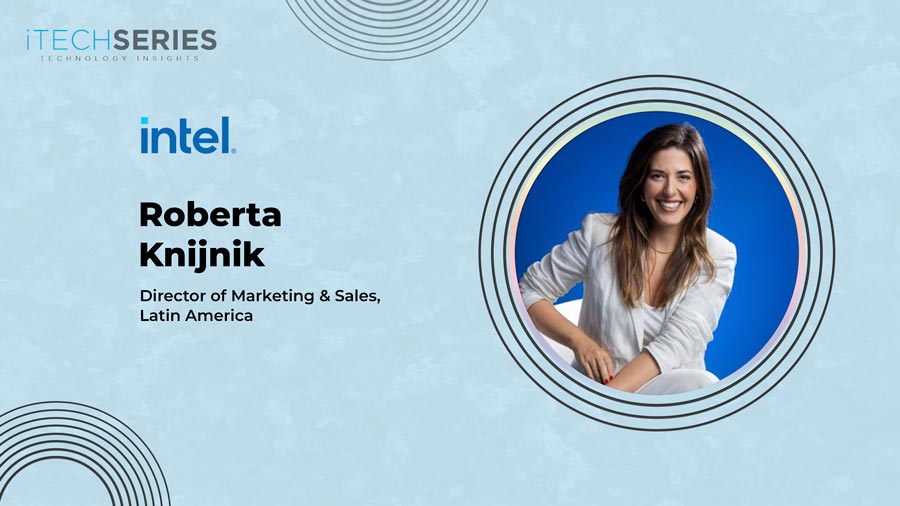
With two decades of experience across sales, marketing, and business leadership, Roberta Knijnik, Director of Marketing & Sales, Latin America at Intel, shares how global experiences have shaped her strategic approach. In this iTechSeries Unplugged interview, she discusses connecting people, technology, and business, aligning teams, leveraging customer insights, measuring impact, and driving meaningful results.
Welcome to the interview series, Roberta. Could you tell us about yourself and your marketing journey?
Thank you for having me. I’m very happy to be part of this interview series.
I’ve spent the last 20 years building my career across sales, marketing, and business leadership, primarily in the technology industry. I started my career in Brazil, and throughout my journey I’ve had the opportunity to live and work in Argentina, Israel, and the United States. These international experiences have had a tremendous impact on how I see business, people, and different cultures and have shaped the way I approach marketing and leadership today.
Over the years, my journey has evolved from traditional marketing and demand generation into a much broader role, where marketing, sales, customer relationships, and business strategy are deeply connected. Today, at Intel, I lead strategic work with Dell across Latin America, working closely with our sales teams, customers, and partners to turn technology innovation into business impact.
One of the things I enjoy most about marketing is that it sits at the intersection of people, business, and technology. It’s not only about creating a great campaign or telling a compelling story, but it’s about understanding the customer, identifying what really matters to the business, and bringing different teams together to make it happen.
Another important part of my journey has been inclusion and diversity. I’ve had the opportunity to take on leadership roles in this space and to be a voice for inclusion both inside and outside Intel. That experience reinforced something I strongly believe: when you bring different perspectives to the table, you don’t just create a more inclusive environment, but you create better ideas and better business outcomes.
So, if I had to summarize my marketing journey, I would say it has been about continuously connecting strategy, technology, people, and business results. And I’m still learning and evolving every step of the way.
How do you balance global brand positioning with diverse market realities and customer expectations across regions?
I believe the key is to have a strong global brand foundation while giving local teams the flexibility to make the story relevant to their markets and bring it to life through local proof points.
A global brand should be consistent in its purpose, values, and core message, but the way you bring that message to life needs to reflect local customer needs, culture, market dynamics, and business priorities. I don’t believe in a “one-size-fits-all” approach. The biggest mistake global brands make is treating localization as translation.
In my experience working across Latin America and with global organizations, I’ve learned that listening is just as important as communicating. Before adapting a global strategy, I like to understand each market: what customers want, how they make decisions, what resonates culturally, and what the local business needs to achieve.
For example, when working with partners such as Dell across Latin America, we have a global technology story, but the customer journey and market dynamics can be very different from country to country. Our role is to preserve the strength and credibility of the global Intel brand while translating that value into something that feels relevant and actionable locally.
I also see local teams as strategic partners, not simply as execution teams. They bring invaluable customer and cultural insights that can actually make the global strategy stronger.
So, for me, the balance is global consistency with local relevance: protect what makes the brand unique, but give markets enough flexibility to tell the story in a way that genuinely connects with their customers.
What does effective alignment between brand, marketing, sales, and partner teams look like in practice?
Effective alignment happens when everyone is working toward the same business outcome and not just executing the same plan.
In practice, it starts with a shared understanding of the business priorities, the customer, and what success looks like. Brand defines the long-term story and positioning, marketing translates that into programs and experiences, sales brings the customer perspective and commercial priorities, and partners help us scale the impact and reach the market.
The most important thing is to break down the silos between these teams. I like to establish clear ownership, shared goals, regular communication, and (most importantly) common metrics. When everyone can see how their contribution connects to the bigger business objective, alignment becomes much more natural.
In my experience working across large and diverse regions like the Americas in the past and now Latin America, this means bringing sales and partner teams into the conversation early, rather than presenting them with a finished marketing plan. If marketing and sales only align after the marketing plan is ready, they aren’t aligned. We discuss where the business opportunities are, what customers are asking for, and how we can jointly create demand and accelerate growth.
And I think the strongest partnerships happen when both sides feel they are winning. It’s not about marketing supporting sales or a partner supporting the business: it’s about creating a joint strategy where the value for the customer and the business is clear for everyone.
Ultimately, I measure alignment by what happens beyond the meetings: Are we making better decisions? Are we reaching the right customers? Are we accelerating the business? And can we clearly connect our marketing activities to those outcomes?
“Marketing becomes truly strategic when we move beyond measuring activity and demonstrate how marketing is contributing to the business outcomes that leadership cares about.”
With your experience, how do customer insights shape your approach to brand and marketing strategy?
Customer insights are at the center of how I approach marketing strategy. For me, great marketing starts with understanding the customer before deciding what we want to say to them. Data and research are important, but so are conversations with customers, feedback from sales teams and managers, partner insights, and understanding what is happening in the market. An insight that doesn’t change a decision isn’t an insight. It’s information.
One example from my experience at Intel was about the evolution of artificial intelligence. We conducted research with our partner ecosystem and found that most companies were already seeing performance improvements from adopting AI, but many were still struggling with how to prioritize projects and, importantly, how to measure the results.
That insight changed the way we approached our communication. Instead of focusing primarily on the technology itself, we started incorporating more practical customer stories, showing how companies were using AI and turning the technology into tangible business results. This made the conversation much more relevant and helped customers see not just what the technology can do, but how they can actually apply it to their business.
Customer insights should always lead to action. I always ask, “What did we learn?” What are we going to do differently because of it? And how will we measure whether that change created value for the customer and for the business?
That is when insights truly become strategy.
How do you approach building a social media strategy that drives both engagement and brand impact?
I approach social media strategy by starting with the business objective and the audience, rather than starting with the platform. For me, the first question is: What do we want people to think, feel, or do differently because of our presence on social media? Once that is clear, we can define the right content, channels, formats, and metrics.
Social strategy needs to balance three things: brand storytelling, audience relevance, and business impact. We need content that builds the brand over time, but also content that is useful, authentic, and connected to what our audience actually cares about.
My experience has also taught me that social media works best when we don’t treat every audience the same. I look at local culture, customer priorities, market maturity, and what type of content resonates in each market, while keeping the global brand consistent.
I also believe strongly in the power of people. Some of the most engaging content is not necessarily highly produced corporate content, but it can be a customer story, an employee perspective, a leader sharing an opinion, or a real example of how technology is solving a business challenge. That human element makes the brand more credible and relatable.
Finally, I look beyond engagement metrics. Likes and impressions are useful, but I want to understand whether social is contributing to brand perception, audience growth, customer conversations, thought leadership, and ultimately business outcomes.
The goal is not simply to have people see the brand. It is to make the brand relevant enough that people want to stop, engage, remember, and, after that, act.
Which metrics or indicators do you rely on to determine whether a marketing strategy is delivering meaningful business results?
The starting point should always be business impact. If we want marketing to be truly strategic, we need to measure our success using the same business metrics that executives are looking at.
That means understanding what the business is trying to achieve (whether that is revenue growth, pipeline, market share, consumption, customer acquisition, or another strategic priority) and then building our marketing strategy and measurement framework around those objectives.
From there, I look at three levels of impact:
First, business impact: Is marketing contributing to the outcomes that matter most to the business?
Second, brand impact: Are we strengthening brand awareness, perception, preference, and our position in the market?
And third, customer behavior and engagement: Are we reaching the right audiences, generating meaningful engagement, creating customer conversations, and influencing behavior throughout the customer journey?
I also believe the most important metrics should be defined before we launch a program. That creates clarity across marketing, sales, and leadership about what success looks like and allows us to make better decisions along the way.
Marketing becomes truly strategic when we move beyond measuring activity, such as impressions, clicks, or the number of campaigns delivered, and can clearly demonstrate how marketing is contributing to the business outcomes that leadership cares about.
What advice would you give marketing professionals aiming for regional or global leadership roles?
My biggest advice would be to start thinking beyond your own market and beyond your own function before you have the title.
If you aspire to a regional or global leadership role, you need to develop a broader business perspective. Understand not only marketing, but also sales, finance, customers, partners, and the overall business strategy. The more you understand how the business works, the more strategic your marketing decisions become.
I would also encourage people to actively seek international experiences. Working across different markets teaches you that there is rarely one right answer. My own career has given me the opportunity to live, travel, and work in different places, and each experience taught me something different about leadership, culture, and how people make decisions. That perspective has been incredibly valuable in leading across large and diverse regions.
Another important piece of advice is to build relationships before you need them. Regional and global leadership is highly collaborative. You need to be able to influence people who may not report to you, work across cultures and functions, and build trust with different stakeholders.
And finally, I would say: be curious, stay close to the customer, and don’t be afraid to take on challenges that are bigger than your current role. Some of the most important steps in my career came from raising my hand for opportunities where I didn’t necessarily have all the answers, but I was willing to learn, bring people together, and figure it out.
About Roberta Knijnik
Roberta Knijnik is a marketing and business leader with 20 years of experience across sales, marketing, and the technology industry. Currently at Intel, she leads brand management and the strategic partnership with Dell Technologies across Latin America. Her international experience spans Brazil, Argentina, Israel, and the United States. She brings expertise in marketing strategy, customer relationships, team leadership, communications, employer branding, and driving business impact through people, technology, and collaboration.