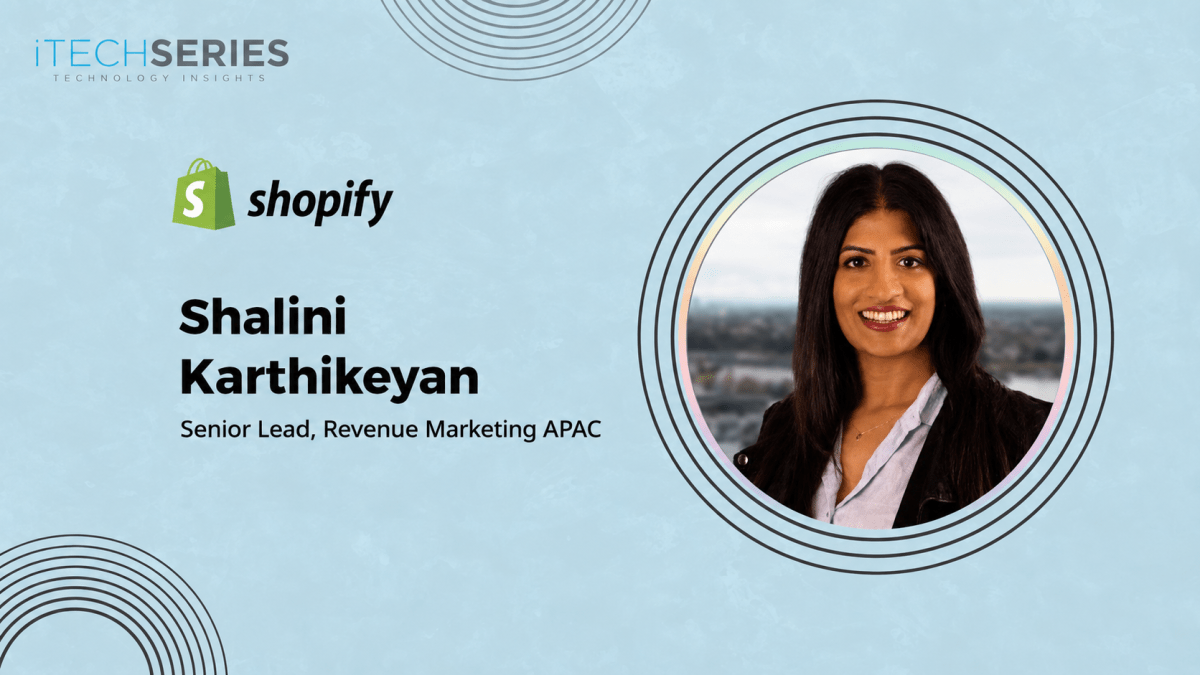
Shalini Karthikeyan, Senior Lead, Revenue Marketing APAC at Shopify, shares her perspective on building revenue-focused GTM strategies across APAC. She explores how to balance global consistency with local relevance, align marketing and sales, scale authentic personalization with AI, measure true marketing impact, and build future-ready organizations through smarter systems, stronger collaboration, and a relentless focus on revenue.
Welcome to the interview series, Shalini. Could you tell us about yourself and your journey as a marketer?
I’m a go-to-market and marketing operator, with 12 years in B2B now, currently Senior Lead for Revenue Marketing across APAC at Shopify, including a 9-month stint leading the ANZ team through a tough commercial season.
My journey has been less “straight line” and more “follow the problem.” I’ve always gravitated to the messy middle where marketing meets sales, where a campaign either turns into revenue or it doesn’t. That’s shaped how I work: I’m results-first, I like clear goals and owners, and I’d rather be challenged on my assumptions than told my numbers look pretty. Marketing is a craft, but it’s a commercial craft. If it isn’t moving the business, it’s a hobby.
Over time I got less interested in the campaigns and more interested in the systems underneath them. I kept noticing where teams were quietly losing time, signals scattered across tools, and work being done by hand that shouldn’t be. So now I build the thing that closes the gap, often AI-native workflows I’ve built myself without waiting on engineering. I do my best work where the playbook is still being written.
APAC is a diverse region. How can GTM strategies balance local relevance with global consistency?
The mistake is treating “global consistency” as “global sameness.” Consistency should live at the level of the message and the brand promise, not the execution. In APAC, ANZ, Japan, and the rest of the region behave completely differently with different buying cultures, partner ecosystems, and even what “credible” looks like.
So the model I lean on: global sets the strategic pillars and the guardrails; regions own how those show up in the market. Same hero message, locally earned proof. A case study landing in Sydney won’t automatically apply in Tokyo, so we localise the proof, partners, and channels while keeping the overall strategy intact. Global gives you leverage and coherence; local gives you relevance and trust. You need both, and you need to be honest about which layer a decision belongs to.
How do you align GTM, sales enablement, and signal intelligence to build a stronger revenue engine?
Alignment is a communication problem before it’s a data problem. The engine works when marketing, sales, and enablement are all reading from the same scoreboard: MQL, Sales Accepted Leads, created opportunities, closed won, not three different definitions of “a good lead.”
Practically, that means I spend as much time talking to our sales teams as I do building campaigns. I run a weekly roundup for sales tailored to what they actually need to know, and I treat their feedback as signal, not noise. On the intelligence side, the real unlock is attribution honesty: understanding first touch versus last touch versus campaign influence and being upfront that historic campaigns keep influencing this quarter’s pipeline. The teams that win are the ones who close that loop: marketing generates the signal, sales acts on it, and enablement makes sure nothing gets lost in translation.
What role does AI play in scaling personalisation while maintaining authentic customer interactions?
AI is brilliant at scale and terrible at judgement, so I use it exactly that way. It’s my leverage for the heavy lifting, pulling data, drafting, and spotting patterns across campaigns, so I can spend my time on the parts that actually need a human: the insight, the point of view, the relationship, and most importantly, authenticity.
Personalisation at scale only stays authentic if a human owns the intent behind it. The risk is using AI to send more mediocre, “personalised” noise faster. That’s not personalisation; that’s spam with a merge field. My rule is simple: AI drafts, humans decide. It should make interactions more relevant and more human, never less. The moment the customer can tell a machine is talking to them with no one behind it, you’ve lost the trust you were trying to build.
“The mistake is treating ‘global consistency’ as ‘global sameness.’ Consistency should live at the level of the message and the brand promise, not the execution.”
With your integrated marketing experience, how do you balance product, brand, and demand marketing?
I don’t think of them as three budgets fighting over a table. They’re three timescales. Brand is the long game; it’s why anyone picks up the phone at all. Demand is the near term; it’s the pipeline this quarter. Product marketing is the bridge; it makes sure the story we’re telling actually matches what we sell.
The balance comes from the message. Right now, a lot of my work sits on a single pillar, helping merchants move to a modern stack with confidence, and that one message flexes across all three: brand builds the belief, product marketing makes it concrete, and demand converts it. When they’re all pointed at the same story, they compound. When they’re not, you get a brand that promises one thing and a demand engine selling another, and customers feel the seam.
You’ve consistently driven pipeline growth. What metrics best measure marketing’s business impact?
The honest answer: the ones closest to revenue. Impressions and clicks are diagnostics, not outcomes. I care about created opportunities, SAL and closed wins, and crucially, marketing’s influence on them, not just the leads with our name on the last click.
That said, the metric conversation I fight hardest for is attribution nuance. Last-touch attribution flatters whoever happened to be standing nearest the deal when it closed. The real story is usually multi-touch and lagged; campaigns from months ago are still shaping today’s pipeline. So the metrics that matter most are the ones that tell you what actually moved the deal, even when that’s inconvenient. If a metric can’t survive the question “and how do you know that campaign caused it?”, it’s decoration.
What advice would you give marketing and GTM leaders who want to build future-ready organizations in the age of AI?
Three things.
- Get scrappy about channels. When a channel you relied on gets pulled, don’t wait for permission to be creative; earned, owned, and partner channels can carry a lot more pipeline than people assume if you’re willing to hustle.
- Use AI to buy back judgement time, not to replace judgement. Automate the grunt work so your best people spend their hours on strategy and relationships. AI should make your team more human-facing, not less.
- Be ruthless about the scoreboard. Future-ready isn’t a tool stack; it’s a culture that agrees on what “impact” means and tells the truth about attribution. Tools change every six months. Clarity on what actually drives revenue is what compounds.
And honestly, stay close to your sales teams. The best marketing intelligence in the world is useless if the people carrying the bag don’t trust it.
About Shalini Karthikeyan
Shalini Karthikeyan is a GTM and marketing operator with extensive experience across channel marketing, demand generation, and revenue leadership. She has driven significant growth, including $52M in pipeline and 8,000+ leads in 24 months. Her work focuses on transforming fragmented signals, manual workflows, and unclear priorities into scalable systems. Passionate about practical AI adoption, Shalini builds AI-assisted GTM workflows that improve decision-making, personalization, operational efficiency, and sustainable business growth.