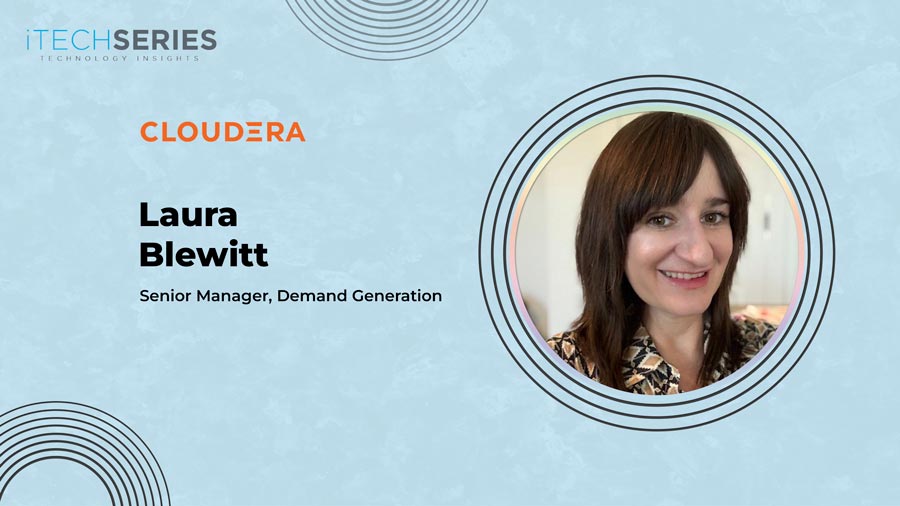
Laura Blewitt, Senior Manager of Demand Generation at Cloudera, shares how her journalism background has shaped her approach to modern B2B marketing. She discusses why AI demands greater accuracy, alignment, and trust; how Generative Engine Optimization (GEO) is redefining content strategy; and the leadership principles behind successful demand generation and go-to-market execution.
Welcome to the interview series, Laura. Could you tell us about yourself and your journey as a marketer?
Thank you so much for having me. My marketing journey began in the newsroom. I’m a trained journalist with a degree in multimedia journalism from UT Austin, and I spent nearly a decade covering business news before pivoting to marketing.
My transition started with freelance content marketing, which eventually evolved into a full-time role in integrated marketing for a PE-backed data and analytics software company. This was a pivotal moment for me because it allowed me to leverage a unique hybrid skillset: the technical discipline of writing, editing, and content generation, combined with the strategic ability to take massive, complex concepts and repackage them into digestible, compelling stories. At my core, I am a writer.
Part of my passion for writing extends beyond the office. I’m also a devoted singer and songwriter who leads an indie rock band. Marketing music and art is a completely different animal than B2B, and doing it on a shoestring independent budget teaches you to be incredibly scrappy. That experience carries over into my corporate work; it keeps me lean, focused, and highly intentional about maximizing ROI, no matter the budget size.
From your perspective, what are the top priorities for modern demand generation teams as AI continues to reshape B2B marketing?
This is where you can see my journalism roots bleeding into my marketing strategy. My top priority today is accuracy.
As LLMs increasingly scrape the web to answer buyer queries, demand gen leaders have to be hyper-vigilant. Every piece of content we put out, whether it’s on our website, YouTube, or social media, must be pristine, up-to-date, and factual. If we publish outdated or incorrect information, LLMs will ingest it, hallucinate, and misrepresent our products to potential buyers.
Because of this, we are seeing a massive paradigm shift from traditional SEO to GEO (Generative Engine Optimization). I remember the days of forcing content into a rigid box—obsessing over exact headline lengths and keyword density and playing games with algorithms. Today, the game has changed. It’s no longer about checking algorithmic boxes; it’s about providing the most accurate, well-rounded, data-backed information possible so that generative engines recognize your brand as the definitive source.
That said, my journalism background also makes me look at the AI revolution with a bit of skepticism. I have been analyzing numbers manually my entire life. When I first started using LLMs to analyze data, I was shocked to find it making basic addition and multiplication errors in simple CSV files. I love what AI can do, but it cannot be left unsupervised. Modern demand gen teams must remember that AI is a tool, not a replacement for human oversight. We have to remain strict stewards of accuracy and truth for our brands and our clients.
Which best practices have been most effective for aligning brand, product marketing, and demand generation teams?
Once again, my journalism background heavily dictates my approach here. In journalism, everything runs on a strict style guide—whether it’s the AP Stylebook or a publication’s specific internal rules. For example, one major newspaper might require spelling out “artificial intelligence” on all references, while another allows “AI.” Everyone follows the same rules to protect the publication’s credibility.
Corporate marketing needs that same editorial discipline. The most effective way to align brand, product, and demand gen teams is to treat your brand guideline book as the absolute law.
One of the biggest challenges marketing leaders face is controlling what I call “rogue, random acts of marketing.” You might have a hyper-enthusiastic salesperson creating their own localized logos or a demand gen team tweaking product positioning on the fly to hit a quick metric. When teams drift like that, the market gets confused.
By anchoring all three departments to a single, uncompromising brand and style guide, you ensure that product marketing’s positioning matches the brand team’s vision, which in turn matches the demand gen team’s live campaigns. To scale effectively, everyone has to be singing from the same songbook.
Can you tell us about your most memorable marketing campaign experience?
I was lucky enough to experience it earlier this year at my current company, Cloudera. One of the most exciting initiatives I oversee is our company podcast, The AI Forecast. True to my beliefs about brand integrity, the podcast isn’t a pitch fest—we don’t promote Cloudera at all. Instead, it’s a pure thought-leadership play where we host weekly conversations about data, analytics, and the future of AI.
A few months ago, I was allowed to bring our entire podcast advertising budget in-house. It was a massive responsibility, but a huge opportunity to experiment. Working alongside an incredible colleague, we completely pivoted our strategy and built out targeted, in-app Spotify campaigns from scratch.
The results were a complete game-changer. Almost overnight, our quarter-over-quarter streaming growth skyrocketed by literally 1,000%.
The absolute highlight for me was sitting in our Quarterly Business Review (QBR) and watching our VP of Demand Generation present the data. She told the room, “This is the first time in my career that I get to report a 1,000% growth figure.” Hearing that was incredibly exciting but also deeply humbling. As a data-driven marketer, I managed our expectations, knowing that the initial percentage jumps are lightning in a bottle. Achieving that kind of impact for the podcast and the company is something I’ll never forget.
“The most effective way to align brand, product, and demand generation teams is to treat your brand guideline book as the absolute law.”
When launching a new product or solution, what factors are most critical to a successful go-to-market strategy?
Working in the fast-paced world of data, analytics, and enterprise databases has taught me one absolute truth: things will change. You can plan, plan, and plan for months, but if you cannot be nimble, pivot gracefully, and embrace rapid shifts, you simply won’t survive in this industry.
Because agility is non-negotiable, the absolute most critical factor for a successful GTM strategy is uncompromising alignment.
Achieving that alignment requires clearing a massive modern hurdle: the communication trap. I think every leader today can relate to this. We are available on so many platforms at all hours of the day, and everyone knows they can reach us. I’ll frequently find myself on a live Zoom call, a message flashes by on my screen, and I read it while trying to stay focused on the meeting. By the time the call ends, I’m left wondering: Wait, did they Slack me? Was it an email? A text? A WhatsApp message? It gets incredibly chaotic.
To counter that noise and keep a GTM strategy on the rails, you have to establish strict, regular cadences and clear communication channels. Everyone—from executive leadership and internal teams to external agencies—must stay locked in lockstep. Ultimately, it all boils down to building a foundation of deep professional trust. When you trust your team and have that baseline alignment, you can pivot instantly when market conditions or product timelines inevitably shift.
How do you measure multi-channel campaign performance, and which KPIs do you prioritize?
Like any modern marketer, the foundation of my measurement strategy is engagement—but the key is recognizing that engagement looks radically different depending on the channel. Because my company is deeply data-driven, and I am too, it’s an excellent fit. We look at everything possible, and we avoid the trap of prioritizing one single metric over another because every touchpoint serves a unique purpose.
We tailor our KPIs directly to the format:
- Thought Leadership & Podcasts: Here, success is about reach and community building. We prioritize streams, plays, and follower growth to see if our message is actually resonating over time.
- High-Intent Content (White Papers & E-books): For these assets, we drill down into click-through rates (CTR) and conversion rates—specifically looking at who is willing to register their details to download a piece of deep-dive content.
- Interactive Experiences (Webinars & Presentations): We look far beyond the initial registration number. We analyze actual attendance rates, average viewing duration, active engagement metrics (like how many questions they asked in the Q&A), and downstream behavior—tracking whether they visited our website or viewed a product page in the days following the event.
Ultimately, multi-channel performance isn’t about finding a single “silver bullet” metric. It’s about building a holistic dashboard where every channel has its own scorecard, allowing us to see how awareness at the top of the funnel translates into active intent further down.
What advice would you give to marketers aspiring to grow into demand generation and GTM leadership roles?
My biggest piece of advice is simple: Be highly visible, be an absolute doer, and become fiercely reliable.
The executive leaders I work with are incredibly busy. They aren’t looking to micromanage; they love working with people who can take a high-level piece of direction and completely run with it without needing constant hand-holding.
I see this gap all the time, particularly when dealing with external vendors or agencies. You often have to follow up multiple times just to get a response or an answer to a critical business question. Because that lack of follow-through is so common in the professional world, doing the exact opposite makes you a standout performer.
When you are the person who proactively follows up, demonstrates extreme responsibility, builds deep professional trust, and consistently delivers great results, it never goes unnoticed by leadership. If you want to move into a demand gen or GTM leadership role, prove that you can manage projects autonomously today. When executives know they can hand you a complex initiative and trust it will get done flawlessly, you naturally become the person they tap for the next big promotion.
About Laura Blewitt
Laura Blewitt is a B2B marketing leader with a distinctive background in journalism, content strategy, and storytelling. A multimedia journalism graduate from the University of Texas at Austin, she spent nearly a decade covering business news before transitioning into marketing. She is passionate about transforming complex ideas into compelling narratives that drive business impact. Outside of work, Laura is a singer-songwriter and leads an indie rock band, bringing creativity, adaptability, and an ROI-focused mindset to everything she does.