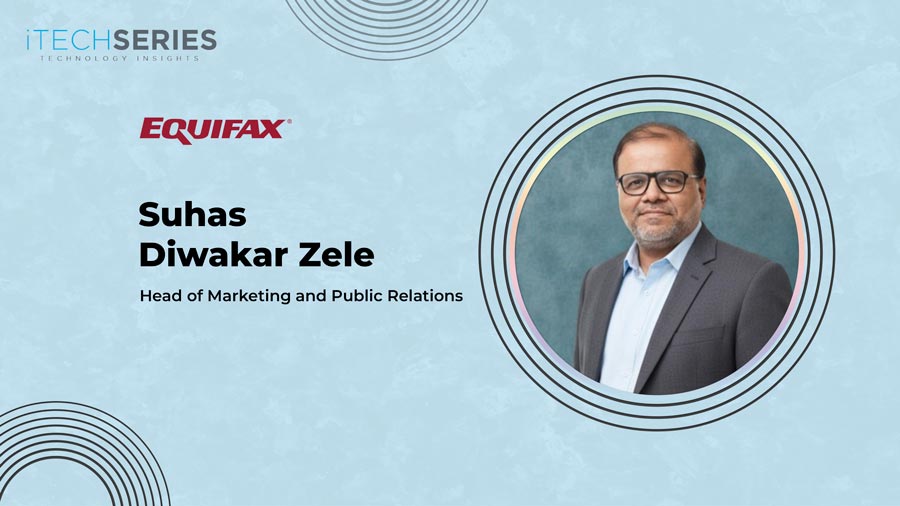
In this edition of our interview series, Suhas Diwakar Zele, Head of Marketing & Communications at Equifax India, shares his perspective on building trust-led growth in regulated industries. He discusses aligning brand, communications, and revenue, creating impactful GTM strategies, leveraging AI for smarter marketing, and developing the leadership mindset needed to drive sustainable business growth.
Welcome to the interview series, Suhas. Could you tell us about yourself and your journey as a marketer?
Over the last 17 years, my journey has been deliberately diverse. While I currently operate in the highly regulated credit and data analytics space as the Head of Marketing & Communications at Equifax India, my career has spanned a wide spectrum of business models—including fintech, digital payments, enterprise software, e-commerce, publishing, trade fairs, and consulting.
Navigating these varied sectors has been my greatest strategic asset. Rather than being confined to a single playbook, I have been able to take the rapid agility, brand storytelling, and consumer-centricity of e-commerce and publishing and inject them directly into the complex, B2B matrix of software and financial services.
If I had to define my evolution as a marketer, it is driven by a relentless desire to constantly learn, upgrade, and evolve. I have transitioned from being a functional marketing expert to a business integrator—someone who sits at the intersection of data intelligence, technology innovation, and trust-driven financial decision-making.
True business leadership demands continuous intellectual evolution. To ensure my strategies consistently outpace market disruptions, I actively invest in sharpening my executive edge—having recently completed the Executive Programme in Fintech and AI at IIM Calcutta while currently pursuing the Chief Growth and Marketing Officer Programme at ISB.
How do you balance pipeline generation, brand reputation, and corporate communications in a highly regulated industry?
As a marketing leader, I balance them by refusing to treat them as isolated silos. In a highly regulated ecosystem, these three elements are fundamentally interconnected. Corporate communications build the foundation of trust, brand reputation scales that trust into market authority, and pipeline generation monetizes that authority.
For example, I recently overhauled our strategic PR and agency partnerships. By driving executive profiling and proactive regulatory commentary, we secured significant organic media share of voice and top-tier publication features. That corporate communication built immense brand equity. I then strategically channeled that equity into pipeline generation by conceptualizing and launching our flagship IP, “Equifax Elevate.” We used the brand’s elevated reputation to curate exclusive CXO roundtables, directly partnering with Sales leadership to turn those high-level conversations into a measurable, high-intent pipeline.
Long-term brand building and short-term revenue goals often compete. How have you balanced the two?
They only compete if the marketing function is misaligned with the broader P&L. I balance them by engineering what I call “revenue-driving IPs.” Effective marketing leadership requires that we never launch a long-term brand initiative without attaching a short-term commercial engine to it.
A prime example is the strategic revamp of our market intelligence property, “Disha Insights.” The long-term brand goal was to develop a large-scale thought leadership platform that shapes industry conversations and institutionalizes Equifax India as the definitive voice on data and analytics. However, to solve for short-term revenue, I worked closely with our digital teams to integrate new lead-capture features directly into the platform. Simultaneously, we deployed targeted performance marketing campaigns for newly launched data products. This ensured that while we were building long-term category dominance, we were actively capturing high-velocity enterprise inquiries today.
You’ve worked closely with product, risk, and sales teams. What are the key ingredients of a successful go-to-market strategy for data and analytics solutions?
The most critical ingredient is acting as the central translator across the enterprise matrix. Data and analytics are essentially “invisible” products; you are selling predictability, risk mitigation, and speed.
When architecting a Go-To-Market strategy, my first step is cross-functional orchestration. I work in lockstep with the Chief Risk Officer to ensure our narrative is legally and regulatorily unassailable. Then, I partner with Product and Sales to translate those complex cloud capabilities into compelling commercial toolkits. We recently overhauled our foundational brand collateral, equipping our internal sales force with highly modular pitch decks, localized use cases, and product one-pagers. You can have the best AI-scoring model in the market, but if you haven’t aligned Risk, Product, and Sales to tell a cohesive, highly consultative story, the GTM will fail.
“The most critical ingredient of a successful GTM strategy is acting as the central translator across the enterprise matrix.”
Where are you seeing the greatest impact of AI and automation in modern marketing?
I see the most profound impact in how AI acts as an organizational multiplier. It is no longer just a tactical tool; it is a strategic capability that fundamentally elevates our operational effectiveness and intellectual agility.
I am a strong advocate for continuously upgrading our marketing infrastructure. Rather than focusing on isolated applications, we have embedded leading generative AI models and advanced research engines directly into our core workflows. By leveraging these technologies for deep ecosystem research, rapid market exploration, and the synthesis of complex data, we have essentially automated the heavy lifting of knowledge building.
This tech-forward approach removes daily operational friction and changes the very nature of how my team operates. It allows me to protect their most valuable asset, their intellectual bandwidth, redirecting their focus away from manual execution and entirely toward high-impact strategic growth, category design, and relationship building.
What role does thought leadership play in influencing decision-makers and strengthening brand reputation?
In a highly regulated environment like credit intelligence and data analytics, trust isn’t just a marketing metric; it is the ultimate commercial currency. Thought leadership is how we operationalize and scale that trust. It is how we offer clarity in a complex ecosystem, inviting decision-makers into our vision well before any commercial conversation begins.
When I collaborate with industry stakeholders or scale platforms like “Disha Insights,” the primary objective is to shift our positioning from a functional vendor to a strategic advisor. CXOs today are dealing with unprecedented regulatory and technological shifts. They aren’t just looking for data feeds; they are looking for certainty. By proactively addressing market complexities and shaping the narrative around responsible lending and digital governance, we effectively de-risk their decision-making process. That is exactly how you elevate brand reputation: your brand becomes trusted the moment the market begins relying on your foresight to navigate their own challenges.
However, as we continuously explore the intersection of technology and business, I always remind my teams of one core truth: we operate in an era where advanced automation gives us incredible scale, but it is just an enabler. Trust is a distinctly human emotion. Ultimately, people do business with people. It is intellectual integrity, empathy, and the way we handle authentic human communication that truly cements influence and builds an enduring, trusted brand legacy.
What advice would you give marketers aspiring to move from execution roles into marketing leadership?
First, fundamentally shift your core metric of success. When operating in an execution role, the primary question is often, “Did we launch this campaign on time?” At the leadership level, the only question that truly matters is, “Did this initiative accelerate commercial growth, shape the category, and positively impact the P&L?”
Second, step entirely out of the marketing silo. To lead effectively, you must intimately understand the mechanics of the broader business: risk, compliance, product development, and most importantly, sales. The landscape of digital transformation and AI is evolving too rapidly to rely on rigid playbooks. Cultivate the strategic agility to anticipate market shifts and become perfectly comfortable operating interchangeably as the high-level business architect and the hands-on orchestrator whenever the business demands it.
Finally, never allow your designation to become a ceiling on your curiosity. The most effective leaders operate with the understanding that intellectual capital does not respect hierarchy. You must be as willing to absorb a new perspective from a fresh graduate as you are from a seasoned board member, provided it adds genuine value to your knowledge bank. True market authority isn’t about having all the answers; it is about cultivating the relentless humility to learn, adapt, and continuously improve at every stage of your career.
About Suhas Diwakar Zele
Suhas Diwakar Zele is a marketing leader with over 17 years of experience across credit bureaus, fintech, financial services, and digital ecosystems. He specializes in trust-led growth, go-to-market strategy, brand reputation, corporate communications, and AI-driven marketing. Passionate about translating complex technologies into compelling business narratives, he has been recognized with the Brand Impact Award 2025 and as one of the Most Admired Brand Leaders 2026.