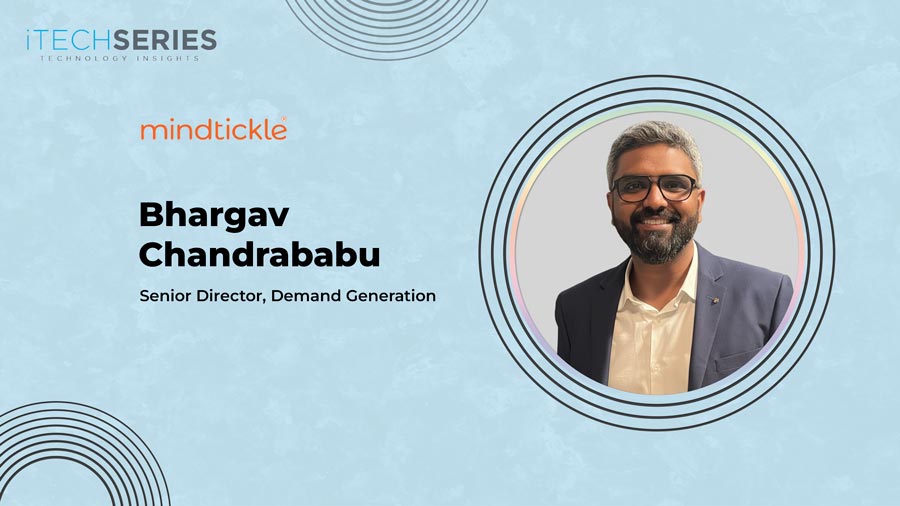
In this iTech Series Unplugged interview, Bhargav Chandrababu, Senior Director, Demand Generation at Mindtickle, shares insights on building revenue-first marketing teams, creating a predictable pipeline, and navigating the AI era. He discusses the evolving role of B2B marketers, the importance of sales alignment, and the mindset required to drive sustainable growth.
It’s great to have you for this interview, Bhargav. Could you tell us about yourself and your journey as a marketer?
The best careers are rarely the ones you planned. Mine certainly wasn’t. I started in sales, spent time as a coder, and somehow found a way to bring both worlds together as a marketer—building demand engines for Mindtickle, Sprinklr, Freshworks, and InMobi, four companies that collectively redefined their categories in B2B SaaS.
A serious marketing career wasn’t even on my radar when I started. Though looking back, there were early signs. I used to blog about music on Blogger while still in college, making a little money from Google Adsense here and there. Nothing significant, but it got me curious about how digital platforms worked.
What really set the direction was joining InMobi in 2015. Mobile advertising was at an inflection point, and learning digital marketing inside an ad tech company is honestly one of the best educations you can get. You develop a certain tech fluency from day one, the kind that stays with you regardless of what industry you move into later.
From there, every role has been some version of the same challenge. build a team from the ground up, scale it, and make it a predictable source of pipeline. That was true at Freshworks during their hypergrowth phase and at Sprinklr when I was the first digital marketing hire after the function moved from the US to India, and it’s what I’m doing now at Mindtickle.
Thirteen years in, the thing I care most about hasn’t changed: marketing that’s measured by the revenue number. Everything else is in service of that.
What are the key pillars of a high-performing demand generation strategy today?
The first is technology and data infrastructure. Before you spend a rupee or a dollar, you need to know what you’re measuring and how. At Freshworks, one of the first things we did was build an integrated MarTech stack and connect everything to a central data warehouse so insights were democratised across functions rather than sitting in one team’s dashboard. None of that would have been possible without an exceptional data analytics team. Without that foundation, everything else is guesswork dressed up as strategy.
The second is channel discipline. Organic, paid, ABM, field—none of these work in isolation. The best demand generation engines treat channels as a portfolio, not a menu. You make deliberate bets, understand how the audience converges, and optimise the mix over time. I find the teams that consistently struggle are the ones chasing the channel of the moment rather than building something that compounds.
The third is AI fluency, and I don’t just mean tools. I mean building a team that thinks natively in AI, using it for content operations, signal-based targeting, and automating workflows that used to require headcount. The marketers who will matter in the next two to three years aren’t necessarily the ones who know which tools to use. They’re the ones who think in systems and know how to integrate AI into how a team operates. That’s a significant mindset shift, and most organisations are still in the early stages.
And fourth, which most people underinvest in, is sales alignment. The honest reality is that marketing and sales have structurally different incentives; marketing optimises for volume and velocity at the top of the funnel, and sales optimises for quality and close rate at the bottom. Those tensions don’t disappear easily. The best demand gen strategy in the world fails if sales don’t trust the leads or understand the intent signals behind them. The teams I’ve seen consistently outperform are the ones where marketing and sales are operating from the same playbook.
Over the past decade, how have you seen B2B SaaS marketing evolve, especially in the way teams approach pipeline and revenue ownership?
Earlier, marketing was largely seen as a support function. We ran campaigns, generated leads, and handed them over. The conversation with the CEO or CFO was about brand awareness and share of voice, things that were genuinely hard to tie to revenue. That has changed dramatically.
The first big shift was attribution. As MarTech matured, CRMs, marketing automation, and intent data platforms matured. It became possible to connect marketing activity directly to the pipeline and revenue. Marketing leaders stopped presenting share of voice and started presenting pipeline contribution, cost per opportunity, and marketing-sourced ARR. That changed the conversation in the boardroom entirely.
The second shift, which is still playing out, is ownership. The best marketing leaders I know don’t think of themselves as service providers to sales. They think of themselves as co-owners of the revenue number. At Mindtickle, I present weekly to the CEO on inbound performance, channel, and pipeline contribution. That is a fundamentally different relationship to the business than marketing had a decade ago.
The third shift is around how buyers make decisions. Today you’re not selling to one person; you’re influencing a buying committee of six to ten stakeholders, each with different concerns and different stages of awareness. That’s reshaped how ABM works and how the pipeline is built. Campaigns are no longer about reaching a decision maker. They’re about orchestrating a conversation across an entire account. It should be contextual to the journey of the customers we are chasing.
“The best demand generation engines treat channels as a portfolio, not a menu. You make deliberate bets, understand how the audience converges, and optimise the mix over time.”
How is AI reshaping the relationship between marketing, sales enablement, and revenue growth?
AI is doing something interesting: it’s compressing the distance between intent and action across the entire revenue funnel.
On the marketing side, the impact is most visible in how teams operate. Content and SEO programmes that once required large teams and long cycles can now run leaner and faster. Signal-based automation means outbound sequences are triggered by actual buying behaviour, not arbitrary nurture schedules. That kind of precision simply wasn’t practical two years ago.
On the sales enablement side, and this is something I’ve seen first-hand at Mindtickle, AI is fundamentally changing how reps show up to customer conversations. Personalised coaching based on individual skill gaps means every rep is learning differently, not sitting through the same training as others. Real-time deal intelligence flags risks in active opportunities and recommends the next best move before the rep has to ask. Reps walking into sales calls today are better prepared if they’re leveraging the tech well.
Where it gets genuinely exciting is the intersection of marketing and sales. When marketing’s intent signals feed directly into sales workflows, and sales feedback loops back into marketing’s targeting, AI stops being something teams adopt in isolation and starts functioning as a connected system.
The honest caveat I’d add is this: AI amplifies good strategy and good data. If your fundamentals are weak, AI makes the mess faster. The companies that will win are the ones that already have clean data, aligned teams, and a strong context layer that makes that data meaningful.
What would be your advice to marketers on developing the right skills and mindset to succeed?
Three things, in the order that I learned from my mentor, which I often share with others now.
First, learn the business before you learn the tools. I’ve met brilliant marketers who know every platform inside out but struggle to have a conversation with a CXO or a sales leader about revenue. The marketers who grow fastest are the ones who can sit in a business review and understand what the numbers mean, not just their own numbers but the business’s numbers. That fluency is what gets you a seat at the table.
Second, own an outcome, not a function. There’s a meaningful difference between “I run demand generation” and “I own the pipeline target.” The first is a job description. The second is a leadership position. The earlier in your career you start thinking in terms of outcomes rather than activities, the faster you’ll move.
Third, be genuinely curious about technology, but don’t be seduced by it. The MarTech landscape is overwhelming and getting more so with AI. The marketers who build durable careers are the ones who can tell the difference between signal and noise and make technology work in the service of strategy rather than the other way around.
And one mindset thing I’d add is to get comfortable with being wrong in public. Marketing is inherently experimental. A test-and-learn culture has to start with leaders who are willing to say “that didn’t work; here’s what we learned.” That psychological safety is what separates teams that iterate from teams that repeat.
Ultimately, the marketers I’ve seen grow the fastest are the ones who are just as comfortable being uncomfortable as they are being right.
Could you tell us about your most memorable experience as a marketer?
The one that stays with me is from my early days at Sprinklr.
As I mentioned before, I was building the digital marketing function from the ground up, and the self-serve motion was fairly new territory for the company — an organisation that had historically grown through outbound and enterprise field sales. Building that confidence that inbound could work required as much internal selling as external marketing.
What I remember most is the moment, about eighteen months in, when the self-serve motion crossed its first meaningful revenue milestone. It sounds modest in hindsight, but at the time, it was proof of concept for something nobody was sure would work. We eventually grew it fourfold in Net New ARR over the following years, thanks to a resilient inside sales team.
But the number isn’t what stays with me. What I remember is the leadership support through a journey that had no guaranteed outcome and the team that built something meaningful without a playbook. There’s something particular about being a small team delivering a meaningful outcome inside a large organisation; the ownership feels different, the wins feel more personal, and the losses teach you more.
About Bhargav Chandrababu
Bhargav Chandrababu is a marketing leader with 13 years of experience scaling demand generation across four category-defining SaaS companies: Mindtickle, Sprinklr, Freshworks, and InMobi. He also advises early-stage startups on demand generation and go-to-market strategy and serves as an Advisory Board Member at Bhumi, one of India’s largest volunteer-based NGOs.