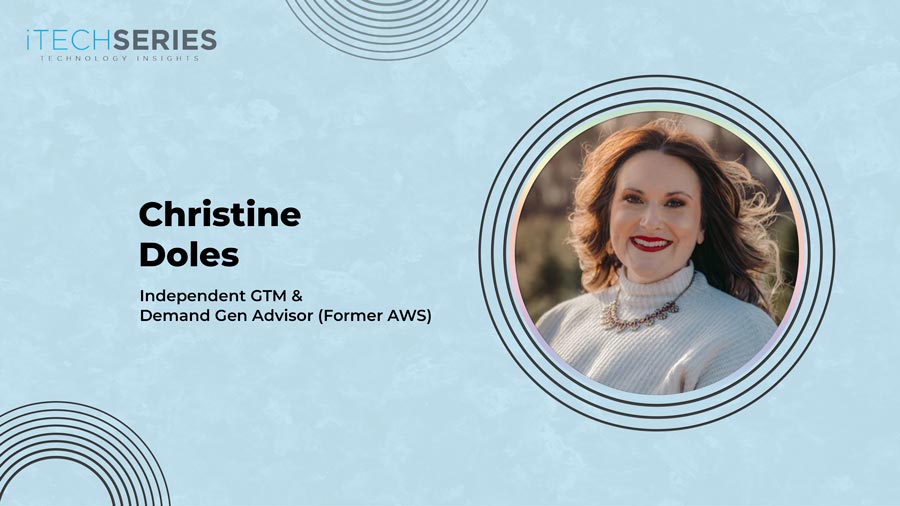
Christine Doles, an Independent GTM & Demand Gen Advisor (Former AWS), shares insights into building scalable demand-generation engines, aligning global and regional teams, and closing pipeline gaps. She also explores customer-centric storytelling, personalized journeys, campaign execution strategies, and data-driven budget allocation approaches that drive measurable growth and long-term business impact.
Welcome to the interview series, Christine. Could you tell us about yourself and your journey as a marketer?
Thank you so much for having me. I usually describe myself as a ‘Go-to-Market Architect’ and a ‘Builder of Demand Generation Engines.’ I have about 18 years of experience in the B2B marketing space, specifically focusing on taking complex, technical enterprise capabilities and translating them into highly scalable demand generation campaigns.
If I look back at my journey, I truly cut my teeth in marketing at Infor, managing digital demand programs for their complex ERP and supply chain portfolios. That was my very first major corporate marketing role right out of the gate, following an invaluable foundational internship at an office furniture manufacturer where I first learned the ropes of the corporate world.
From Infor, I moved deeper into institutional and research markets at ProQuest and then spent several years at Thomson Reuters leading content and digital demand strategy for the highly complex tax and accounting segment. Most recently, that trajectory brought me to AWS, where I managed global industry marketing programs and built demand frameworks that delivered over $380 million in Sales Qualified Lead pipeline.
Parallel to my corporate career, I’m also an Adjunct Professor currently teaching Principles of Marketing, as well as Consumer Behavior, Personal Selling, and Global Marketing in the past. I love this because it allows me to bring real-world, hyperscaler marketing strategy into the classroom while keeping my corporate strategies grounded in disciplined academic frameworks.
Where does alignment typically break down in global integrated marketing, and how do you rebuild it?
Alignment almost always breaks down in the translation layer between global strategy and local field execution. What happens is that the global campaign teams build these massive, beautifully designed global playbooks in a vacuum. Then they toss them over the fence to regional teams who say, ‘This doesn’t fit our local market nuance, and our sales team won’t use it.’
To rebuild that alignment, I use what I like to call a ‘Squad’ or ‘Center of Excellence’ model. Instead of dictating strategy top-down, you pull regional field marketers and sales leadership into the campaign architecture process early. When I was at AWS, we standardized global playbooks but built in explicit ‘flex-points’ for the local markets. If you give local teams a voice in the framework of the campaign and solve their specific regional sales pain points, they go from being passive recipients to active champions of the engine.
Where do you see the biggest gaps between pipeline creation and conversion?
The single biggest gap is the ‘No-Man’s Land’ between Marketing Qualified Leads and Sales Accepted Leads. Marketing teams love to celebrate hitting their lead generation numbers, but if those leads sit untouched in a CRM system for a week, the pipeline dies of cold exposure.
To bridge this gap, you have to shift the metrics from volume to velocity and intent. It’s important to optimize lead management workflows and create a seamless handoff motion with Sales. If Marketing can provide Sales with behavioral data—showing exactly what content a prospect engaged with, what niche trade publications they are reading, and what intent signals they are flashing—Sales doesn’t feel like they are cold calling. They are stepping into a warm, context-rich conversation. When you fix the handoff, conversion rates follow naturally.
Can you walk us through your most challenging yet successful campaign that delivered a strong pipeline and conversion?
One of the most challenging but rewarding initiatives was scaling our global industry marketing campaigns to reach highly specialized business decision-makers. The challenge with enterprise B2B marketing is that you cannot rely on generic, mass-market digital plays. You are trying to engage C-suite buyers who have incredibly high filters for noise.
We shifted our strategy away from broad-brush campaigns and focused heavily on niche targeting, specifically placing content in highly specialized industry trade publications and meeting decision-makers inside their trusted industry associations. We paired this with high-touch, hyper-focused industry symposiums. By solving highly specific, industry-aligned pain points rather than pitching a product, we built an incredibly robust trust layer. That single, end-to-end integrated engine ultimately drove over $389 million in total SQL pipeline and smashed our performance targets by over 300%.
“True customer-centric storytelling means making the customer the hero, making their business pain point the conflict, and positioning your solution simply as the tool that helps them win the day.”
In global multi-channel campaigns, where do you see the biggest drop-offs in the customer journey, and how do you address them?
The biggest drop-off happens right after the initial engagement—the ‘one-and-done’ webinar or whitepaper download. A prospect interacts with a high-value piece of content, and then they are dumped into a generic, linear email sequence that treats them like a total stranger.
We address this by embedding behavior-driven personalization and intent data directly into our campaign frameworks. If a buying group from an enterprise account attends a webinar, our automated nurture logic shouldn’t just send them another generic brochure. It should include a personalized next step—like an invite to an exclusive symposium or a targeted, industry-specific customer story that speaks to their specific corporate hurdles. You fix drop-offs by making the customer journey feel like a continuous, responsive conversation rather than a series of disconnected marketing events.
Where do most B2B marketing teams go wrong when trying to build customer-centric storytelling?
Most B2B companies suffer from ‘feature-itis.’ They are so proud of their software, their cloud capabilities, or their technical roadmaps that they make the product the hero of the story. But the customer doesn’t care about your product; they care about their own survival, their own efficiency, and their own growth.
This is where my background as a marketing professor comes in handy—I always tell my teams to look at consumer behavior. Even in B2B, you are still marketing to human beings. True customer-centric storytelling means making the customer the hero, making their business pain point the conflict, and positioning your solution simply as the tool that helps them win the day. When you shift the narrative from ‘Look what our platform can do’ to ‘Look what you can achieve,’ your messaging instantly cuts through the market clutter.
How do you allocate your marketing budget across channels to maximize impact and efficiency?
I look at budget allocation through a strict data-driven, multi-touch attribution framework. I don’t believe in ‘set-it-and-forget-it’ annual budgets.
I structure spending into a balanced model: a significant portion goes to our core ‘always-on’ digital demand channels—like SEM, paid media, and content syndication—where we can directly track pipeline contribution and ROI. Another portion is strictly carved out for high-impact experiential marketing, like industry third-party events, which drive the final stage conversion and velocity.
But the key to efficiency is maintaining an agile ‘innovation fund’—about 10 to 15% of the budget—dedicated to testing modern marketing tactics, new intent-data platforms, or AI-driven optimization tools. If a test proves it can improve lead quality or lower our customer acquisition cost, we can instantly scale it. If it doesn’t, we kill it fast and reinvest the dollars into our proven pipeline engines.
About Christine Doles
Christine Doles is a senior marketing leader with more than 15 years of experience building and scaling integrated marketing programs for global technology organizations. She specializes in demand generation, content strategy, and go-to-market execution that drives pipeline growth and revenue impact. Known for aligning cross-functional teams and simplifying complex solutions into compelling narratives, Christine is also an adjunct faculty member passionate about mentoring and developing the next generation of marketers.