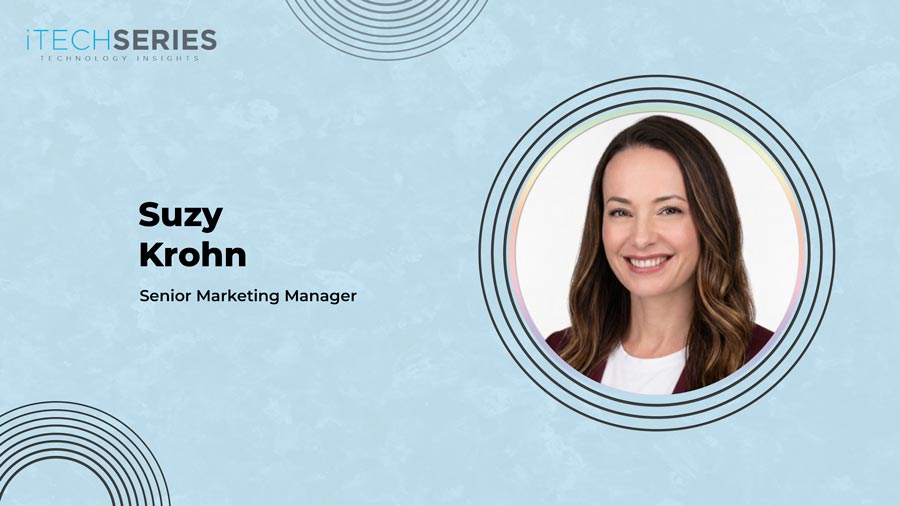
In this interview, Senior Marketing Manager Suzy Krohn shares insights from her experience leading demand generation and digital marketing initiatives across leading technology companies. She discusses the evolving role of marketing in driving revenue growth, strengthening GTM alignment, leveraging AI, optimizing customer journeys, and building high-performing teams in complex B2B environments.
Welcome to the interview series, Suzy. Could you tell us about yourself and your journey as a marketer?
Thank you so much for having me. My career has been driven by one core belief: that marketing should be measurable, strategic, and deeply connected to revenue outcomes.
I started at Microsoft, managing digital demand for Office 365 and Azure. That foundation in SEM, landing page optimization, and trial conversion shaped how I think about the full funnel. From there, I moved into agency-side work at Wheelhouse Labs, which gave me incredible breadth running paid programs across both B2B and B2C accounts simultaneously.
The through line in all of it has been performance: what’s actually driving the pipeline, and how do we do more of it efficiently? That eventually brought me into enterprise cybersecurity and tech, first at F5, then Palo Alto Networks, and Cloudflare, where I led global paid media and digital demand for enterprise and executive segments. There, I owned multi-channel programs end-to-end, from strategy and audience segmentation through CRO, attribution, and executive reporting. I partnered closely with Sales and BDR leadership to ensure that marketing-generated leads converted into opportunities and pipeline.
You’ve led global marketing initiatives. What are the biggest challenges in scaling campaigns across different regions?
You must be willing to adjust strategies as tactics evolve and new channels surface. You can’t really master Digital Marketing until you’ve realized that success usually comes from experimentation and understanding your ICP (Ideal Customer Profile).
At Cloudflare, running global programs for enterprise segments, I learned quickly that audience signals, buying committee dynamics, and even platform performance vary by region. What resonates in NAMER doesn’t always translate to APAC; the pain points, the compliance concerns, and the personas involved in a security buying decision are all slightly different.
Another challenge is budget allocation. When you’re operating globally, you need a disciplined framework for deciding where to concentrate spend based on pipeline signals and intent data rather than just historical preference. I leaned on Demandbase’s account tiering and intent signals to make those calls rather than distributing budget evenly and hoping for the best.
And last but not least is agency and team coordination. I ran weekly performance syncs with external agency partners across channels, and maintaining accountability to shared KPIs across time zones and market contexts is genuinely hard. You need clear measurement frameworks, rigorous attribution, and the discipline to act on data quickly. The best GTM teams create shared incentives and reporting across functions.
As a performance marketing leader, how do you connect campaign performance to revenue outcomes?
This is the question I’m most passionate about, and honestly, the one where a lot of marketing teams still fall short.
My approach starts with instrumentation. You can’t connect marketing to revenue if your attribution stack isn’t built properly. At every company I’ve been at, I’ve worked to ensure that GA4, Salesforce, Bizible, and Marketo are talking to each other and that we’re tracking the full funnel: CPC and CTR at the top, MQL-to-SAL conversion in the middle, and opportunity creation and pipeline velocity at the bottom.
But beyond the tools, the real unlock has been how I engage with Sales. At Cloudflare, I served as an embedded partner to BDR and Sales leadership. We were aligned on territory account plans and pipeline targets before campaigns even launch. That allowed me to increase Sales Accepted Leads 2x in nine months, not by generating more volume, but by improving lead quality and handoff. That’s the distinction between a marketing org that reports on clicks and one that actually moves pipeline.
The industry has started moving beyond MQL-centric thinking toward product-qualified leads and sales-qualified accounts. B2B decisions are driven by buying groups, not individual stakeholders.
How has marketing’s role evolved in the overall go-to-market strategy with greater alignment across revenue teams?
The biggest shift for Marketing I’ve seen is moving from a support function that generates leads to a genuine strategic partner in the revenue motion. Earlier in my career, the relationship between marketing and sales was transactional: we handed over leads at a threshold, and Sales did what they do best, close deals. That model is broken.
At all 3 of my most recent roles, I was deep in a compliance-driven, enterprise security environment where the buying cycle is long, and the stakeholders are cautious. In that context, marketing needs to be embedded in territory planning, not just campaign execution. At Cloudflare, I worked directly with field leadership, aligning digital programs to account plans and pipeline targets. The KPIs we shared weren’t impressions or MQLs; they are SALs, pipeline contribution, and opportunity conversion.
The broader industry is moving toward what some are calling a revenue organization: marketing, sales, customer success, and ops under a unified mandate with shared goals. I think that’s exactly right. And it requires marketers who are comfortable in Salesforce, who can present pipeline narratives to executives, and who aren’t precious about campaign performance for its own sake.
“The biggest shift for Marketing I’ve seen is moving from a support function that generates leads to a genuine strategic partner in the revenue motion.”
Customer journeys are becoming increasingly complex. How do you map and optimize them effectively?
The B2B customer journey was already complex, with multiple stakeholders, long sales cycles, and content consumed across a dozen touchpoints before anyone talks to Sales. The challenge now is that those touchpoints are multiplying: search, LinkedIn, programmatic, third-party content placements, event follow-up, email nurture, and direct SDR outreach.
My approach is to build the funnel view first. At F5, when I launched a net-new SaaS product, I built CRO and A/B testing frameworks spanning across ad creative, copy variants, and landing pages, because I knew the funnel would need continuous iteration. We improved web form conversion 1.5% QoQ through structured experimentation and generated $900K+ in attributed pipeline in six months. This discipline of test-learn-iterate across every stage is how I think about journey optimization.
At Cloudflare, I used DemandBase intent signals to understand where accounts are in their journey and allocate spend accordingly, so we were not treating a low-intent account the same way we treat one actively researching solutions. This account-tiering approach is what drove roughly a 30% reduction in CPL and CPM-to-MQL. Closed-loop reporting, which ties marketing efforts directly to the pipeline at every stage of the buyer journey, is essential. You need to know not only that someone converted, but also where in the journey the conversion happened and what influenced it.
As AI becomes more integrated into marketing, how can teams use automation to improve efficiency while maintaining creativity and authenticity?
This was something I actively navigated at Cloudflare. I deployed AI-assisted analysis to surface performance insights faster; tasks that previously required a half-day of data wrangling were reduced to minutes, enabling near-real-time optimization decisions. We also began utilizing LLMs to keep stakeholders informed on campaign performance and details. Over time, we advanced to building AI agents capable of autonomously handling repeatable tasks, such as passing leads to sales with actionable recommendations, including email follow-ups and call scripts.
Like most marketers, I am fully embracing AI technology to optimize my work, but I’m also cautious of overusing AI and creating a poor user experience. I believe the ideal balance involves human-driven content with AI assistance, treating AI as an amplifier of creativity and productivity rather than a replacement for human judgment and strategic thinking.
In cybersecurity marketing, especially, authenticity and trust matter enormously. You’re talking to CISOs and IT security leaders who are sophisticated and skeptical and have very low tolerance for generic messaging. AI can help you scale personalization and speed up analysis, but the insight into what keeps a CISO up at night has to come from a human who understands the buyer. The best-performing B2B brands deliver experiences that feel human, even when powered by technology.
What approaches do you use to keep your team motivated while driving strong marketing performance?
I think about motivation in two ways: clarity and ownership.
On clarity: People perform best when they understand exactly how their work connects to outcomes that matter. I invest a lot in making sure my team (and agency partners) understands not just the KPIs but the why behind them: why we’re targeting these accounts, why we’re prioritizing this channel mix, and why SAL quality matters more than MQL volume. When the strategic rationale is clear, people make better decisions independently and feel more invested.
On ownership: I try to give people real accountability for things they can influence. At Cloudflare, when I reduced CPL by 30% through account segmentation and channel optimization, it wasn’t just me; it was a team with the freedom to experiment, the data to learn from, and the accountability to act on what the data showed. I build testing frameworks not just for the performance benefit but because testing creates a culture of learning where experimentation is expected.
I’ve had some incredible leaders in my career that I have learned from. What they had in common is that they rewarded and celebrated wins (big and small), but they also encouraged honest post-mortems to learn from failures, mistakes, or unproven hypotheses.
About Suzy Krohn:
Suzy Krohn is a demand generation and paid media marketing leader with over a decade of experience driving global growth across B2B SaaS, IT, and cybersecurity organizations. She specializes in building high-performing teams and scalable marketing programs that increase brand awareness, improve lead quality, and accelerate pipeline growth. Passionate about sales and marketing alignment, Suzy combines data-driven strategy, attribution expertise, and AI-powered innovation to deliver measurable business outcomes.