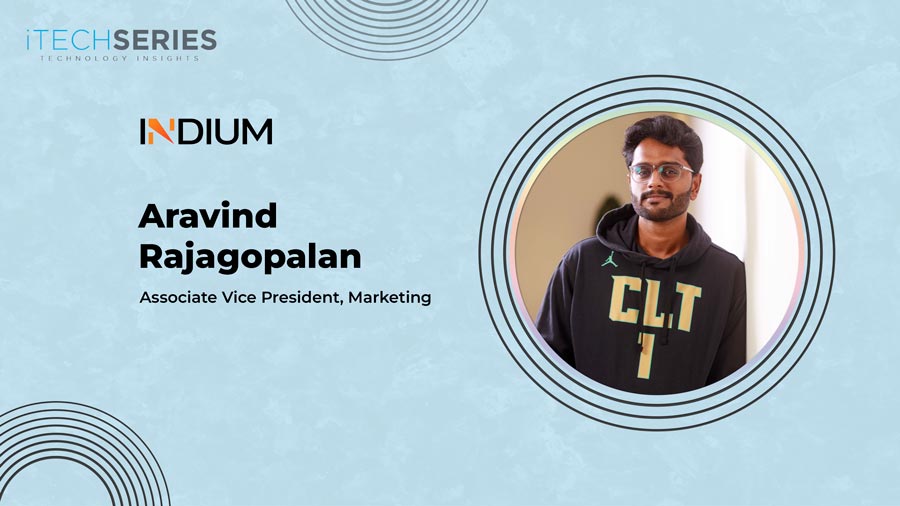
Aravind Rajagopalan, Associate Vice President of Marketing at Indium, shares insights from his journey in B2B SaaS and revenue-driven marketing. He discusses field marketing, ABM, and account-centric strategies, alongside pipeline creation, sales alignment, AI adoption, and building scalable programs that consistently drive revenue impact and long-term business growth.
Welcome to the interview series, Aravind. Could you tell us about yourself and your journey as a marketer?
I’ve spent close to nine years in B2B SaaS and services marketing, working across Zoho, Locus, Kissflow, and now Indium. A lot of my experience comes from outbound and field marketing, where the focus has always been on building programs that translate into meaningful pipelines.
Over time, I’ve had the opportunity to lead 200+ events across North America, work on ABM initiatives for enterprise accounts, and collaborate on partner ecosystems that open up new growth avenues.
At Indium, I currently lead content, PR, outbound, and partner marketing. It all comes down to building a marketing engine that consistently drives pipeline and earns a clear seat at the revenue table.
How has the role of marketing evolved within an integrated revenue organization over time?
Marketing today works much more closely with revenue than before.
If you look at how programs, campaigns, touchpoints, and even individual interactions are built, they’re all designed around a clear understanding of the buyer and how deals move forward.
The way teams operate is far more account-centric. There’s a deeper focus on understanding buying groups, aligning messaging to different stakeholders, and engaging at the right moments across the journey.
I see marketing at its strongest when it consistently shows up in closed revenue conversations.
Many organizations aim to align brand, demand, and revenue. What does true alignment look like in practice, and why is it so difficult?
Only about 35% of B2B organizations feel tightly aligned across marketing and sales, and it’s easy to see why. In most setups I’ve seen, teams still plan and measure in their own lanes, even when everyone is working towards the same outcome.
When alignment is working, it’s very visible from the outside. A buyer engages with the brand early on, and that story carries through. By the time sales steps in, the context is already there. Conversations pick up from where marketing left off, and the deal moves forward without having to restart the narrative.
Getting there is where it becomes difficult. A lot of it comes down to how teams operate day to day. Goals sit within functions, timelines move differently, and context can slip as work passes from one team to another. Keeping that continuity intact takes deliberate coordination and a shared view of the accounts everyone is working on.
One thing that’s made a difference for me is keeping the account view constant, even as teams and touchpoints evolve around it.
What separates ABM programs that actually drive enterprise deals from those that only generate activity and dashboards?
You can usually tell pretty early which ABM programs are actually going somewhere.
Activity looks strong, engagement is there, meetings pick up, and dashboards trend in the right direction. Look closer, and the deal itself hasn’t really moved.
The ones that land enterprise deals are far more deliberate. The focus stays on a small set of stakeholders, with a clear understanding of what matters to them and how to engage in a way that advances the opportunity.
By the time sales steps in, there’s already a clear thread to pick up, and the deal continues without friction.
In my experience, it comes down to depth. The more time spent understanding the business, the more likely the program is to convert into real opportunities.
“Marketing is at its strongest when it consistently shows up in closed revenue conversations.”
If someone had to build a field marketing engine from scratch today, what would your step-by-step playbook look like?
My 5-step playbook for building a field marketing engine:
- Identify high-value accounts in close alignment with sales, and this is where everything starts.
- Map key stakeholders and deeply understand their buying journey and influence.
- Design integrated, account-centric campaigns from curated events and roundtables to targeted digital experiences.
- Drive tight sales alignment before, during, and after every initiative to ensure continuity.
- Measure what truly matters—pipeline impact and deal progression—and continuously refine based on outcomes.
Field marketing delivers real impact when it moves beyond logistics and becomes a strategic lever for enterprise engagement.
“Field marketing is the art of creating moments that convert into deals.”
Which key metrics and reports do you prioritize when evaluating a campaign’s success?
The metrics that matter are the ones closest to revenue.
Pipeline generated, pipeline velocity, and deal influence are the first signals I look at.
Then engagement within target accounts, meeting conversion rates, and opportunity progression across stages.
Win rates, deal size, and cycle time close the loop on whether the campaign is actually driving impact.
Pay attention to consistency across campaigns, attribution clarity, and how insights feed back into optimizing future strategies and improving overall marketing effectiveness.
With AI embedded across marketing, how do leaders scale performance while preserving human insight, creativity, and judgment?
AI has fundamentally improved speed and scale across marketing, especially in data analysis and personalization.
The core still comes down to understanding people and building messaging that earns trust over time.
The real opportunity is in using AI to remove friction, so more time goes into strategy and creativity.
AI can optimize decisions. Direction is still a human call. Leaders must also establish clear ethical guidelines, continuously validate outputs, and ensure teams remain accountable for consistent, customer-centric outcomes.
About Aravind Rajagopalan
Aravind Rajagopalan is a B2B SaaS marketing leader with extensive experience across Zoho, Locus, Kissflow, and Indium. He specializes in enterprise field marketing, ABM, and outbound strategies, focusing on building programs that drive meaningful pipeline and revenue. With a strong background in global markets, he leads integrated marketing efforts across content, PR, partnerships, and events to create scalable, account-centric growth engines.