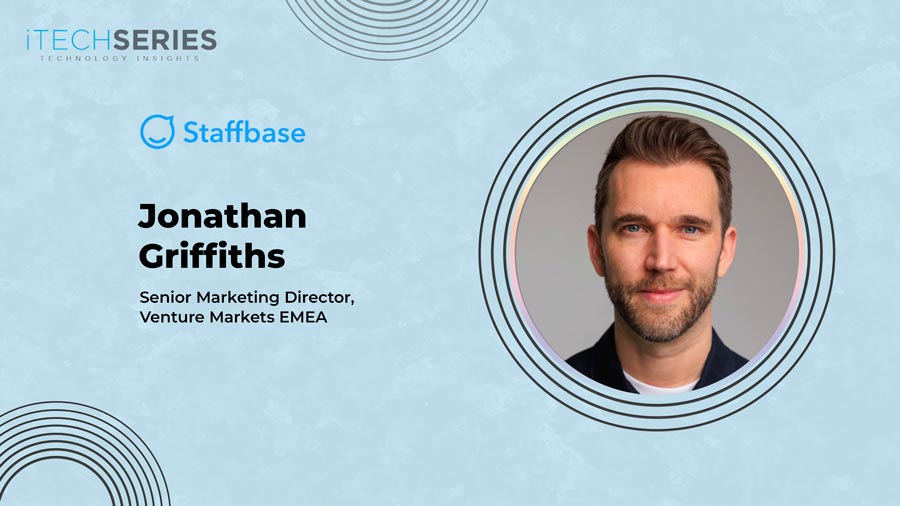
Jonathan Griffiths, Senior Marketing Director, Venture Markets EMEA at Staffbase, shares insights from over two decades in marketing leadership across global brands and high-growth companies. He discusses balancing brand and demand, building high-performing teams, and aligning marketing with revenue, grounded in human-centered leadership, deep customer understanding, and a disciplined, insight-driven approach to sustainable growth.
Welcome to the interview series, Jonathan. Could you tell us a bit about yourself and your journey as a marketer?
I’ve been in marketing for over two decades, and in leadership roles for the majority of that time. I’d describe myself as a generalist marketer who has specialized in regional marketing and the balance between brand and demand—both of which I believe are essential to commercial success.
I’ve been fortunate to work on some incredible projects and brands, including Precor, Rugby World Cup 2019, the Tokyo 2020 Olympic Games, Pax8, Acronis, and most recently, Staffbase. In recent years, I’ve become increasingly focused on combining my passion for human-centred leadership with my marketing career—and that thread runs through everything I do.
You’ve built marketing teams across multiple regions. What principles guide you in creating a high-performing marketing organisation?
I came across the “Hungry, Humble, Smart” framework early in my career—introduced to me by a Marketing Director I admired—and it’s shaped how I recruit, manage, and coach ever since. It’s not just a hiring filter; it’s a philosophy I try to live by myself.
Beyond that, I want people who are genuinely passionate about the audiences they’re marketing to. Not just the personas on a slide, but really understanding who those people are, where they spend their time, and what motivates them. And I want people who are excited by the craft—who push back against boring B2B and look for ways to do things differently.
The other piece is culture. I believe you get the best out of people through kindness, empathy, and inspiration. Creating psychologically safe environments where people can be honest, take risks, and grow—that’s not soft. That’s how high performance happens.
What is your approach to building growth marketing strategies that drive both acquisition and retention?
I genuinely believe you have to balance brand and demand. Close off brand investment, and the demand pipeline dries up over time. Focus only on the brand, and you end up with vanity metrics and no foundation. The tension between the two is where the interesting work lives.
I also still believe in the funnel—but I think the most useful way to look at it is on its side, as a customer journey rather than a linear path. Anyone can enter at any stage, and your job is to be relevant and helpful wherever they are, not to force them down a predetermined route.
In your experience, how has marketing evolved in working more closely with sales and customer success?
The three functions have to work hand in hand—that’s just the reality of modern B2B, where you’re managing pre-sales, sales, post-sales, upsells, and cross-sells all at once. Marketing should have a presence across all of it, using insights from sales and CS to sharpen strategy, messaging, and tactics.
There’s also an internal communications dimension that I think gets underestimated. We need to be better at understanding our internal audiences and making sure our messaging and plans land clearly with the people delivering them. Alignment between teams isn’t automatic—it has to be worked at.
I do think we’ve made genuine progress as an industry in recognising marketing as a revenue-generating function rather than a support service. But there’s still room to go further.
When faced with several campaign ideas, how do you decide which ones to pursue?
The first question I always ask is, “Does this fit the current strategic direction—not just for marketing, but for the business?” What are we positioning, who are we going after, and what are we trying to achieve right now? A campaign targeting one persona in one vertical is a very different exercise from one aimed at another audience in a different market, and both need to be grounded in that context.
From there, I want to understand the bill of materials—can this campaign be executed across integrated channels? We know customers need multiple touchpoints with consistent messaging, so if an idea only works in one channel, that’s a problem.
And then, has the campaign actually considered the customer journey? Is it helping someone move forward, wherever they are, or is it just expecting people to follow the path we’ve designed for ourselves?
“A campaign targeting one persona in one vertical is a very different exercise from one aimed at another audience in a different market, and both need to be grounded in that context.”
What has been your most memorable experience as a marketer?
I’ve been genuinely lucky, and I try not to take that for granted. But building a team from scratch at Pax8 stands out. Launching a brand into a completely new market is one thing—but doing it while simultaneously building a team around shared values, not just shared goals, was something else. Watching that come together was special in a way that’s hard to replicate.
How do you use data insights to continuously optimise marketing campaigns for better impact?
Data tells you what happened. The skill is in understanding why—and what to do next.
My approach has always been to start with a clear hypothesis before a campaign launches: what do we expect to see, and why? That gives the data something to push back against. Without it, you end up selectively reading results to confirm what you already believe.
In practice, I look at data across the full customer journey—not just top-of-funnel vanity metrics, but how leads progress, where they drop off, and what the sales and CS teams are seeing on the ground. That qualitative layer matters as much as the numbers. Some of the most useful campaign insights I’ve ever had come from a conversation with a salesperson, not a dashboard.
The other discipline is knowing when to optimise and when to stay the course. There’s a temptation to react to every data point, but meaningful patterns take time to emerge. Constant pivoting often does more damage than a campaign that needed a few more weeks to land.
What are the key principles for managing change while keeping teams motivated and aligned?
Teams are more unsettled than ever right now. We’re living through what many are calling a permacrisis at the macro level, and inside organisations there’s enormous pressure—AI, restructures, layoffs, investor expectations. In that environment, the instinct to over-communicate process and under-communicate humanity is understandable, but it’s the wrong call.
People need to feel led, not managed. That means kindness, empathy, and inspiration—especially when there’s uncertainty. And it means structured, consistent communication. If there’s a vacuum of information, people will fill it themselves, usually with the worst-case version. An update that says “there’s no update yet” is still valuable.
The thing I feel most strongly about is that organisations are at risk of losing their humanity as technology accelerates. Keeping that at the centre—in how we lead, how we communicate, and how we treat people—is something I think about a lot.
About Jonathan Griffiths
Jonathan Griffiths is a CIM-qualified marketing executive with over 20 years of global experience across B2B and B2C markets in EMEA, the US, and Japan. As Senior Director of Marketing, Venture Markets at Staffbase, he leads regional strategy and go-to-market execution. He has held leadership roles at Acronis and Pax8 and previously led marketing for major global sporting events, driving growth, brand impact, and high-performing teams.