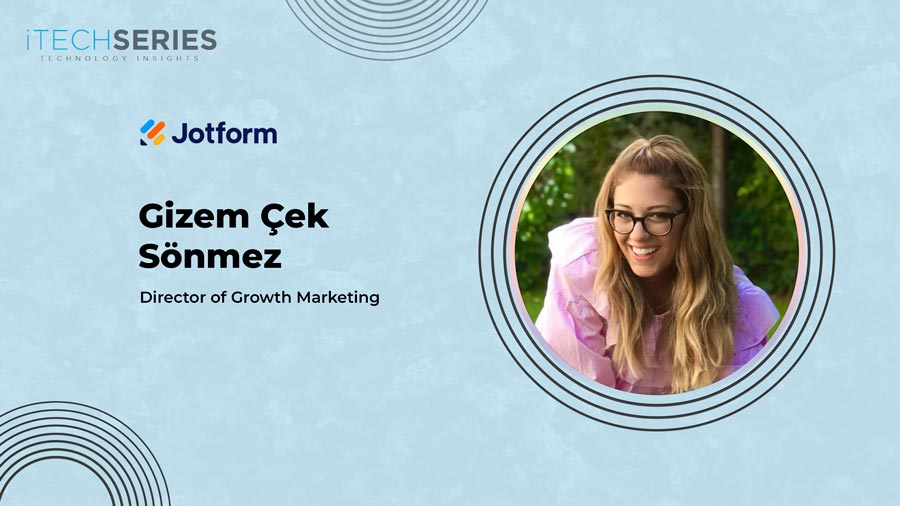
Gizem Çek Sönmez, Director of Growth Marketing at Jotform, shares her journey from traditional to digital marketing and how it has shaped her approach to growth. She explores the evolving role of marketing in go-to-market strategy, the importance of meaningful metrics, content effectiveness, experimentation, and thoughtfully integrating AI while keeping human judgment at the core.
Welcome to the interview series, Gizem. Could you tell us about yourself and your journey as a marketer?
My journey started in traditional marketing, which gave me a strong foundation and helped me understand the logic behind marketing early on. It also taught me that marketing is, above all, a communication-driven field.
As technology and SaaS companies started gaining momentum, I naturally moved into digital marketing. What made that shift especially valuable for me was being able to combine traditional marketing principles with the speed and flexibility of the digital world.
Today, I work across areas such as growth marketing, email marketing, campaign marketing, product marketing, and product launches. What I’ve always found most fulfilling about marketing is seeing how a product finally meets its audience. So much work goes into building something, and marketing plays a key role in turning that effort into real engagement, growth, and measurable results. That has always been one of the most satisfying parts of the job for me.
How has marketing’s role evolved within the broader go-to-market strategy?
I think marketing has become much more central to the broader go-to-market strategy than it used to be.
In the past, marketing was often seen mainly as the team responsible for awareness or lead generation. Today, it plays a much broader role in positioning, customer education, product understanding, activation, and growth.
This shift happened because go-to-market is no longer just about getting attention. It is about creating the right journey across the full customer experience. That is why marketing now needs to work much more closely with product, sales, and other customer-facing teams. When that happens, marketing becomes much more than a support function. It becomes a real driver of how a product reaches the market and gains traction.
As Director of Growth Marketing, what metrics do you prioritize beyond traffic and engagement to measure real business impact?
Traffic and engagement can be useful signals, but on their own, they do not tell the full story.
I usually focus more on metrics that show movement across the user journey. Depending on the campaign, that can include activation, conversion, retention, product adoption, pipeline contribution, and revenue-related outcomes.
I also pay close attention to downstream behavior. It is not enough for a campaign to generate clicks if users do not take the next meaningful step. For me, the more important question is whether marketing is helping users get closer to value. That is where the real business impact becomes visible.
“Go-to-market is no longer just about getting attention. It is about creating the right journey across the full customer experience.”
You’ve worked across multiple layers of content strategy. What defines high-performing content in today’s B2B landscape?
For me, high-performing content is content that is genuinely useful, clearly positioned, and built for a specific audience.
In B2B, content performs best when it helps people understand something faster, solve a problem, or make a decision more easily. A lot of content underperforms not because the topic is weak, but because the message is too broad or the audience is not clearly defined.
I also think strong content needs to support different stages of the journey. Some content drives discovery, some builds trust, and some supports conversion. The key is not just producing more content but creating the right content for the right moment and making sure it connects to a real business goal.
How do you build a culture of experimentation without slowing down execution?
I think experimentation works best when it becomes part of the workflow, not an extra layer added on top of it.
One mistake teams often make is treating every test like a major project. In reality, experimentation becomes much more sustainable when it is built into everyday decision-making. That means being clear about what is being tested, why it matters, and what the team is hoping to learn.
It is also important to stay practical. Not every decision needs a large test, and not every test needs to be perfect. In many cases, small and focused experiments are enough to create learning without slowing the team down. Over time, those repeated learnings become very valuable and help teams make better decisions faster.
As a marketing leader, how have you implemented AI tools for your marketing campaigns without being completely reliant on them?
I see AI as a tool that improves speed and efficiency, but not as something that should replace judgment.
It can be very useful for generating starting points, organizing ideas, speeding up research, or supporting workflows. In that sense, it helps teams save time and focus more on strategy and execution.
At the same time, I do not think AI should be responsible for final thinking. Strong marketing still depends on understanding the audience, making good decisions, and applying context. Those are the parts that still need human judgment.
I also believe AI will play a major role in shaping the future of marketing. It is not something marketers can simply ignore. I do not think AI will just take jobs away on its own, but I do think the people who know how to use it well, guide it, and turn it into a real advantage will produce better work. The bigger risk is for those who resist it completely, because adaptation will matter more and more.
So for me, the most effective approach is to use AI as support, not as a substitute. It can help teams move faster, but the direction still has to come from people.
What key lessons from your marketing journey would you share with aspiring marketers?
One of the biggest lessons I’ve learned is that marketing never stands still. It evolves constantly, and with AI, that pace of change has become even more visible.
I do not think marketers should see that as a disadvantage. The real value comes from adapting, learning, and finding ways to benefit from new technology instead of resisting it. Marketing will always need human judgment, creativity, and a real understanding of people. But AI can still create a major advantage in terms of speed, efficiency, and output when used in the right way.
In my own case, I come from a traditional marketing background, and moving into digital marketing taught me how to measure performance, follow metrics more closely, and use data more effectively. That shift helped me see how much the field can change and how important it is to keep evolving with it. I believe the same is true today with AI. The more open we are to learning, the more we will discover how much it can contribute to the way we work.
About Gizem Çek Sönmez
Gizem Çek Sönmez is a marketing leader with over 16 years of experience across traditional and digital marketing. Currently Director of Growth Marketing at Jotform, she specializes in growth, content, and campaign strategy. Her work focuses on driving measurable impact, combining data with creativity, and leveraging AI as a strategic enabler while maintaining strong human judgment in decision-making and execution.