In this exclusive interview, Gokul Suresh, Head of Demand Generation at Whatfix, shares insights on scaling demand generation, building field marketing systems, and measuring impact beyond MQLs. He discusses evolving marketing playbooks, aligning with sales, and creating programs that drive pipeline, revenue, and long-term enterprise growth.
Welcome to the interview series, Gokul. Could you tell us a bit about yourself and your journey as a marketer?
I’ve been in B2B SaaS marketing for over 12 years now, and honestly, it wasn’t something I planned. It happened gradually. I’m a Computer Science graduate, but during engineering, I realized I was far more fascinated by advertising, storytelling, and human psychology, how people think and make decisions, and what truly influences them. That curiosity quietly became the foundation of how I approach marketing.
I started as a Content Marketer and took a leap of faith in 2015, joining a little-known garage startup called Whatfix. That was 11 years ago, and I’m still here. What began as a small startup is now a category leader in digital adoption, serving enterprise customers globally. Being part of that journey from early experiments with almost no marketing infrastructure to building a structured, multimillion-dollar demand engine has been one of the most defining experiences of my career. I also documented much of this evolution on my LinkedIn profile because I genuinely believe long tenure growth stories deserve more attention. Staying, in many ways, is its own kind of ambition.
At Whatfix, I’ve had the rare opportunity to help build almost every part of the marketing engine from scratch. I began with content, social, product marketing, and community, essentially laying the inbound foundation. As the company scaled, I led PR for Whatfix till Series B, built field marketing into a core demand pillar, created a growth marketing team to run experiments, and eventually moved into leading the broader revenue marketing function.
Today, I head the Demand Generation team, which includes Field Marketing, ABM, Performance Marketing, and Marketing Automation, essentially the team responsible for a large share of the marketing budget and significant expectations for results.
The beauty of staying true throughout that journey is the perspective it offers. Every stage demands a different version of you. What works at $1M ARR breaks at $10M, and what works at $10M doesn’t scale at $50M. The push from $50M to $100M becomes less about clever strategy and more about endurance, building systems that consistently deliver, quarter after quarter.
How does a demand generation strategy need to evolve as a company scales, and what do most teams often underestimate?
The companies that struggle at scale are almost always carrying playbooks they built too early and never revisited. For example, with Field Marketing, I always advise marketers/founders to go knee-deep into investing once your entire process of post-event outreach is sorted and it’s bringing your ROI. Until then, if you plan to scale quickly, things are going to break.
As you move into the growth stage, demand gen starts to look more like a portfolio. You layer in intent-based programs, ABM motions, partner co-marketing, and larger owned events. The mix shifts from purely relationship-led to a blend of relationship and signal. Sales alignment becomes non-negotiable here.
And at scale, the challenge is different again. It’s less about finding what works and more about building systems that deliver consistently, quarter after quarter, without burning out the team or the budget. The danger at this stage is complexity and the problem of too many. Too many programs, too many channels, and attribution debates that consume more energy than they generate insight.
The mistake I see most often, at every stage, is measuring marketing programs with the same or similar conversion metrics. Each channel-be it field marketing, performance marketing, automation, ABM, or outbound-is vastly different. When you have similar metrics attached to each, some of them will always lose because their value shows up later, in pipeline quality, win rate, and deal velocity, not in immediate MQL volume.
The measurement framework has to match the stage and the program type, or you’ll keep cutting the things that are actually working.
What factors do you consider when deciding which field marketing programs, channels, or events to prioritize across regions?
At Whatfix, we run 130+ events a year. Roughly 80% are physical tradeshows, executive connect events, our own roadshows, roundtables, and partner events. That volume sounds impressive, but the discipline behind it is what makes it effective.
We evaluate field marketing investments across four dimensions, which together help us decide whether to proceed.
- Sales motion and deal size: Whatfix primarily sells to large enterprises globally, and we’re both platform-agnostic and industry-agnostic. This opens opportunities across BFSI, Life Sciences, Digital Transformation, L&D, HR, Supply Chain, and more. Matching the right event with the right sales motion is our most important filter.
- Quality over volume: Events work best when they’re not treated as a checklist but as intentional touchpoints designed around how buyers actually buy in a specific region and stage of the journey. As a rule of thumb, we look for at least a 70% match with our Ideal Customer Profile (ICP) for any event we sponsor. We also have a dedicated Events BDR function at Whatfix, created because of the high lead volume we generate each year. Every lead is categorized and handled by the Events BDR team or nurtured through marketing automation.
- Buyer behavior in the region: Every region has different nuances. Before planning for a region, we ask whether deals are relationship-led, partner-led, or digitally influenced. That single insight shapes our approach whether we prioritize tradeshows, executive dinners, partner events, or content and intent-based programs.
- Scope beyond demand generation: Field marketing isn’t only about demand generation. It helps companies connect with audiences in person and can also validate GTM strategy, ICPs, market maturity, pricing, demo feedback, and new sales motions.
How has field marketing’s role evolved by working more closely with sales and other revenue teams?
When I started, field marketing success was often measured by the number of leads, attendance, or Marketing Qualified Leads (MQLs). Even now, most of the new systems start similarly. From just generating top-funnel leads. While those metrics aren’t wrong, they’re incomplete. They tell you something happened, not whether it mattered.
In the 2nd year, we shifted focus to SQLs and pipelines, evolving from purely top-of-funnel campaigns to programs that could influence mid- and bottom-funnel outcomes. That changed how sales perceived field marketing entirely.
Event leads are unique. They sit between a high-intent inbound lead and a low-intent outbound lead. And they need a specialized outreach motion. We built a dedicated Events BDR team of 12–15 people to solve exactly that. That specialization is what drives meaningful conversion from lead to SQL to closed revenue.
Then came pipeline acceleration programs that we planned to work closely with sales on. Sitting in pipeline reviews, identifying stalled accounts, and designing events that directly unblock them. A well-timed executive dinner can do more than three months of nurture emails.
While we haven’t yet piloted this, our next goal is to work with Customer Success to help them improve customers’ overall retention rate through strategic events.
I strongly believe that Field Marketing should essentially work across the entire pipeline. It’s simply the best way to reach people, build relationships, and create credibility without being salesy.
“The mistake I see most often is measuring every marketing program with the same metrics. If you do that, you’ll keep cutting the things that are actually working.”
How do you measure the success of your field marketing initiatives, and what data guides your optimization decisions?
The straightforward thinking is that if I spend X dollars, I should win XY dollars. In reality, it’s not always that simple. Field marketing has multiple layers of success metrics. Let me break it down.
Leading indicators include audience quality, ICP fit, seniority, target account coverage, context of conversations, and meetings set up from an event. The more predictable these are at the start, the higher the chances of success.
Mid-funnel impact is where I spend the most analytical time: pipeline sourced and influenced; deal acceleration (did opportunities in the program move faster?); and meeting creation rates. These connect field activity to commercial outcomes without demanding perfect attribution, which is rarely possible in complex enterprise deals.
Revenue outcomes are the long game: ARR won and influenced, win-rate lift for accounts that participated in programs versus those that didn’t, and deal velocity trends over time. These take longer to materialize but show whether your field strategy is creating durable demand or simply generating activity.
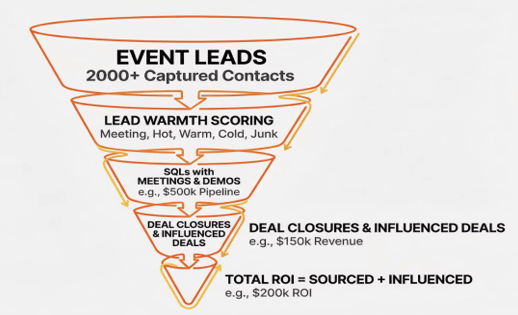
Total leads captured → lead warmth scoring (meeting, hot, warm, cold, junk) → SQLs with meetings and demos → deal closures and influenced deals → total ROI = sourced + influenced.
Having this backward math model before running an event changes how you design it. You start with the commercial outcome and work backward to the audience size, quality bar, and follow-up motion required.
Qualitative signals also matter how sales conversations shift post-event, which touchpoints move accounts from cold to engaged, plus intangible outcomes like GTM validation, brand footprint, competitive intelligence, and thought leadership.
One caution: don’t chase the attribution rabbit hole too early. Multi-touch attribution is complex. Until ROI is predictable, focus on simple backward math rather than sophisticated models that create false precision.
Tell us about your most challenging yet memorable experience as a marketer.
Honestly, the most challenging and most meaningful experience has been staying as a marketer at a company for 11+ years!
There are very few people like me in the B2B SaaS Marketing world. From the inside, it demands continuous trust in the company, in leadership, and most importantly in yourself to keep evolving as the role and expectations change underneath you. There were genuinely hard moments. Bets that didn’t pay off. Times when staying felt harder than leaving.
But the long-term journey gave me something rare: the ability to see how decisions compound over years, not quarters. The experiment that failed in year one becomes the foundation of a scaled program in year four. The hire you made when the team was tiny becomes a leader three years later. When you’re around long enough, you start to see the full arc. And that’s beautiful.
One moment that still makes me smile: an ex-partner of Whatfix moved on to one of the fastest-growing semiconductor companies in the world. Three years later, he reached out on LinkedIn, this time, as a prospect. Conversations, event invitations, and relationship-building over months. Two years after that LinkedIn message, the deal closed. Five years. One relationship. One deal. That’s the kind of closure you only get from being somewhere long enough to see things through.
How have AI-enabled tools changed the way you approach field marketing strategy and execution?
On execution, the whole team uses AI daily. Drafting follow-up sequences, curating feedback and highlights, building account-specific content, and improving targeting. Work that took days now takes hours. It’s a blend of ChatGPT, Gemini, and NotebookLLM. I’ve also been using Gamma.app for slide creation: what used to take hours is now a solid structure in 10–15 minutes of editing.
On strategy, AI has made me faster at spotting patterns across data where the pipeline is stuck and what’s contributing from each event. I’ve been experimenting with the MCP layer on my personal laptop, connecting datasheets, slides, and LLMs to compress multi-day analysis into near real-time. Still early, but genuinely exciting.
There’s also a big, funny aspect. How Field marketers take pride in the fact that AI can’t replace them. Field marketing is fundamentally about human trust. A well-run roundtable works because buyers feel safe having real conversations, no pitch deck, just peers working through a shared challenge. A leadership dinner works because people feel that someone genuinely thought about why they specifically should be there. That feeling of intentionality, you cannot automate it.
As a leader, how do you keep your team motivated and aligned to deliver on marketing goals?
I keep coming back to two things: clarity and ownership.
Motivation erodes fastest when people don’t understand why their work matters. Not in the abstract “we’re building a great company” sense, but concretely, how does this event connect to the pipeline and revenue? How does this roundtable create a real conversation with a CXO? How is this webinar helping in moving prospects down the funnel?
So I invest a lot of time in context. I try to make sure the people I work with understand the business at a level that lets them make good decisions without needing constant direction.
On alignment: I’ve found that it comes almost entirely from trust. Trust that I’m giving people problems worth solving, not just tasks to execute. Trust that when they challenge an idea or flag a concern, it’s welcome. Trust that if they take a calculated risk and it doesn’t work, we’ll learn from it together rather than treat it as a failure.
I always preach, “No questions are dumb if you ask them, you get clarity.” If you don’t, you work on assumptions that lead to more problems.
Strong teams aren’t built on pressure. They’re built on purpose, progress, and the belief that their work genuinely matters.
About Gokul Suresh
Gokul Suresh is a B2B SaaS marketing leader with 12+ years of experience scaling marketing from an early-stage start-up to a global enterprise business approaching $100M ARR. He joined Whatfix as its first marketer when it was still a garage start-up and has since built many parts of the marketing function from the ground up. Today, as Head of Demand Generation, he owns the full pipeline engine, which includes field marketing, performance marketing, ABM, and marketing automation globally. His focus is on building demand engines, aligning marketing tightly with sales, and turning marketing programs into predictable, revenue-driving growth systems.
Beyond his operating role, Gokul is an active voice in the SaaS marketing community, regularly speaking at industry conferences, hosting and participating in podcasts, and sharing practical insights on building scalable demand engines and modern field marketing programs. His perspective combines hands-on execution with strategic thinking on how marketing can function as a true revenue driver in enterprise SaaS.
Connect on LinkedIn: Gokul Suresh