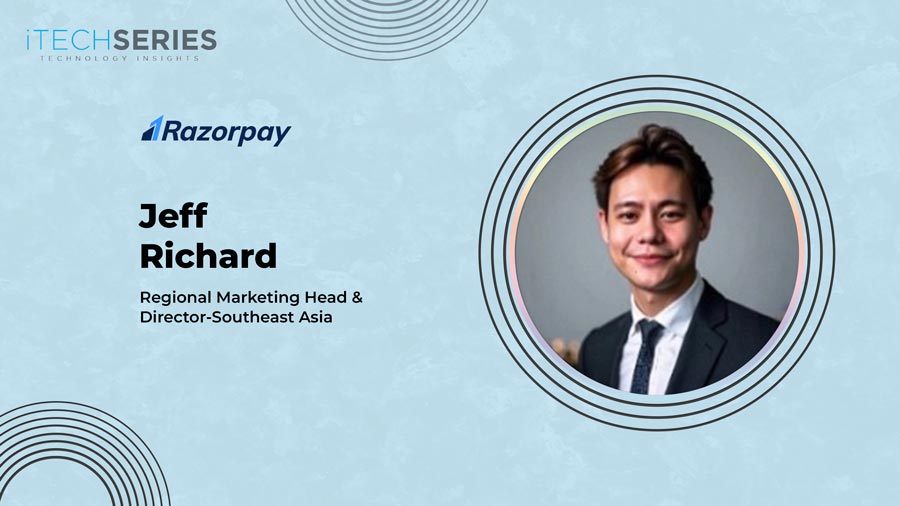
In this interview, Jeff Richard, Regional Marketing Head & Director-Southeast Asia at Razorpay, shares how marketing has evolved from an execution-led function into a central growth and decision-making engine. He explores integrated go-to-market models, balancing brand and growth, scaling across Southeast Asia, and building disciplined, data-led systems that drive predictable, commercial impact.
Could you tell us about yourself and your journey as a marketing leader?
My journey started by working at the intersection of strategy, data, and execution and learning early on that these elements only create value when they are tightly connected. That early exposure trained me to step back and understand how markets actually function, what data is revealing beneath surface-level metrics, where constraints exist across product, sales, or regulation, and which decisions genuinely move outcomes. When I transitioned into a more senior role, I viewed marketing as a growth discipline that sits close to revenue, product design, and commercial decision-making.
As my scope expanded, I worked across consumer, SME, and B2B environments, often in fast-moving and regulated markets where execution quality matters as much as strategy. Over time, my role evolved from delivering initiatives to owning growth more holistically. This meant defining target segments, shaping go-to-market strategy, and ensuring those decisions were translated into clear, prioritised execution across acquisition, lifecycle, and monetisation. Throughout my career, I have remained close to data to keep strategy grounded, while staying close enough to execution to understand what teams face on the ground.
Today, I operate focused on clarity and impact. I spend time making deliberate choices about where to play, how to win, and what to deprioritise, and then structuring teams, systems, and metrics to execute with discipline. For me, marketing is about creating alignment between vision and execution and driving growth that is measurable, repeatable, and scalable.
Where have you seen marketing’s role change the most within an integrated go-to-market setup?
The most significant change I have seen is marketing evolving from an execution function into a central growth and decision-making engine within the go-to-market system. Historically, marketing success was often measured by activity, such as leads generated, impressions delivered, or campaigns launched. Today, marketing is accountable for shaping demand, guiding customer journeys, and contributing directly to pipeline quality and revenue outcomes.
Within integrated go-to-market models, marketing now plays a much stronger role in prioritisation and orchestration. By analysing customer behaviour, segment performance, and funnel dynamics, marketing helps the business decide where to invest resources and which opportunities are worth pursuing. This is particularly important in Southeast Asia and Malaysia, where markets differ significantly in adoption, trust, and digital maturity, making standardised assumptions unreliable.
Marketing also acts as the connective layer across sales, product, lifecycle, and brand, ensuring that initiatives reinforce each other rather than compete. Equally important is commercial accountability. Marketing decisions are shaped by ROI, capacity, and downstream impact, not just creativity. As a result, my role has shifted from delivering campaigns to designing the systems, processes, and decision frameworks that ensure initiatives translate into predictable business results.
How do you balance brand-building with aggressive growth targets across Southeast Asian markets?
Brand and growth are mutually reinforcing levers, not separate. Brand builds trust, reduces perceived risk, and improves conversion efficiency, while performance-driven growth delivers scale and short-term impact. The key challenge is deciding where to invest and how to sequence efforts, so they work together rather than compete for attention or budget.
In B2B FinTech and payments, especially in markets like Malaysia, credibility plays a direct role in decision-making. Buyers often evaluate providers based on reputation, stability, and peer validation before engaging seriously. In these contexts, brand investment directly supports growth by reducing sales friction and improving activation. In more digitally mature or competitive markets, performance-led initiatives can take a larger role because customers are more comfortable making faster decisions.
Operationally, I embed brand into demand generation and lifecycle programmes. Thought leadership, case studies, and PR are designed to support acquisition, sales conversations, and retention rather than exist in isolation. I balance investments by measuring outcomes such as engagement quality, conversion rates, sales cycle length, and retention. This ensures brand-building remains accountable while strengthening long-term growth efficiency.
When entering a new market or launching a new product, how do you design an effective go-to-market strategy?
I design go-to-market strategies by starting with strategic clarity rather than tactics. The first step is defining where the business can realistically win by identifying the most valuable segments, understanding their unmet needs, and clarifying the specific outcomes the product must deliver to gain traction. Without this alignment, even strong execution will underperform.
Once the strategic intent is clear, I focus on aligning the operating model. Product readiness, pricing, messaging, onboarding, and sales motion must be designed to support early adoption before scaling demand. This prevents early traction from leaking due to misalignment. From there, I prioritise initiatives based on impact and feasibility, sequencing efforts so that learning compounds and momentum builds.
Measurement and iteration are built into the process from the start. Performance is tracked across the full funnel, and insights are used not only to optimise execution but also to challenge underlying assumptions. This ensures that go-to-market efforts evolve into a scalable growth system rather than a one-off launch.
“The most significant change I have seen is marketing evolving from an execution function into a central growth and decision-making engine.”
As a regional marketing leader, how did you adapt growth strategies across diverse Southeast Asian markets?
Adapting growth strategies across Southeast Asia requires balancing consistency with flexibility. Markets differ widely in customer behaviour, regulation, infrastructure, and competitive intensity, so a single execution model rarely works. I start by grounding strategy in local market intelligence, using data and insight to understand what truly drives adoption in each market.
At the same time, I maintain a consistent regional/global framework for acquisition, activation, retention, and monetisation. This creates alignment and comparability across markets while allowing execution to adapt locally. Messaging, channel mix, and partnerships are tailored to local realities, and teams are empowered to adjust tactics within clear strategic guardrails.
Continuous learning is central to this approach. Performance insights from each market are reviewed regularly, contextualised, and shared. This allows successful patterns to be scaled thoughtfully while avoiding overgeneralisation. The result is growth that is both locally effective and regionally scalable.
How do data and automation help you scale growth efficiently without overcomplicating execution?
Data and automation are enablers of clarity rather than complexity. Data is used first and foremost to support decision-making by focusing on a small set of metrics that genuinely guide prioritisation and investment. This creates a shared language across marketing, sales, and operations and keeps execution aligned to business objectives.
Automation is applied selectively to remove friction from recurring processes, improve speed and consistency, and allow teams to focus on higher-value work. Automated workflows support timely engagement, personalisation at scale, and efficient handoffs between teams. Rather than building overly complex systems, I prioritise simplicity and reliability for teams and end-users.
When designed well, data and automation make execution more predictable and scalable. They allow marketing to move quickly, adapt to insights, and drive growth across markets without adding unnecessary layers of process or complexity.
How do you decide which growth levers to prioritise at different stages of the funnel as the business scales?
Funnel optimisation is a system-level problem. Each stage of the funnel influences the others, so prioritisation requires understanding where improvements will have the greatest downstream impact. In earlier stages, this often means focusing on awareness and high-quality acquisition, particularly in markets where trust and education are critical. As the business matures, the emphasis shifts toward activation, retention, monetisation, and advocacy.
Decisions are always grounded in data and unit economics. By analysing conversion rates, customer behaviour, and cost-to-impact ratios, it becomes clear which levers offer the highest return at any given stage. This allows resources to be allocated dynamically while maintaining a balance between short-term performance and long-term scalability. The goal is sustainable, predictable growth rather than isolated optimisation. Every lever is chosen based on how it strengthens the overall growth system.
What would be your advice to aspiring marketing leaders on developing the right skill sets?
Aspiring marketing leaders should think beyond execution and tactics. Leadership requires strategic clarity, commercial understanding, and the ability to align people and processes around outcomes. A strong foundation in data and analytics is essential, but just as important is the ability to interpret insights, make sound trade-offs, and translate complexity into clear direction.
One quality that is often underestimated is humility. The strongest leaders recognise that they do not have all the answers. They stay open to learning from their teams, from peers, and from the market itself. This humility is closely tied to the art of asking good questions. Knowing what to ask and when to ask it often matters more than having immediate answers. Good questions surface blind spots, challenge assumptions, and help teams focus on what truly matters rather than what is simply visible.
Another critical skill is the ability to anticipate issues before they surface. This comes from pattern recognition, listening carefully to weak signals, and connecting insights across data, customer feedback, and execution realities. It also requires the ability to operate at multiple levels at once, seeing the big picture of strategy, revenue, and market dynamics while still paying attention to the small details that determine whether execution succeeds or fails.
Early in my career, I learnt a few lessons that continue to shape how I work today. I learnt the importance of speed and momentum and that waiting for perfect information often creates more risk than moving forward thoughtfully and learning along the way. I learnt to be proactive, to test ideas quickly, and to stay close to execution rather than observing from a distance. Being hands-on taught me that progress comes from action and that clarity often emerges through doing.
Ultimately, effective marketing leadership is a combination of humility, curiosity, anticipation, and decisiveness. It is about asking better questions, listening deeply, moving with intent, and turning insight into action. The leaders who make the greatest impact are not those who claim to know everything, but those who create momentum, learn continuously, and consistently deliver meaningful business results.
About Jeff Richard
Jeff Richard is a marketing leader who builds and scales high-impact teams across startups and multinational organisations. With board-level experience and deep expertise in fintech, e-commerce, FMCG, and consulting, he drives growth by aligning strategy, data, and execution. Jeff specialises in go-to-market design, demand generation, lifecycle marketing, and sales enablement, transforming marketing into a disciplined, scalable revenue engine that delivers measurable, lasting commercial impact across diverse markets and complex, fast-moving environments globally.