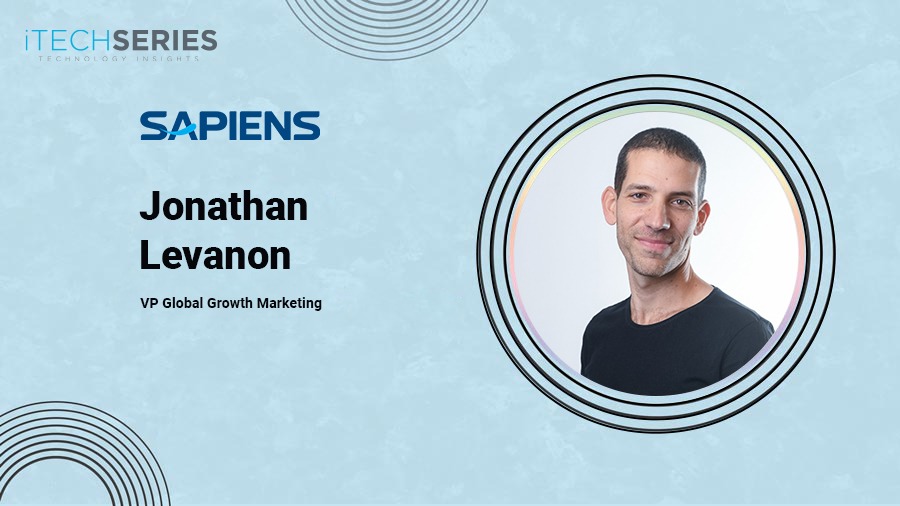
Jonathan Levanon, VP of Growth Marketing at Sapiens, shares how an engineering mindset shapes scalable, predictable growth. He discusses building disciplined operating models, using data as a decision framework, aligning teams across the pipeline, and applying AI to drive sustainable demand, leadership accountability, and long-term revenue performance.
Welcome to the interview series, Jonathan. Could you tell us a bit about yourself and your journey as a marketer?
Hello, and thank you for having me!
My professional background is actually in engineering, not marketing, and that has shaped how I think about growth from day one. I was trained to break complex problems into systems, understand constraints, and rely on evidence rather than assumptions. When I moved into marketing, I didn’t see it as a creative function but as a growth problem that needed structure and accountability.
As my career evolved, I transitioned from execution into building and leading global growth organizations in complex B2C & B2B environments. Today, as VP of Growth Marketing, my focus is on designing operating models that connect strategy, data, people, and execution across regions, long sales cycles, and multiple business lines. The goal is not activity, but consistency – creating systems that perform predictably over time.
Data has always been my primary reference point. not as a reporting exercise, but as a way to bring clarity to decisions and remove emotion from debates. In environments where growth expectations are high and margins for error are small, data becomes the light that guides prioritization, tradeoffs, and long-term direction. It’s what allows growth to scale without losing discipline.
What does a truly scalable and predictable demand generation engine look like in practice, and where do most organizations get it wrong?
A scalable and predictable demand generation engine is built on shared data and shared understanding, not on individual channels or isolated funnel stages. In practice, it means the organization has a single, trusted view of the entire pipeline – from first signal to closed revenue – and uses that view to make coordinated decisions.
It’s also important to recognize that scalability looks very different depending on the company’s stage. In startups, speed and learning matter more than predictability. In SMBs, the challenge is moving from founder-led intuition to repeatable processes. In enterprise environments, predictability becomes critical because growth depends on coordination across regions, functions, and long sales cycles. Treating these stages the same is one of the most common mistakes organizations make.
Data plays a central role, but not as a reporting layer. It functions as a common language across marketing, sales, and revenue teams. When everyone is working from the same definitions, assumptions, and performance indicators, tradeoffs become explicit and decisions become faster and more accurate.
Where many organizations struggle is in treating demand generation as a collection of disconnected activities. Teams optimize their own stages or channels in isolation, often with different success metrics and time horizons. That creates local improvements but global inefficiency. Pipeline gaps are discovered too late, and forecasts rely more on hope than evidence.
Predictability emerges when the entire pipeline is analyzed as a system, understanding how volume, quality, velocity, and capacity interact across functions. When data is used to synchronize execution rather than justify results, demand generation becomes something you can manage and scale with confidence.
You often say that data without a strategy is just noise. What’s your framework for turning raw data into decisions that drive revenue?
For me, the role of data is not to prove a point – it’s to listen. If you come to the data already knowing what you want it to say, it usually becomes a justification exercise. That’s when it turns into noise.
I start by being clear about what I care about and what I’m willing to act on. In growth, there is always too much data. The real challenge is deciding which signals matter and deliberately ignoring the rest. If a metric doesn’t change a decision, it doesn’t belong in the conversation.
From there, I work backward from the outcome we’re trying to influence – pipeline quality, velocity, or revenue predictability – and focus only on the signals that reflect movement in those areas. When those signals change, we respond. When they don’t, we don’t overreact.
Used this way, data becomes a guide rather than a report. It helps teams stay aligned, removes emotion from debates, and keeps decisions grounded in what the business is actually telling you, not what you hope to hear.
Digital transformation is an overused term. From your experience, what does real digital transformation in growth marketing actually look like?
Real digital transformation has very little to do with adopting new technology and everything to do with changing how an organization makes decisions. You see it when digital capabilities stop being layered on top of existing problems and instead reshape how teams work together.
In growth marketing, this often starts with visibility across the entire pipeline. What that visibility looks like varies by scale. In smaller organizations, it might be about finally connecting marketing and sales data. In larger enterprises, it’s about aligning multiple regions, products, and teams around the same definitions and decision cadence. For example, when marketing, sales, and operations work from the same data definitions and timelines, conversations shift. Instead of debating lead quality or attribution after the fact, teams can identify where momentum slows, where handoffs break, and where capacity (and not effort) is the real constraint. That alignment alone often delivers more impact than any new platform.
Another clear sign of real transformation is when automation and analytics are used to reduce friction, not add complexity. I’ve seen organizations unlock scale simply by redesigning how demand signals flow across regions and teams, so prioritization is consistent, follow-up is timely, and forecasting reflects reality rather than optimism. In those cases, technology enables discipline, not speed for its own sake.
When digital transformation is real, teams spend less time explaining results and more time acting on them. Data becomes a shared reference point, workflows become intentional, and growth becomes something the organization can manage with confidence rather than chase reactively.
In a market obsessed with rapid wins and new trends, how do you defend focus, patience, and sustainable growth at the leadership table?
I don’t defend patience as a principle; I defend it as an economic reality. Short-term wins are valuable, but only when they don’t undermine long-term efficiency, credibility, or pipeline health. In complex B2B environments with long sales cycles, every rushed decision has a delayed cost.
At the leadership table, focus becomes easier to defend when conversations are grounded in unit economics, capacity constraints, and long-term impact. For example, it’s easy to push aggressively for more top-of-funnel volume, but if sales capacity, regional readiness, or follow-up quality doesn’t scale at the same pace, the result is friction rather than growth. The pipeline may look healthier in the short term, but conversion and trust suffer downstream.
I’ve seen this play out in global organizations where regions operate at different maturity levels. Accelerating campaigns without aligning processes, data definitions, and ownership across teams often creates more noise than value. In those moments, discipline means slowing one part of the system so the rest can keep up.
My role is to help leadership see not just what we can accelerate, but what acceleration might break and whether that tradeoff is worth it. When those implications are visible, patience stops being a “marketing ask” and becomes a business decision rooted in protecting future growth.
“A scalable and predictable demand generation engine is built on shared data and shared understanding, not on individual channels or isolated funnel stages.”
How are you practically applying AI today to improve targeting, personalization, or forecasting—and where do you see the biggest real ROI?
Today, we apply AI most actively where content and data scale create complexity. We use AI to identify patterns across content formats, messages, campaigns, user journeys, and data tables to understand what truly resonates – across audiences, regions, and different stages of the pipeline. AI helps us iterate faster by suggesting messaging variations and testing directions based on historical performance and emerging signals. It also highlights potential bottlenecks and crucial conversions junctions and suggests potential optimization. It doesn’t replace strategy or creativity, but it significantly shortens feedback loops and reduces uncertainty in execution.
The ROI here comes from efficiency – wasting less budget on underperforming ideas (and processes) and scaling winning narratives with more confidence. Many of these capabilities are powered by the AI already embedded in third-party platforms we use, which process volumes of engagement and intent data that would be impossible to analyze manually.
Looking ahead, especially toward 2026, the focus shifts from content, data and process optimization to decision support at scale. This is where AI delivers its most durable value. Rather than thinking in terms of standalone tools, we think in terms of agents aligned to real roles and real decisions.
Growth teams will leverage agents that act as social listeners, surfacing intent signals, narrative shifts, and in-market accounts, as well as buying-persona simulators that help stress-test messaging and positioning before it reaches the market. SDRs will rely on AI as a research and prioritization layer, helping them focus effort where it has the highest likelihood of impact. Analysts will use AI to surface patterns, anomalies, and risk signals across the full pipeline, not just isolated stages.
For leaders, the value is especially tangible. AI helps expose early signs that plans are drifting off course – whether that’s a mismatch between pipeline growth and sales capacity, regional performance diverging from assumptions, or forecast confidence eroding before it shows up in revenue. Instead of reacting late, leadership can intervene earlier, with context and clarity, while decisions are still reversible.
Forecasting is another area where AI becomes increasingly important. Instead of relying solely on historical averages, AI helps identify shifts in velocity, regional dynamics, and capacity constraints earlier, making planning more resilient and less reactive.
What would be your advice to marketers looking to step into leadership roles?
The most important shift is moving from proving that marketing works to demonstrating that you understand how the business works. Leadership is not about having the best ideas; it’s about making decisions that hold up under pressure and uncertainty.
Many marketers (I’m one of them) grow up professionally in startup or SMB environments, where speed and ownership are everything. Stepping into leadership, especially in enterprise contexts, requires a different mindset: patience, systems thinking, and the ability to scale decision-making through others.
Marketers who successfully step into leadership roles are the ones who connect execution to outcomes, ask better questions, and take ownership beyond their functional boundaries. Just as importantly, they know how to listen to their teams, to the signals coming from the market, to what the data is actually telling them and to other company functions feedback (specifically Sales and Product). That listening ability often reveals constraints, tradeoffs, and risks long before they show up in results.
Growth leadership is ultimately about accountability. Being willing to stand behind decisions, learn from outcomes, and adjust course when needed without losing direction or credibility with the people executing the work.
About Jonathan Levanon
Jonathan Levanon is a strategic growth executive with 15+ years of experience leading global demand generation, ABM, and growth operations for enterprise organizations. As VP, Global Growth Marketing at Sapiens, he drives pipeline acceleration, digital transformation, and market expansion. A recognized thought leader and advisor, Jonathan specializes in scaling growth through disciplined, data-driven, and AI-powered strategies.