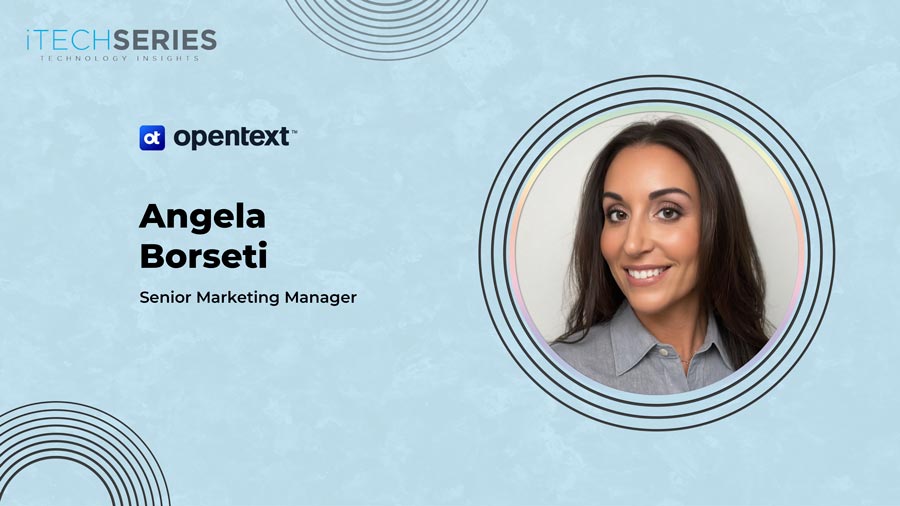
In this interview, Angela Borseti, Senior Marketing Manager at OpenText, explains how modern marketing has become a strategic growth engine within integrated GTM models. She highlights global-regional alignment, the shift from lead volume to account-based value, revenue-focused metrics, AI-powered decision-making, and building collaborative, future-ready teams that accelerate sustainable enterprise growth across complex global organizations worldwide.
Welcome to the interview series, Angela. Could you share your journey to becoming a marketing leader?
My journey has been shaped by equal parts curiosity, resilience, and a deep belief in doing meaningful work. Early in my career, I focused on mastering execution, from learning the business and understanding customers to delivering consistently strong programs.
As I progressed, I began leaning into stretch opportunities, raising my hand for complex, cross-functional initiatives, and taking ownership of larger, more visible programs. Those moments pushed me beyond execution and into leadership, where success depended not just on my work but on how I enabled and aligned others.
Along the way, I learned that strong marketing isn’t all about flashy campaigns. It’s about listening, understanding customer pain points, and translating strategy into action at scale. That mindset helped me evolve from managing campaigns to building integrated, repeatable growth engines.
Today, my leadership approach is grounded in collaboration, accountability, and momentum. I’m focused on partnering closely with the business and creating environments where people feel empowered to do their best work. That progression, from practitioner to strategic leader, continues to shape my growth today.
In your experience, how can regional campaigns be effectively coordinated to support global GTM objectives while maintaining local relevance?
The key is clarity first, customization second. Strong regional execution starts with a clear global framework from shared messaging and positioning to success metrics. From there, regions should be empowered to localize based on market maturity, buyer behavior, and regulatory realities. I’ve found the most success when regions are treated as strategic partners, not downstream executors. Regular feedback loops, shared playbooks, and open communication ensure we’re moving in the same direction while still honoring what makes each market unique. It’s a balance of consistency and flexibility, and when done right, it becomes a growth multiplier.
How has your approach to lead generation evolved as you scaled programs across complex, enterprise environments?
My approach has shifted from volume-focused to value-driven. In complex enterprise environments, success isn’t about generating the most leads; it’s about generating the right engagement with the right accounts at the right time. Now more than ever, I focus heavily on account-based alignment, powered by tools that monitor intent and behavior signals. These insights help us understand where buyers are in their journey, what they care about, and when they’re most receptive, so we can prioritize outreach and tailor messaging with purpose. Rather than engaging a single contact in isolation, we design journeys that intentionally reach technical buyers, business leaders, influencers, and decision makers. This multithreading approach creates multiple entry points into the account, strengthens internal advocacy, and reduces reliance on any one individual to carry the buying conversation forward. Programs that are coordinated across email, digital, content, events, and sales touchpoints help every interaction feel connected and purposeful.
How do you design campaigns that connect strategy to execution, and which metrics or KPIs do you prioritize to measure impact?
For me, strategy only matters if it’s executable. I start by clearly defining the business objective, then reverse engineering the campaign architecture, including channels, assets, workflows, and measurement. Every initiative needs a “line of sight” from vision to delivery.
In terms of KPIs, focusing on metrics that reflect true business impact matters most. Pipeline influence and marketing-sourced revenue show how marketing contributes to deal progression and growth. Conversion across funnel stages helps us identify friction and ensure strategy and execution stay aligned. Engagement quality reveals real buying intent beyond surface-level activity, while program velocity measures how efficiently accounts move through the pipeline. While traditional metrics still matter, I’m most focused on indicators that reflect real business impact, not just activity, across the buying lifecycle.
“Strong marketing isn’t all about flashy campaigns. It’s about listening, understanding customer pain points, and translating strategy into action at scale.”
Where have you seen marketing’s role change the most within an integrated GTM setup?
Marketing has evolved from a support function to a strategic growth driver. In modern GTM environments, marketing sits at the intersection of revenue, data, customer experience, and brand. We’re no longer just building awareness; we’re shaping demand, influencing buying groups, enabling sales, and driving lifecycle engagement. The biggest shift has been toward shared ownership. Success now depends on deep alignment across Marketing, Sales, Product, and Operations. That level of integration requires marketers to think more like business leaders than frontline managers.
Tell us about your most memorable experience as a marketer.
One of my most memorable experiences was recently having the opportunity to take the stage at an industry event and share how we had transformed our go-to-market approach through an account-based experience driven by intelligent insights.
It represented years of evolving from traditional demand generation to a more intentional, account-centric model focused on alignment around the full buying group. We weren’t just talking about a campaign; we were demonstrating how data, technology, and human insight could come together to create more relevant, personalized experiences at scale.
What made the moment especially meaningful was seeing how ABX changed the way our teams worked. It helped us move from isolated activities to coordinated engagement, from lead volume to account value, and from reactive execution to proactive growth. It reinforced for me that the most impactful marketing happens when experience, strategy, and execution are all in harmony.
Where are you seeing AI deliver the most meaningful impact across marketing strategy today?
AI is creating the most value where it helps teams move faster and operate more strategically. I’m seeing a strong impact in predictive analytics and intent modeling, which allow us to prioritize the right accounts and engage buyers at the right moment. Personalization and content optimization are also key, helping us deliver more relevant, role-based experiences and continuously refine what resonates.
It’s also driving meaningful gains in workflow efficiency, streamlining reporting, segmentation, and campaign operations so teams can spend more time on strategy, creativity, and customer insight. Used thoughtfully, AI helps marketers move faster and work more strategically. The key is, as with anything, it’s all about balance. It should strengthen human judgment and leadership versus replacing it.
What would be your advice for marketers aiming to build the right skill sets for the next phase of their careers?
My biggest advice is to stay curious and stay adaptable. Marketing continues to evolve, and the strongest professionals are the ones who are willing to keep learning and adjusting. Tomorrow’s marketers need to blend creativity with analytics, strategy with execution, and empathy with business acumen. Technical skills matter, but so do communication, leadership, and critical thinking. And there are great tools available today that make this easier, helping you build confidence with data, ask better questions, and turn metrics into meaningful stories as part of your everyday work.
Mentorship is another powerful accelerator for growth. I’m grateful for my mentors, as the right ones can challenge your thinking, offer perspective, and help you navigate the “tough stuff” with greater confidence. At the same time, becoming a mentor yourself sharpens your leadership skills and reinforces what you’ve learned. Growth compounds when knowledge, experience, and trust are shared.
About Angela Borseti
Angela Borseti is a strategic marketing leader who operates at the intersection of analytics and execution, helping global enterprise teams translate complex priorities into integrated programs with measurable revenue impact. She has led global campaigns across casualty insurance, content management, and supply chain industries, aligning ABX, SEO, lifecycle, digital engagement, and sales activation. Known for turning ambiguity into a clear strategy, she builds precision-led demand engines focused on outcomes, alignment, and scalable growth.