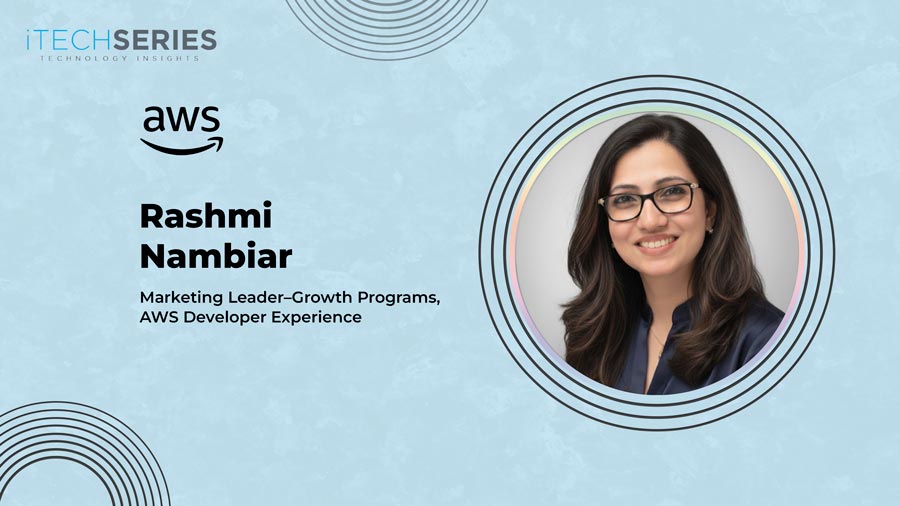
Rashmi Nambiar, Marketing Leader for Developer Growth Programs at AWS, shares her journey from classical marketing foundations to building community-powered growth at a global scale. In this interview, she explains how trust-driven developer ecosystems work, why Business-to-Developer (B2D) marketing plays by different rules, and how DevRel delivers long-term impact beyond short-term metrics.
Please tell us a bit about yourself and your journey as a marketer.
I have spent close to two decades building marketing programs in the technology industry. My journey started with the classical marketing foundations of positioning, segmentation, and go-to-market, and then evolved as I moved deeper into technical ecosystems where trust, learning, and community matter as much as demand generation. Working across diverse markets and maturity curves, from highly scaled engines to “build-from-zero” motions, has shaped a leadership style that is equally strategic and hands-on. Today, my focus is designing growth programs for the AWS developer experience team that are measurable, globally scalable, and community-powered, where success is defined not just by awareness but by impact across the entire technical audience lifecycle, all the way to advocacy.
What does an “always-on” developer community ecosystem look like at a global scale?
“Always-on” is not about “always-posting.” It is about creating an ecosystem where developers can consistently learn, build, connect, and influence without needing a launch moment to feel the momentum. In practice, this often looks like a single home base with many entry points for content, hands-on learning, events, and community discovery, so developers can choose the path that best fits where they are in their journey. The AWS Builder Center is an example of this hub model, bringing builder resources, community engagement, and discovery into one place so that developers can show up any day, find value in minutes, and contribute in ways that compound over time.
How do you design global developer programs that remain locally relevant across markets (India, SAARC, and beyond)?
Designing global developer programs that truly land in different geographies starts with the understanding that this is not a one-size-fits-all campaign or a one-person role. At AWS, developer advocates, program managers, and functional specialists collaborate closely to understand what developers are trying to ship, which constraints they face, and what success looks like locally, and then map those realities to a global narrative. Programs scale faster and feel more authentic when they are carried out by trusted peers beyond corporate voices. For us, it is our tech community program members, such as AWS Community Builders, AWS Heroes, AWS User Group Leaders, and AWS Student Cloud Captains, who are cloud enthusiasts and thought leaders.
How is B2D marketing different from traditional B2B marketing?
Business-to-developer marketing is fundamentally about earning trust with a technical audience that has a very different decision logic from traditional B2B buyers. At AWS, we refer to them as builders, and builders are not persuaded by high-level claims. They want documentation, code, workshops, real examples, and proof that stands up in a terminal, not just in a slide deck. In this context, community is not just another channel but the place where adoption is de-risked, skills are built, and advocacy is formed, which means you may not see instant ROI in the form of lead spikes, but you build a long-term preference that outlasts any single campaign.
“Business-to-developer marketing is fundamentally about earning trust with a technical audience that has a very different decision logic from traditional B2B buyers.”
What mistakes do brands commonly make when launching developer programs?
Brands often stumble by treating developers as a generic audience segment instead of a persona with their own norms, language, and expectations. Communities do not behave like campaigns; they behave as ecosystems. Therefore, launching with big messaging with thin utility and strong narratives without meaningful enablement creates a disconnect. Another trap is over-reliance on vanity metrics, such as registrations and impressions. Focus instead on the deeper signals, such as repeat participation, user-generated content, and product feedback, which indicate whether developers feel they can influence what happens next.
How do you demonstrate the business value of DevRel and community programs to leadership teams focused on near-term ROI?
Demonstrating the value of Developer Relations and community programs to the organization starts by translating community outcomes into clear business language without losing the essence of what makes community work. When framed correctly, community programs can be tied to product adoption, feedback velocity, and customer lifetime value, while preserving the authenticity that makes developers want to engage in the first place.
How are trends like AI, platform abstraction, and faster release cycles changing DevRel?
Several macro trends are reshaping DevRel, and insights from AWS leaders are helpful in framing the change. Werner Vogels describes the rise of the “renaissance developer,” someone who blends AI tools with human judgment, curiosity, and systems thinking, and DevRel must enable that evolution by helping developers learn how to think about systems and patterns, not just which tools to use. Matt Garman, in turn, highlights AWS’s AI focus on enterprise integration and real P&L impact, moving beyond generic chatbots toward agents and systems that can take meaningful action when grounded in enterprise data. This expands DevRel’s role into helping customers operationalize these capabilities responsibly and at scale.
What metrics best indicate a developer community is healthy and delivering real impact?
For developer communities, the most important community health indicators are behavioral signals that accumulate over time rather than short-lived spikes. Healthy communities show strong retention and repeat participation, a growing base of contributors who create posts, codes, and talks, and vibrant peer-to-peer support where questions are increasingly answered by the community itself rather than by staff alone. Additional markers include progression across the journey from learning, building, connecting, and advocating, with more organizers, more credible voices, and more sustained meetups that signal resilience beyond any single program or campaign. Of course, having a more diverse representation in tech makes it even more worthwhile.
About Rashmi Nambiar
Rashmi Nambiar is a forward-thinking marketing leader with nearly two decades of experience building growth programs across the technology industry. She currently leads global developer growth initiatives for AWS Developer Experience, designing community-powered, scalable programs rooted in trust and impact. Known for blending strategic rigor with hands-on execution, Rashmi is a strong advocate for diversity and inclusion and believes innovation thrives when people think independently together. She is also pursuing her Doctorate in Business Administration at the University of Maryland Global Campus.